
















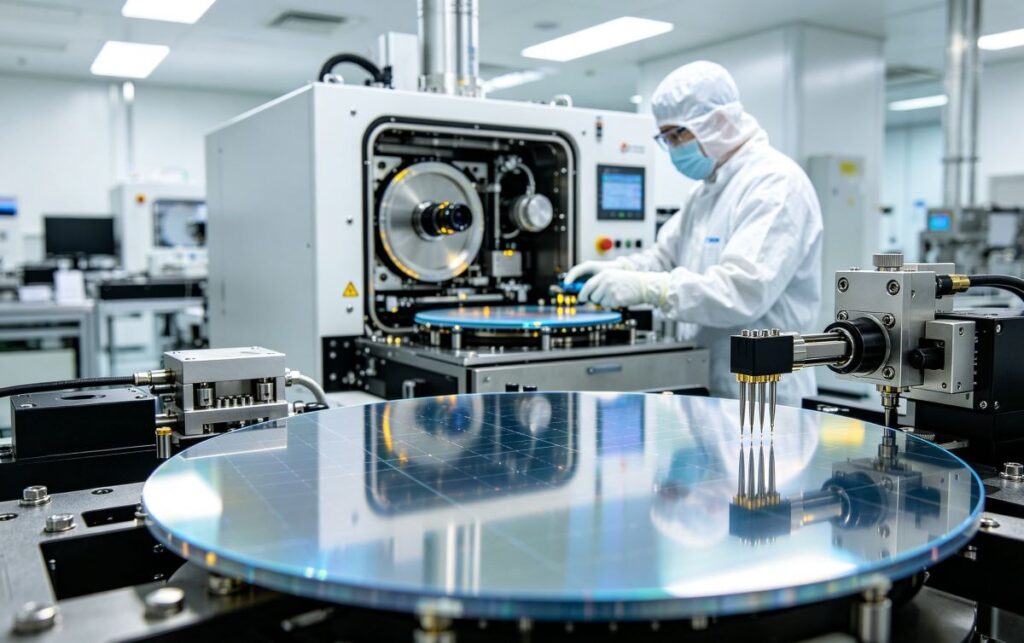
As U.S. manufacturers invest in automation, robotics, and advanced production technologies, keeping operations running reliably has become just as important as increasing output. With reshoring initiatives and ongoing labor shortages accelerating automation adoption, more automated production lines are coming online than ever before. Modern factory floors depend on sensitive electronic controls, and these controls do not tolerate rough power the way older mechanical equipment did. When voltage sags, swells, or fluctuates, the effects can ripple through an entire production line. Power quality is quietly becoming one of the most overlooked risks in smart manufacturing and broader Industry 4.0 initiatives. Understanding where that risk comes from, and how it can be managed, is the first step toward more dependable production.
For many automated facilities, a three phase voltage stabilizer has become a practical solution for maintaining stable power conditions and protecting sensitive equipment.
The Growing Power Quality Challenges Facing Smart Manufacturing Facilities
Many industrial facilities still operate with electrical infrastructure that was not originally designed for today’s level of automation and connected equipment. As plants add robotics, CNC machines, EV charging stations, and other high-demand equipment, that infrastructure is asked to do more than it was originally built for. Utility grids face their own pressures too, from weather events to rising regional demand. The result is that voltage sags, swells, and brief interruptions are becoming more common, not less.
Automated equipment is far less forgiving of these fluctuations than the mechanical systems it replaced. PLCs, servo drives, CNC controllers, robotics, and machine vision systems all rely on stable voltage to function as designed. Even small deviations can interrupt a process that was running normally moments before. This is one reason industrial voltage stabilizers have become a more frequent topic in facility reliability discussions, alongside more established tools like surge protection and monitoring.
How Voltage Fluctuations Impact Automated Production
When voltage drifts outside expected limits, the first thing to suffer is usually not the equipment itself. It is production reliability. A brief sag that a human operator would barely notice can be enough to interrupt an automated process:
-
CNC machining: controller resets, mid-cycle interruptions, and reduced dimensional accuracy on affected parts.
-
Robotic systems: servo faults, position drift, and unplanned stops that require manual restart.
-
Machine vision and inspection: inconsistent readings that lead to false rejects or missed defects.
-
Testing and quality equipment: measurement drift that undermines confidence in results.
None of these outcomes require a dramatic power event. Small, repeated fluctuations are often enough. Over time, the pattern becomes familiar to plant engineers: production that stops and restarts for no obvious reason, quality data that does not quite line up, and maintenance teams that struggle to find a root cause. The issue is rarely a single failure. It is the cumulative effect of power that is present, but not stable.
Why Existing Solutions Often Fall Short
Facilities usually address power problems with the tools already familiar to them. Surge protectors guard against sudden spikes, but they do nothing for gradual sags or sustained low voltage. Uninterruptible power supplies remain an important part of many facility protection strategies, keeping critical systems running during an outage. However, most are sized for short bridging power during a shutdown sequence, not for correcting voltage that is simply off-target during normal operation. Voltage monitoring systems are useful for identifying problems, but monitoring alone does not fix them; it only confirms that a problem exists.
Each of these tools plays a legitimate role in a broader power protection strategy, and none of them should be set aside. But none addresses the underlying issue on its own: voltage that varies continuously around a facility’s normal operating range, day after day. For manufacturers weighing voltage fluctuation protection options, that gap, between detecting a problem and continuously correcting it, is where voltage regulation becomes relevant.
The Role of Three Phase Voltage Stabilizers in Power Quality Management
A three phase voltage stabilizer sits between the incoming power supply and the equipment it protects. Its function is straightforward: it continuously adjusts voltage to keep it within a stable range, regardless of fluctuations upstream. For automated production environments, this steady supply supports more consistent equipment behavior. Controllers are less likely to reset unexpectedly. Servo systems operate with more predictable response. Inspection and measurement equipment work from a more stable baseline.
It is worth being precise about what a voltage stabilizer does and does not do. It is not a backup power source, and it will not keep equipment running through a full outage. It does not eliminate every source of downtime. What it does is reduce one specific and often underestimated variable: voltage instability. For facilities where automated systems are sensitive to that variable, the practical value tends to show up in a few places:
-
Fewer unexpected interruptions to automated production lines.
-
More consistent process behavior across shifts and production runs.
-
Better protection for the automation investments already in place.
-
Less time spent troubleshooting intermittent, hard-to-explain faults.
None of this means a stabilizer is the right fit for every facility. It is one tool among several, and its value depends on how much of a role voltage instability is actually playing in a given plant’s reliability issues.
Applications in Key Manufacturing Sectors
Voltage stability matters differently depending on the type of production. A few sectors illustrate the range:
-
Automotive and EV manufacturing: robotics used for battery testing, laser welding, and automated assembly depend on consistent voltage for repeatable results.
-
Semiconductor and advanced electronics manufacturing: highly sensitive fabrication and testing equipment can be affected by even minor fluctuations.
-
Aerospace components: tight tolerances leave little room for controller resets or measurement drift.
-
Metal fabrication and CNC machining: consistent voltage supports dimensional accuracy across long production runs.
In each case, the common thread is the same. As automated production lines become more precise, the tolerance for unstable power decreases.
Assessing Power Quality Before Selecting a Voltage Stabilizer
Before choosing equipment, it helps to understand the actual power conditions at a facility. Voltage problems are not always obvious from day-to-day operation. A short power quality assessment can clarify what is really happening:
-
Voltage monitoring over a representative period, not just a single day.
-
Load analysis to identify which equipment is most sensitive to fluctuations.
-
A review of past incidents, such as unexplained resets or quality deviations, alongside the monitoring data.
This kind of assessment turns a general concern into a specific, solvable problem. It also helps determine the right capacity and configuration for a three phase voltage stabilizer, rather than guessing.
Choosing the Right Three Phase Voltage Stabilizer
Once the power conditions are understood, selecting the right three phase voltage stabilizer comes down to a few practical factors:
-
Input voltage compatibility: confirm the stabilizer matches the facility’s supply, commonly 208V, 240V, or 480V in U.S. industrial settings.
-
System configuration: confirm whether the application calls for single phase or three phase support, since requirements can vary across different equipment in the same facility.
-
Capacity: size the unit to the connected load, with reasonable headroom for future equipment additions.
-
Continuous duty rating: verify the unit is rated for continuous operation under the facility’s actual load profile, not just short-term peaks.
-
Response speed: faster correction matters more for facilities with sensitive automated processes.
-
Protection features: look for built-in safeguards against over-voltage, under-voltage, and phase imbalance.
-
Maintenance requirements: consider long-term serviceability alongside upfront cost.
These factors do not need to be complicated. Working from real monitoring data, rather than assumptions, is usually the most reliable way to arrive at the right specification. This is why power quality brands like PowerHome focus on upfront site diagnostics, ensuring the voltage stabilizer’s response speed and duty cycle are precisely matched to the plant’s actual demand.
It is also worth involving the maintenance team early, since they are the ones who will live with the equipment day to day and are often best placed to flag practical constraints, such as available panel space or existing wiring limitations.
Conclusion
Power quality is easy to overlook until it starts affecting production. As U.S. manufacturing floors become more automated, the tolerance for unstable voltage continues to shrink. Three phase voltage stabilizers address one specific part of that challenge: keeping voltage within a stable range so equipment can perform as designed. For facilities weighing where to invest next in reliability, understanding actual power conditions is a practical place to start.
More Stories
How to Choose a BLDC Motor Controller for Robotics and Industrial Applications
How to Choose the Right Air-Cooled Industrial Water Chiller for Manufacturing Applications
Why Multi Gas Detectors Are Essential for Modern Automotive Manufacturing Facilities