
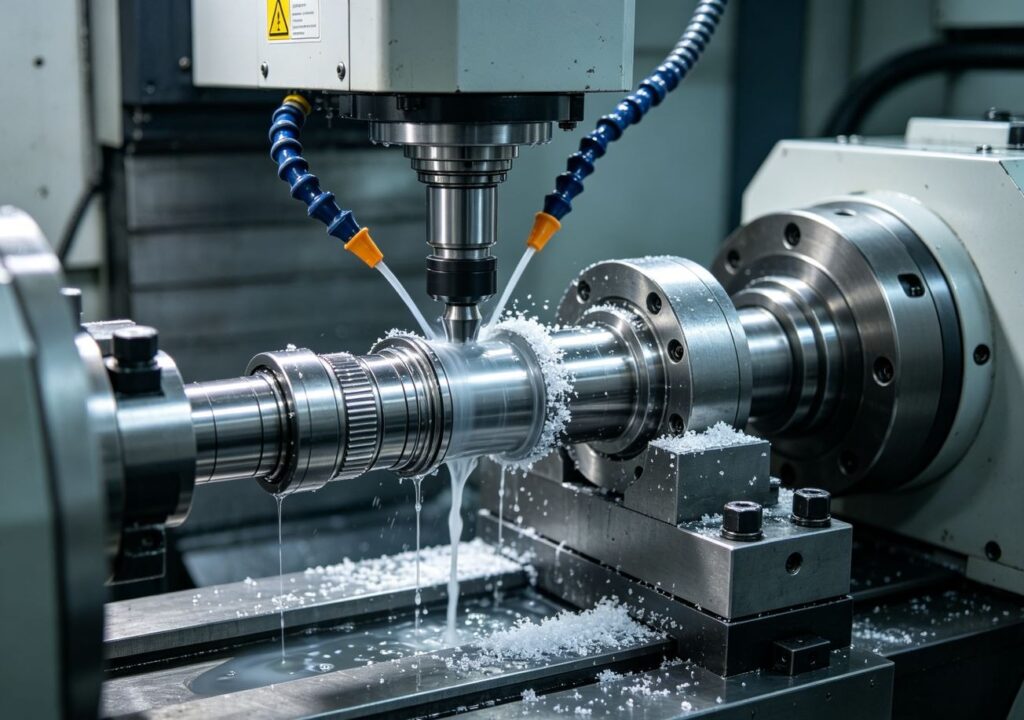
Modern manufacturing equipment runs faster and holds tighter tolerances than ever before. CNC spindles, laser systems, injection molding lines, and battery test benches all generate heat that must go somewhere. When that heat is not removed reliably, precision drifts, parts fail, and downtime follows. An industrial water chiller is the piece of equipment that keeps process temperatures steady, and for many small and mid-sized facilities, the air-cooled type is the simplest way to get there. It needs no cooling tower, no external water loop, and far less plumbing than a water-cooled system, which is why it has become the default choice on so many shop floors. This guide walks through why cooling matters, how these chillers work, and what to check before buying one, so the selection process feels less like guesswork and more like matching a known load to the right machine.
Why Manufacturing Processes Need Reliable Cooling
Heat is not a side effect in manufacturing. It is a variable that directly affects output quality. A CNC spindle that runs hot will expand slightly, and that expansion shows up as dimensional error on the finished part. Laser cutting and welding heads rely on stable optics; overheating shifts focus and weakens the cut or joint. Injection molding needs consistent mold temperatures to avoid warping. Battery and motor test benches generate significant heat during cycling, and inconsistent cooling can skew test results entirely. In each case, the equipment itself may be well designed, but without controlled cooling, its performance ceiling drops. This is the practical reason chillers exist on so many shop floors, not as an accessory, but as a core utility.
What Is an Air-Cooled Industrial Water Chiller?
An industrial water chiller circulates chilled water or a water-glycol mixture through a closed loop to absorb heat from machinery, then rejects that heat elsewhere. The core components are a compressor, an evaporator, a condenser, and a circulation pump. In an air-cooled unit, the condenser rejects heat directly into the surrounding air using a fan, rather than relying on a separate water loop and cooling tower. The chilled fluid then flows to the equipment needing cooling, absorbs heat, and returns to the chiller to repeat the cycle. Because the whole system is self-contained, it can usually be installed close to the machine it serves, with no external water source required.
Why Choose Air-Cooled Over Water-Cooled?
For smaller and mid-sized production lines, air-cooled industrial water chillers are usually the more practical option. Water-cooled systems perform well at very large scale, but they need a cooling tower, ongoing water treatment, and more plumbing infrastructure. Air-cooled units skip most of that.
|
Factor |
Air-Cooled |
Water-Cooled |
|
Installation |
Simple, standalone unit |
Requires cooling tower and piping |
|
Maintenance |
Lower, fewer components |
Higher, water treatment needed |
|
Water use |
None for heat rejection |
Continuous makeup water |
|
Footprint |
Compact |
Larger infrastructure |
For facilities in the 0.5 to 17 ton capacity range, which covers most CNC cells, laser stations, and lab-scale test setups, an air-cooled chiller typically covers the need without the added infrastructure a water-cooled system demands. It also gives smaller facilities more flexibility. A unit can be relocated if a production line moves, added to incrementally as capacity grows, and serviced by a local technician without specialized water-treatment expertise. For a facility running one or two CNC cells today but planning to add a laser station next year, that flexibility often matters as much as the upfront cost.
How to Select the Right Industrial Water Chiller
Choosing the right unit comes down to a handful of factors that determine whether it will actually keep pace with your process.
-
Cooling capacity: Size the chiller to the actual heat load, not just the equipment’s rated power. Undersizing is the most common and costly mistake.
-
Flow rate and pressure: The pump must move enough fluid at enough pressure to reach the equipment, especially if there is distance or elevation between the chiller and the load.
-
Temperature stability: Some processes tolerate a few degrees of swing; precision optics and battery testing do not. Check the controller’s stability rating, not just its set-point range.
-
Voltage and power supply: U.S. facilities commonly run 208-230V single phase or 460V three phase. Confirm compatibility before ordering.
-
Compressor type and reliability: Scroll compressors are common in this capacity range and tend to be quieter and more durable than reciprocating types.
-
Operating environment: Ambient temperature, dust, and available airflow around the unit all affect real-world performance and should match the chiller’s rated operating range.
-
Noise and space constraints: Shop floors and labs have different tolerances here, and it is worth checking sound ratings against your facility’s layout.
None of these factors stand alone. A chiller sized correctly for capacity but starved of airflow, or run on the wrong voltage, will underperform regardless of its spec sheet. It is worth asking a supplier for the actual performance curve at your expected ambient temperature, rather than relying on the nameplate capacity alone, since real-world output can differ noticeably once the unit is placed in a warm mechanical room.
To make selection straightforward, manufacturers like ATO provide clear, transparent specification sheets for every chiller, detailing essential parameters like maximum ambient operating temperature and rated flow rates.
Applications Across Manufacturing
Air-cooled industrial water chillers show up wherever consistent temperature control protects product quality. CNC machining centers use them to hold spindle and coolant temperatures steady during long production runs. Laser cutting and welding systems depend on them to keep optics and resonators within tolerance. Automotive component testing, including battery and motor validation, relies on stable cooling to produce repeatable results. Plastic injection molding uses chillers to control mold temperature and reduce warping or sink marks. Semiconductor and electronics testing labs use smaller-capacity units where even minor temperature drift can invalidate results. Across all of these, the underlying requirement is the same: heat must be removed at a known, steady rate.
Energy Efficiency Matters Too
An oversized or poorly matched chiller wastes energy every hour it runs, cycling on and off more than necessary. Selecting a unit properly sized to the actual load, with a compressor suited to that duty cycle, reduces electricity use and extends component life. Efficient cooling is not just a sustainability talking point; it lowers operating cost and reduces the wear that leads to early failure.
Conclusion
Choosing an air-cooled industrial water chiller comes down to matching real cooling load, flow requirements, and operating conditions to a properly sized unit. Get the capacity and voltage right, account for the environment the chiller will sit in, and the payoff is steadier process temperatures, fewer rejected parts, and less unplanned downtime. For most CNC, laser, molding, and test-lab applications in the sub-20-ton range, air-cooled systems deliver that reliability without the added infrastructure a water-cooled setup requires.
More Stories
Envalior on new thermoplastic formulations to meet HV heat challenges
Schaeffler and Sonatus partnership brings Edge AI to motion control for software-defined vehicles
How Marelli is supporting the transition from ICE to electric powertrains