
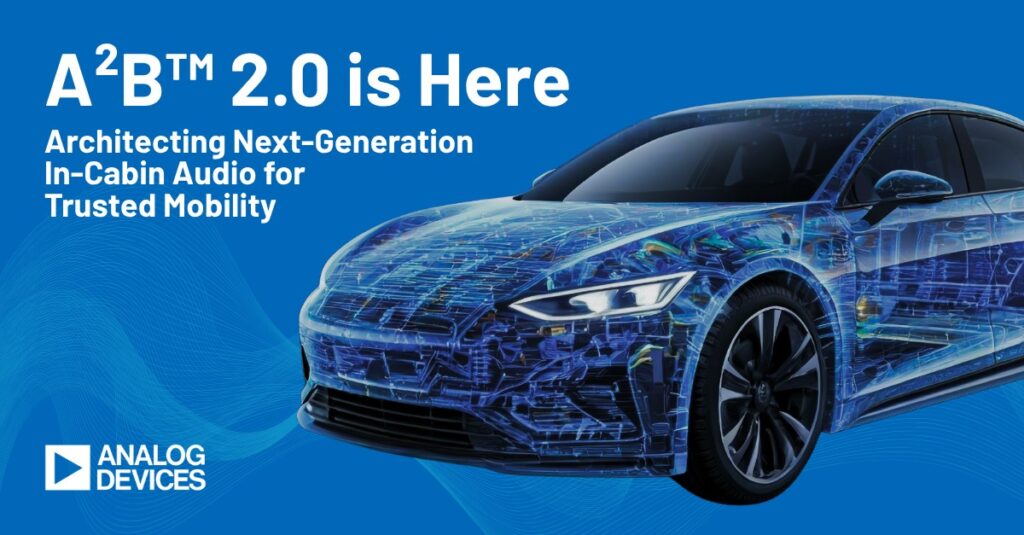
Automotive systems – ranging from ADAS (Advanced Driver Assistance Systems) to infotainment and autonomous driving – are becoming increasingly complex.
ADAS vision systems depend on high-quality video data to make critical real-time decisions that enhance safety and help prevent accidents. At the same time, next-generation infotainment platforms depend on deterministic, high-speed connectivity to reliably scale high-resolution video across pillar-to-pillar and multi-display architectures, enabling seamless immersive in-cabin experiences.
Together, these demands are raising vehicle development costs, making integration more difficult, limiting innovation, and slowing progress in safety.
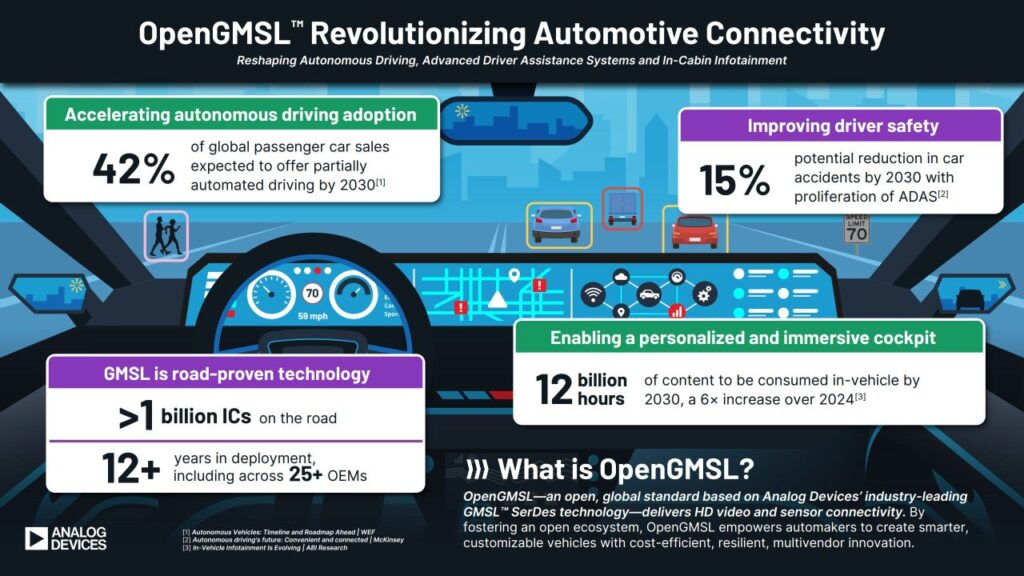
In response, leading automotive industry players have formed the OpenGMSL Association, an initiative which brings together industry leaders to transform SerDes transmission of video and/or high-speed data as an open, worldwide standard across the automotive ecosystem.
By launching the OpenGMSL Association, the industry is creating a global standard that supports innovation in autonomous driving, ADAS, infotainment, and other applications. This enables OEMs and suppliers to develop interoperable solutions to market faster while reducing integration complexity, cost, and risks.
OpenGMSL’s standard is based on industry-leading, road-proven Gigabit Multimedia Serial Link (GMSL) technology from Analog Devices Inc (ADI). Paul Fernando, President of OpenGMSL Association, shared, “with over 1 billion GMSL ICs shipped and adoption by more than 25 global OEMs and 50 Tier-1 suppliers, GMSL is one of the most mature and road-proven high-speed video link technologies in the automotive industry. OpenGMSL builds on this strong foundation to accelerate innovation across autonomous driving, ADAS, and next-gen infotainment — growing an already thriving ecosystem into an open, collaborative future.”
Automotive Industries (AI) asked Yasmine King – Corporate VP, Automotive at Analog Devices Inc, how initiatives such as A2B 2.0 and OpenGMSL are accelerating the shift to software-defined vehicles.
King: Both are examples of areas where we started with highly optimized, purpose-built interfaces for specific use cases. So, on A2B 2.0, we’ve taken what had been our first generation, significantly expanded the capability of our audio connectivity solution — quadrupled the bandwidth and enabling many more audio channels over the single unshielded twisted pair.

We’ve also introduced Ethernet tunneling, which allows A2B networks to interface seamlessly with other in-vehicle networks and evolving Ethernet-based architectures.
But still gives you the very highly optimized, low-latency, deterministic functionality that people are familiar with in A2B.
On GMSL, we decided to open up the standard about a year ago. So, we created a non-profit, independent governing body, OpenGMSL Association.
They are the ones who are now helping direct the standard OpenGMSL.
This brings together a consortium of OEMs, Tier 1s, semiconductor manufacturers, and other ecosystem partners to drive a common standard for high-speed video and data connectivity.
Together, the A2B and OpenGMSL approaches support the evolution toward software-defined vehicles—combining optimized edge connectivity with broader interoperability across the vehicle network.
AI: Are architecture or faster development cycles are driving innovation in the sector.
King: The two are actually quite closely connected. Faster development cycles are enabled by the right architecture, because development no longer stops at the start of production.
It continues even after launch, and the question becomes how quickly you can innovate post-sale.
The underlying architecture framework provides the foundation to support continuous updates after launch.
Open architecture allows you to have greater visibility, with built-in diagnostics and insights built in to support a software-defined vehicle framework that allows systems to evolve throughout the vehicle lifecycle.
AI: In what ways do open and interoperable vehicle networks reduce post-launch integration challenges?
King: There is a balance between two different architectural approaches.
Where you want to optimize for performance, it often makes sense to use very tightly coupled, highly optimized interfaces for specific applications. An example is combining high-performance audio and ultra-low latency, which may require a very highly optimized interface.
In other cases, open, interoperable standards make more sense because you are trying to reduce the friction in system integration and development.
Increasing speed through the ability to work across vendors gives you better resilience, and a better cost structure.
This is where open, interoperable standards come into play.
AI: How does that impact the post-launch integration challenges?
King: There is a lot of discussion in the sector about partnerships. When you have an open, interoperable network, more partners can participate and contribute.
This enables greater flexibility in how systems are integrated and updated, helping reduce post-launch complexity and accelerating innovation over time.
AI: What is the role of observability and diagnostics in enabling safer, faster over-the-air updates?
King: The way I would look at it is, if I can’t see how the system is operating, I have no way to confidently introduce a fix.
To me, observability and diagnostics are the foundations for providing visibility into real-time system behavior. Without that, the updates rely on modeled assumptions rather than actual operation.
While modelling is essential for accelerating development, it doesn’t fully capture how the system performs in the field. So, there is always a risk.
The more you can reduce the gap, the higher the confidence in deploying over-the-air updates safely and efficiently.
AI: How is predictive energy intelligence shaping EV risk, warranty, and lifecycle economics?
King: Our focus is on battery performance, understanding the state of health and state of charge of the battery, and identifying early indicators of potential safety risks, including thermal events, to improve reliability and lifecycle outcomes.
AI: How is this shaping EV risk warranty and life cycle economics?
King: Let me start with economics. If a vehicle is designed to deliver 500-miles of range, but state of charge accuracy is limited, say around 70%, then additional battery capacity must be built to ensure 30% headroom that range can be reliably delivered to guarantee the 500-miles of range.
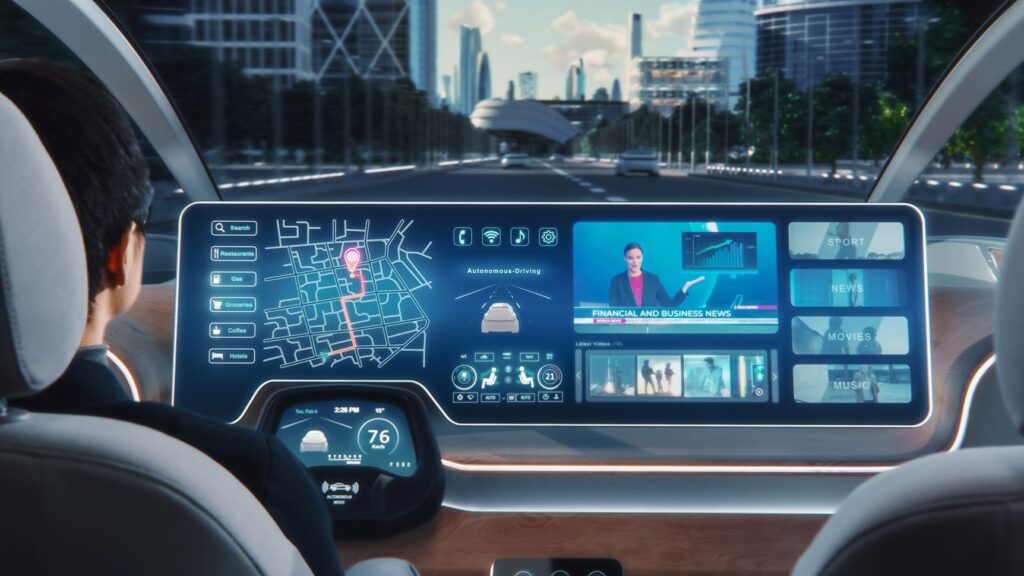
Now, if the state of charge accuracy is 90% or 95%, the required headroom for the battery pack comes down. This lowers battery size, weight, and overall system cost, making the vehicle more efficient and more competitive.
From a risk perspective, predictive capabilities such as thermal anomaly detection provide early insight into conditions that may indicate potential battery safety issues.
Early detection allows the system to prompt service actions to the driver before issues escalate, improving reliability and reducing warranty exposure.
In more critical scenarios, the system can warn the driver with real-time alerts to help ensure safe operation.
These are some key factors that predictive energy intelligence is shaping both risk management and lifecycle economics.
AI: What is needed for in-cabin AI to move from demonstration to production?
King: I think we’re getting closer. We have very strong engagements with OEMs, and are seeing a growing range of AI-driven use cases.
The biggest challenge is monetization. Identifying applications that deliver clear value in a way that the consumer is willing to pay for it. That is where much of the industry is evaluating what works best.
Some of the most common applications include in-cabin agents that have the ability to understand spoken language and respond to natural language, enabling more intuitive, voice-driven interactions.
That is one way of AI being utilized.
Another one that I think is very important is vehicle monitoring, for example, the sentry mode offered in Tesla vehicles. This observes what is happening around the vehicle and determines when to notify the driver of a concerning activity.
Right now, systems like this can be power-intensive by applying AI at the edge, enabling local decision-making and selectively activating centralized compute, you can reduce battery consumption while still delivering a strong user experience.
AI: What does A²B 2.0 bring to Next‑Generation Cabin and SDV Architectures?
King: There are applications today that overload in-vehicle networks. For example, enabling personal sound zones inside a vehicle requires a high number of audio channels.
To support this without adding wiring complexity, A2B 2.0 provides significantly higher bandwidth, quadrupling the capacity of the previous generation.
This reduces the overall system cost, as it minimizes the need for many external components such as filtering, while also simplifying network design.
As a result, it helps bring down the cost of the SDV while also enabling advanced in-cabin features like personal sound zones.
AI: What is next for Analog Devices Inc?
King: We are focused on advancing two key trends in the market.
The first is electrification —enhancing battery performance with predictive insights that give the end consumers greater confidence in transitioning to electric vehicles.
In parallel, we are supporting the shift to software-defined vehicles. The industry is at different stages ofthis transition.
Some OEMs are already well advanced, while others are just beginning.
Our focus is on working with customers to develop network architectures that enable a more seamless transition.
While our primary focus is automotive, we are also seeing these automotive technologies and the capabilities being extended into adjacent markets.
Robotics is a key example, where many of the underlying system requirements are similar to those in vehicles. The platform used for humanoids is very similar to a vehicle.
And so, we are building technologies to enable the emergence of innovations in other markets as well.
The same applies to energy storage systems and data centers, which are leveraging battery management capabilities developed for the automotive sector.
More Stories
Schaeffler and Sonatus partnership brings Edge AI to motion control for software-defined vehicles
NASA on building the future before someone else does
TomTom moves beyond navigation to geospatial intelligence