
Automakers are expected to move faster, scale broader, and spend smarter – even as safe zonal consolidation, hybrid power systems, and AI-enabled features dramatically increase architecture complexity.
In response, NXP Semiconductors has introduced what it says is the semiconductor industry’s first pre-validated, design-ready zonal foundation that combines advanced 48V energy distribution, deterministic data handling, functional safety, and real-time responsiveness.

The hardware-software foundation of the NXP CoreRide Z248 zonal reference system is designed to optimize system performance, reduce system integration effort, shorten development cycles, and allow OEMs and Tier 1s to focus investment where it matters most, according to NXP.
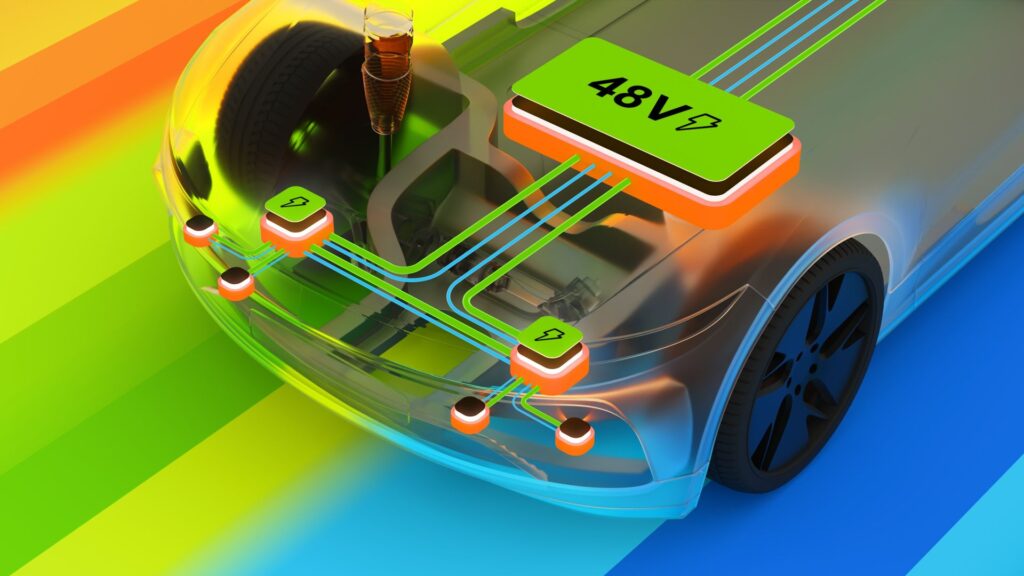
A vehicle zonal reference system groups ECUs, sensors, and actuators by physical location instead of function. Zone controllers handle local devices and connect to a central computer, cutting wiring, streamlining manufacturing, and enabling software-defined vehicles.
NXP’s CoreRide zonal reference system brings scalability to this rising architectural complexity.
It reduces risk by helping OEMs and Tier 1s accelerate development into production, it eases the switch from legacy platforms and lowers total cost of ownership – freeing them from complex integration to put them on a path to production.
“As new E/E architectures redefine vehicle design, our focus is simple: give the automotive ecosystem the foundation to move faster and differentiate with confidence,” said Sébastien Clamagirand, SVP and General Manager, Automotive Systems & Platforms at NXP Semiconductors.
“The CoreRide zonal reference system Z248 delivers a performance-optimized, scalable 48 V foundation that intelligently fuses power, data, and software, while dramatically simplifying system integration, reducing time to market, and enabling OEMs to focus on vehicle differentiation and long‑term value creation.”
Automotive Industries (AI) asked Julien Battiston, Senior Director Marketing – NXP CoreRide Software Defined Vehicle, what the capabilities are of the Z248 zonal reference system.
Battiston: Based on NXP’s S32K5 microcontroller with advanced MRAM, the Z248 enables fast over-the-air updates throughout a vehicle’s life. Its pre-validated software stack simplifies SW integration of complex functionalities like communication, routing, Smart Data Energy Network, AI-enabled virtual sensors, diagnostics, and audio over Ethernet.
The integrated remote protocol stack based on IEEE1722 supports end node integration and ECU consolidation for cost-efficient architectures, while managing energy conversion, distribution, and protection in a hybrid 48 V / 12V zonal systems.
We have taken into account all the critical inputs, including the boot sequence, sleep and wake functions and energy management and distribution. This helps OEMs and Tier 1 suppliers to overcome the main design challenges they face.
AI: How does the Z248 simplify design, speed up development, and improve TCO by integrating end-node functions?

Battiston: We are moving from a position where we supply discrete components one by one to a complete package that is pre-assembled, pre-validated and pre-optimized to plug into the menu settings and meet the main needs of our customers.
The Z248 undergoes extensive system-level validation, showcasing efficient low-power performance, rapid boot, and quick wake-up. Supported by a modern CI/CT/CD environment, it enables faster testing with OEMs and Tier 1s, reducing validation time.
In terms of components, if you look at the main functionality of the zone it consists of compute, communication, energy conversion, energy distribution, and energy management.
The advent of 48-volt systems has changed the requirements of the ECU in the zone. The architecture in the 12-volt zone was mainly focused on compute and communication functionality. With 48 volts it also has to handle energy conversion and distribution, which adds a lot of complexity to the device.
We are also developing the software required to address all the new functionalities, and we validate the stack together with our industry-leading software partners for our customers, which saves them six to nine months of development time.
Development is done in close cooperation and partnership with our customers. We are able to interconnect our CI/CT infrastructure with that of the customer, which enables them to test and provide feedback on a chipset on a weekly basis, which both accelerates development and ensures that both the hardware and software meet their quality requirements.
AI: How does NXP’s new CoreRide zonal reference system bring scalability to the ever-rising architectural complexity?
Battiston: The Z248 zonal reference system is delivered with a complete Board Support Package (BSP) with pre-integrated software from the NXP CoreRide partner ecosystem, including GLIWA’s performance monitoring suite, Green Hills’ software compiler, and Vector’s embedded software and tools. The full package undergoes extensive validation to help ensure optimized performance, while continuously improving processing efficiency and power consumption based on the primary use cases of a zonal ECU.
Its scalable, safe, and secure hardware-software stack adapts easily to different variants of SDV E/E architectures and integrates naturally with NXP’s broader system offering. It leverages technologies across computing, networking, power management, and 48 V energy distribution, including NXP’s S32K566 zonal microcontroller featuring on-chip MRAM that significantly accelerates ECU programming times, both in factory settings and during over-the-air (OTA) updates as well as more frequent data storage while in field
The NXP CoreRide Z248 Zonal Reference System is built upon the broad and scalable portfolio of NXP products which range from lean to high performance zonal systems.
AI: How does Z248 help OEMs and Tier 1s move from legacy platforms to production efficiently while lowering TCO?
Battiston: By us delivering a close to grade A sample grade ECU, they do not have to develop by assembling the components by themselves. They can immediately start adding software on top of what we deliver, which helps them to rapidly transition from what they have today to what they need to have tomorrow while minimizing their internal investments internally.
Tier suppliers can differentiate themselves from their competition by being able to make the transition quickly and cost-effectively. For OEMs, the feedback we get is that the advantage is that we provide the confidence that they will have the component ready on time for serial production and within budget.
AI: Can Z248 scale across different variants of SDV E/E architectures and integrate seamlessly with NXP’s broader system offering?
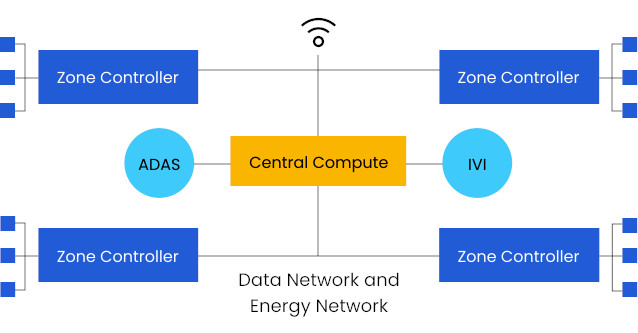
Battiston: It can, thanks to scalability of the platform and to the fact that we have a scalable lineup of analogue and digital products which enable us to range from a very lean to a very high-performance zone where most of the processing power of the car is hosted.
Design complexity is simplified through consolidated routing, diagnostics, gatewaying, virtual sensing, and intelligent power distribution in one ECU
AI: Can the new NXP CoreRide Z248 zonal reference system be deployed across ICE, hybrid and BEV platforms given its housing and wiring loom?
Battiston: This is the constraint we considered when dimensioning the thermal qualities of the product. We are confident that it can be deployed because we work with the OEMs to understand the constraints of the different technologies and then design the product to meet the requirements.
AI: Is the NXP CoreRide Z248 zonal reference system currently available?
Battiston: Itis in the final stages of development. We plan to have it 80% optimized and validated by the end of 2026, and 100% by the first quarter of 2027. The first hardware samples and software layer are already available and delivered to selected customers by end of March 2026.
AI: What is next for NXP Semiconductors?
Battiston: We will be introducing more reference systems to meet the different needs of OEMs, with architecture differing between companies, regions, and countries. Our objective is to develop a platform and architecture which is scalable from bottom.
For that, we are going to develop a complete system reference roadmap that helps us to address all the architecture needs of OEMs and Tiers around the world and speed up vehicle integration. The feedback we have received from the marketplace is positive, but we remain flexible because the needs of the market can change so rapidly.
Where I think NXP is ahead of the rest of the supplier market is that we are not only moving to delivering both hardware and software systems, but we are also adding tools for a collaborative environment and methodologies that allow us to interconnect our deliverables with those of the OEM and Tier 1 partner. This makes us an active partner in the transition to software-defined vehicles, helping our customers to overcome the challenges of increasing speed to market while reducing investment costs.


More Stories
Marquardt on rethinking battery safety as a system
NASA on building the future before someone else does
Infineon on the shift from domain-based to zonal architecture