
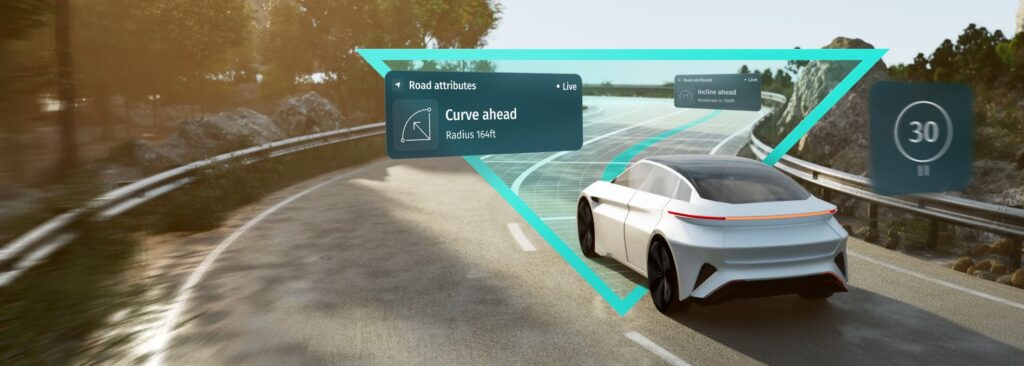
Fragmented development environments, traditional supply chain models, and lack of standardized practices are proving to be roadblocks to faster evolution of software defined vehicles (SDVs).
To help OEMs make the transition faster, HERE and Amazon Web Services (AWS) have introduced SDV Accelerator, a curated collection of the solutions offered in AWS Marketplace. The portfolio features offerings from independent software vendors (ISVs), who play a central role in the automotive industry’s shift to cloud-native implementations.
This initiative offers an automotive-tailored solution guidance with comprehensive SDV architecture and sample code, as well as a curation of AWS services and partner solutions in AWS Marketplace to help automakers fast-track the development of their software-defined vehicles (SDVs).

Automotive Industries (AI) asked Sowmya Gopal, Head of Automotive Navigation Solutions at HERE Technologies, how the new cloud-based SDV Accelerator from AWS and HERE Technologies help accelerate automotive manufacturers’ path to proven virtualization benefits.
Gopal: The aim is to have a digital twin of the car, a pre-integrated environment where developers can design, build and validate the software that they develop virtually, before they can lay their hands on the physical hardware.
This means that your software development cycles are almost 70% faster because you can collaborate on the same environments across different locations, and you don’t have to test everything on physical hardware.
We very often hear from OEMs that they have a fixed budget for designing their digital cockpits. This is their real estate, in which they want to do a lot of cool things. But what ends up happening is that, by the time they have done a couple of iterations with the UI team, they run out of budget. And then you’re basically launching with what you can rather than with what you could have.
With access to a digital twin of the vehicle, you can iterate on the UI for much less, which means you get much closer to the vision of the original design.
AI: How does the SDV Accelerator’s open architecture integrate AWS cloud and AI capabilities with HERE’s mapping and location technology alongside solutions offered by Arm, Elektrobit, FORVIA, Micware, Mireo, NTT DOCOMO BUSINESS, Panasonic Automotive Systems and QNX?
Gopal: For us, it is an ecosystem. HERE has always been technology agnostic. Automotive innovation is the result of different partnerships.
We work with multiple partners, including AI assistants, voice specialists or hardware manufacturers, because we know OEMs make decisions based on their brand, vision and capabilities.
So, we see it as an ecosystem of partners coming together in the AWS world in which developers have the luxury of access to whichever hardware components and software assets that they want to use to prepare for production.
The evolution of SDV Accelerator is driven by the market, and features will be added to meet OEM needs. The present system consists of assets that HERE and AWS already have, and our understanding of what developers need. We will continuously evolve the offerings to meet the OEM and market needs.
AI: How could SDV Accelerator speed automakers’ path to SDV development?
Gopal: We recently ran a proof-of-concept exercise with an OEM in which you create a route from A to B, based on both the navigation and the remaining range of the vehicle. It also identified on which parts of the route one could drive hands free.
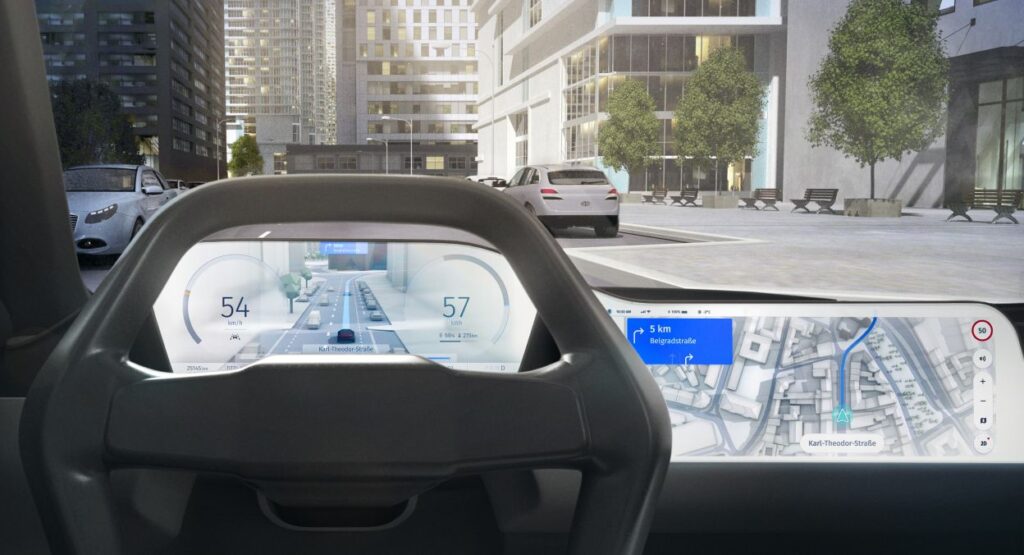
To achieve this, we brought together the navigation, EV, and ADAs domains. User perception suffers if the ADAS system tries to take you left when your navigation says, go right. We believe the simplest solution to managing the large amount of information flowing across the three tech stacks is to use the same maps and routes, so that a user experience can be unified all the way.
But this needs to be validated and tested, and you would rather do this before it goes into test vehicles and, even worse, production cars. We believe it is not just the design that is important, but also the validation and testing of whether the exchange of information across the three tech stacks works as intended.
Take a simple thing such as receiving an alert that you are running out of battery charge. The user perception of the vehicle will be impacted if the alert is incorrect or it happens when they are too far away from a charging station. Then you are confusing a driver rather than helping them.
AI: Where do independent software vendors fit into picture?
Gopal: What independent software vendors should keep in mind is that we must compete with the mobile experiences. To do that, we need to engage with the user. The simpler the platform, the more we can innovate and engage with the end users.
The primary goal for HERE is to have an integrated stack so that you eliminate integration points of failure in the car. The greater the complexity, the more potential points of failure. Innovation is then restricted by the number of integration points you have.
The simpler the solution architecture, the easier it is to innovate. And that is the definition of a true Software Defined vehicle in which the driver experiences continuous improvement, even if the car is three to four years old.
The goal of OEMs to make sure that there is a monetization stream from the user interaction with the software features. The role of independent software vendors is to contribute to this strategy by ensuring there are minimal integration points of failure, that there is alignment across the stack, and whatever they provide can be updated over the air, and above all, can support innovation.
This has been something of a big struggle for the industry. A few years ago, the software in the car did not always evolve, and after four years felt outdated compared to the mobile experience.
This is what we are addressing now with SDV Accelerator.
AI: How would the seamless integration of the HERE Navigation software development kit (SDK) enable automakers to build differentiated, branded navigation interfaces?
Gopal: Our portfolio is designed to be modular, because we understand that different brands have different needs. They can take the full stack of HERE applications, or they can take the HERE navigation SDK and build the UI on top of it.
It really depends on where they want to invest their development resources. The SDK provides access to the maps used for navigation, EV, ADAS and more.
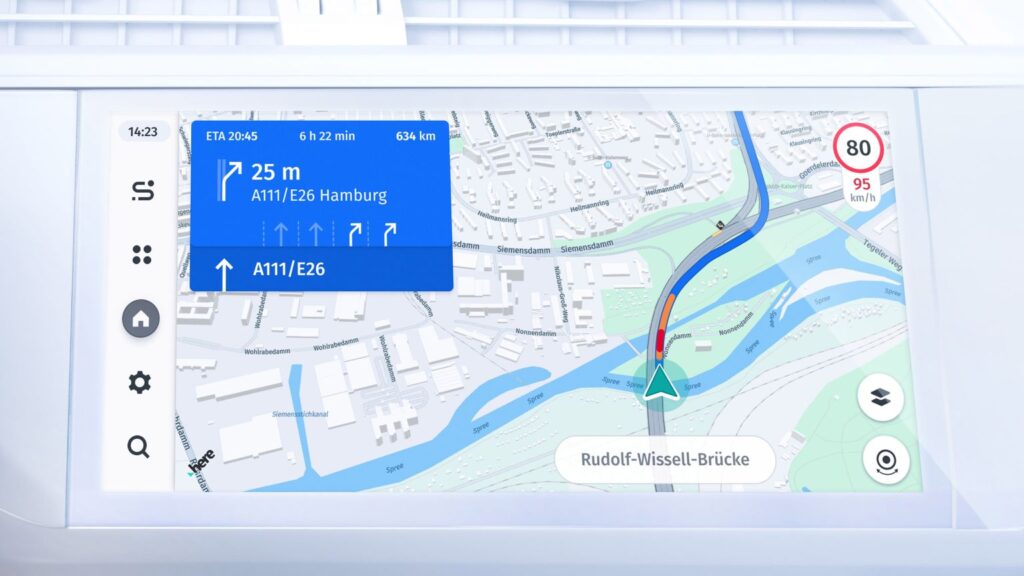
We have layered the maps to provide every application in the vehicle get access to the relevant layers. HERE has streaming maps which are continuously updated, which is very important for ADAS use cases, because live information is safety critical.
It is also important to manage data consumption. Navigation needs visualization components like buildings, but ADAS requires lane level information
To test different scenarios HERE developed SceneXtract, a software tool designed to make it easier and faster for automotive developers to recreate real-world environments for ADAS and Automated Driving (AD) simulation.
It simplifies one of the most time-consuming tasks in ADAS and AD development, which is manually searching, locating, and converting real-world environments into simulation-ready scenes.
This enables the OEM to go to market faster, because they feel comfortable having tested in a virtual environment. Not every OEM has the luxury to test everywhere before they launch. Even if you can test everywhere, you cannot always identify the edge cases.
For testing for example, ScenXtract provides scenarios like complex intersections, or exit with multiple lanes, because these are edge cases where things can fail. If we can avoid driver intervention as much as possible for these edge cases, you build both the system and the user trust into your solutions.
AI: How do you ensure engineers and developers remain focused on customer wants and needs?
Gopal: The key word there is analytics. Now that we have data from all the vehicles out there running our software, discussions are data driven.
Let us look at a simple example. When you create a route from A to B, our software stack provides up to three alternatives. I was never a fan of the feature and asked my engineers why we offer it.
When we analyzed the data, we found that 33% of drivers choose alternate routes. If one in three drivers chooses alternate routes, it is worth investing in this feature.
Data driven decision making is very important when building a new feature. When we launch it, we monitor whether and how people are using it. Do they find it intuitive? Are they using it in specific instances?
Based on that information, you improve the feature, and the user will engage more with it.
AI: Where to for HERE?
Gopal: HERE has been in the automotive industry for 40 years and started with a goal – to make paper maps obsolete, and we have achieved that goal.
Now the focus is on drivers engaging with the user experience in the vehicle. If we can convince drivers and passengers to engage with the in-vehicle experience and it becomes part of their digital life, like mobile phones are I would consider it mission accomplished.
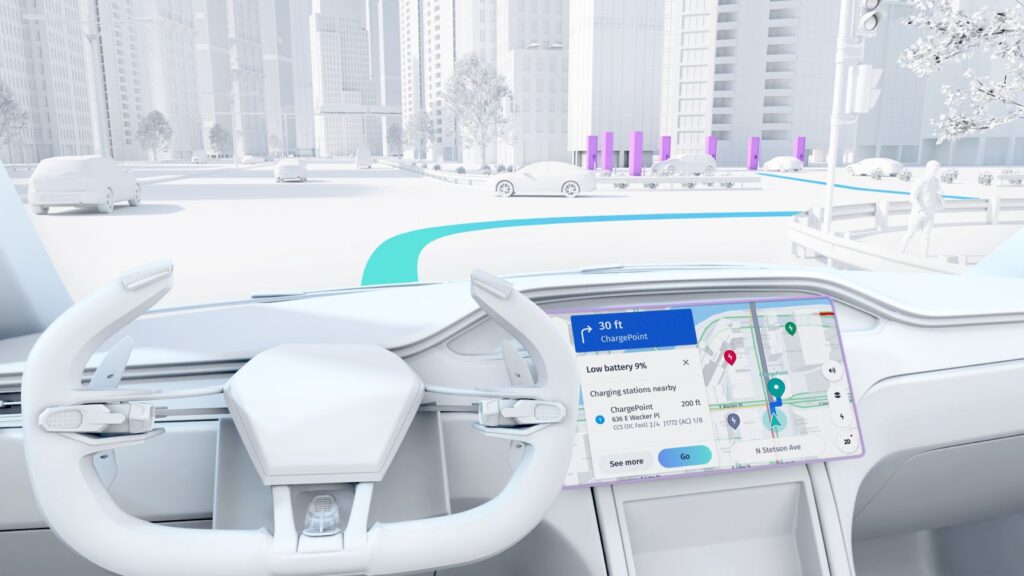
What we can be proud of is that HERE is the only one in the industry that has proven the assumption that the same navigation software can be used across multiple vehicle brands and segments like internal combustion driven vehicles, electric vehicles, light commercial vehicles, fleet and aftermarket solutions.
Using the same software without branching means we can provide economies scale and can innovate faster than others in the market.
Our modular architecture allows us to continuously innovate the application logic, which means how you navigate, how you create optimal routes for EVs, and how you choose hands free routes for navigation on autopilot (NOA).
Specific attributes that are needed for EVS and trucks are add-ons to the core navigation that scales across all the segments.
What changes is the user experience. OEMs have different brands catering for different demographics. That is why we designed the UI to be separate. If you take just the SDK, you can build your own UI on top.
Seeing how well this approach is working, we believe the market is ready for the SDV Accelerator. If you do not have standard stable software, you cannot support designers and developers working in a virtual environment.

More Stories
NASA on building the future before someone else does
Analog Devices Inc opens systems for collaboration to support automotive innovation
TomTom moves beyond navigation to geospatial intelligence