
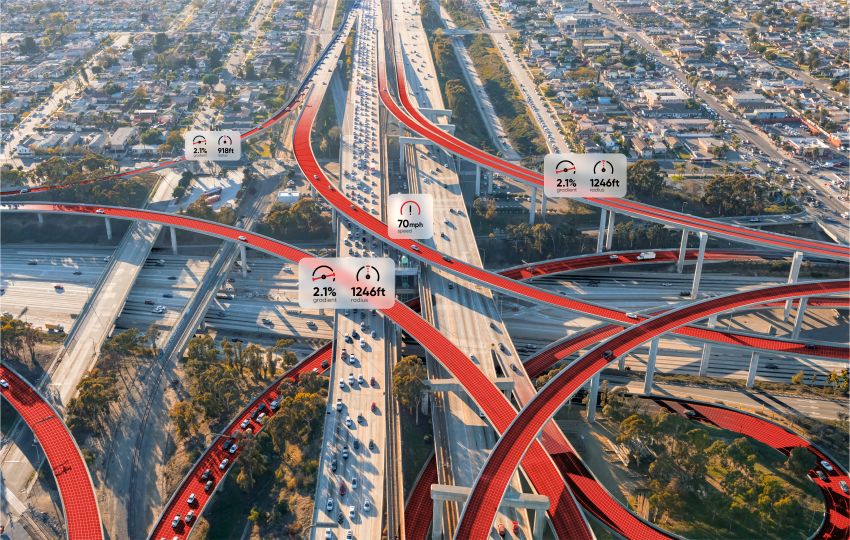
TomTom Map showing gradient and height above sea level.
TomTom is transforming from a traditional navigation provider into a spatial intelligence company by leveraging AI-native mapping, vast data, and agentic technology. It is moving beyond simple turn-by-turn directions to create a living, intelligent digital representation of the world.
To find out more, Automotive Industries (AI) spoke with Leo Sei, Chief Product Officer at TomTom, about the key requirements for enabling AI‑driven automated driving to operate safely and at scale on roads, while meeting public scrutiny and regulatory standards.
Sei: There are multiple aspects to this. One is the ability to do this gradually. A lot of the work we do with car manufacturers and regulators is on the isolation of parts of the road network where we feel very confident, from parts which might not be ready for full automation.

So, it is not a black and white approach, but rather gradual. We refer to it as an Operational Design Domain or ODD.
It determines where a car can travel safely autonomously and then where it hands over to the driver.
A second aspect is auditability and trustability. We want to avoid AI being a sealed black box, especially given the mobility elements and integration into the urban scene.
It is important to understand what training data made the car decide on such actions, and for this, one needs to be able to access the software.
Thirdly, we must make sure we consider the driver, even though they are now technically passengers or less active drivers.
It is important to build trust by providing a good user experience of what the car is thinking, how it is perceiving the world, what made it decide to change lane or to slow down.
There are many more aspects, but I think those three are key pillars we focus on to help with this scalability of autonomous driving.
AI: How do trials of automated vehicles on London’s streets highlight the importance of avoiding errors such as improper stopping, blocking bike lanes, or navigating emergency scenes?
Sei: They show how important it is to understand where we have a good set of data. But, they also show that maps need to be complemented with real time data and sensors.
There may be a delay before an emergency scene gets to the map. But, if you have eyes in the car, you can react to the situation and leverage the map to navigate around.
It is the same for bike lanes, and for cars which have stopped improperly.
What it highlights is that the best autonomous driving experience will be a combination of seeing and knowing, so that you can always balance ways of reacting to the situations.
AI: Do you believe that autonomous vehicles must possess a local driver’s intuitive understanding of the road, including knowledge of every turn, junction, and constraint, to anticipate and respond proactively?
Sei: I believe so, and that is our premise. Maps need to be more than a geographical or geometrical representation of the road.
The image I like to use is if you do not have local intuition, you are really driving much like a tourist in the city. You discover things as you see them.
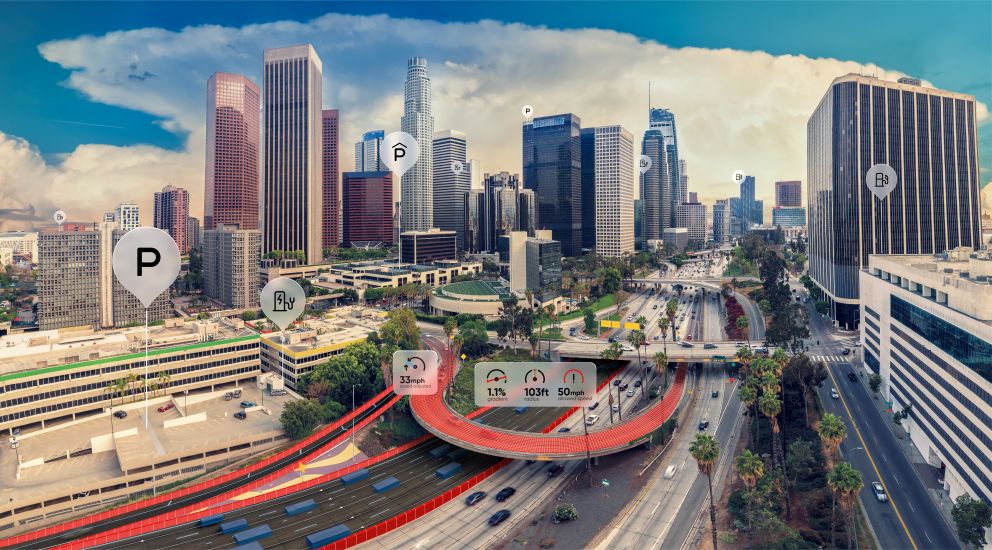
There are countless examples, even around my house, where for example the speed limit changes suddenly on a corner, and you must slow down suddenly.
Knowing about the change is what moves you or the system from tourist to local.
We go further by building in behavior, understanding how locals approach a particular intersection or navigate a roundabout.
At certain intersections or roundabouts, the formal rules of the road may not fully reflect how local drivers typically behave in practice.
By understanding what really happens, we can build that trajectory in the system. So, you become a true local and can move very fluidly in the urban space.
AI: Do maps have to provide more than just navigation for automated vehicles?
Sei: When I look at what maps can provide in the mobility sector, I think it has always been about enhancing safety and improving the ability to drive effortlessly and with fewer incidents.
TomTom was developed to move drivers away from having to look at paper while driving, which is very dangerous.
The technology has advanced. The value of the map lies both in navigation and, more importantly, the location intelligence, that awareness of details on the road, of local behaviors, of speeds, of restrictions, accidents, and road closures.
All those things build on the substrates that will be the foundation of autonomy.
Navigation is just a part of it.
It is now just a building block and a foundation or element of location intelligence.
AI: Why is the notion of mapless automated driving considered largely a myth, and how does ‘seeing’ differ from ‘knowing’ in this context?
Sei: I think the idea of a sensor being able to know enough to not need a map ties back to the tourist versus local discussion.
They may be able to do well and not get you into an accident, but it probably will not be a very smooth ride, and it will be difficult to earn the trust of the public.
Mapless driving technology arose from the very rich and therefore very expensive data required for maps, at least in the early days. The industry looked for a solution which provided scalable map data that costs less.
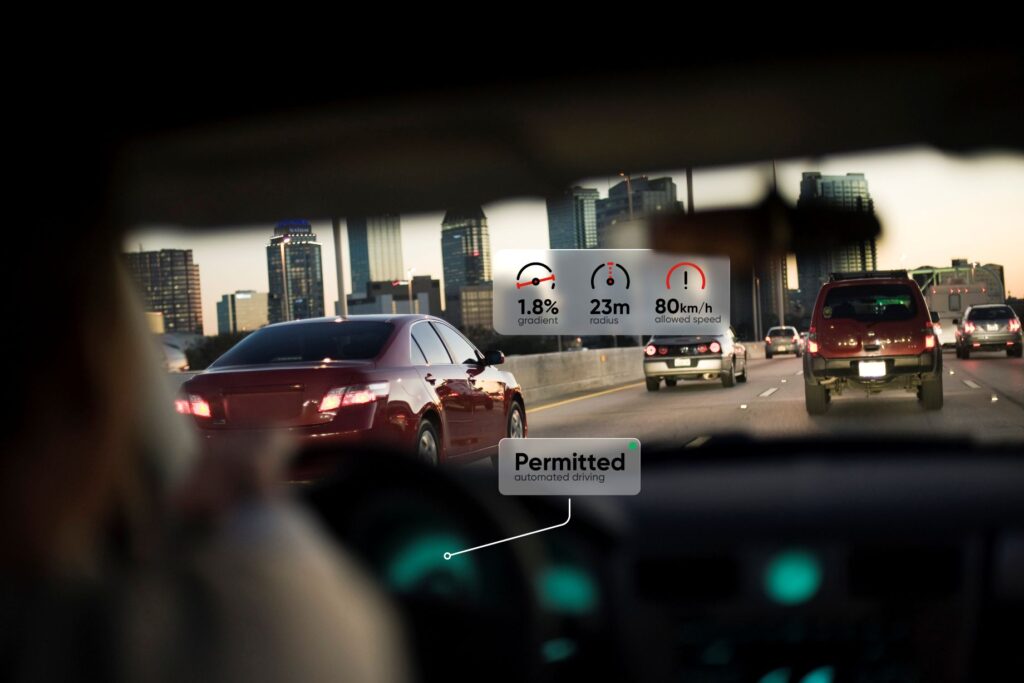
But we are able, with the new technology and our new AI pipeline, to build the right level of richness for the map at a cost that helps the car industry evolve.
The industry has realized that it needs to build a map, because the sensor alone is not enough for autonomous driving.
That distinction between seeing and knowing is also reflected in industry adoption. Earlier this year, we announced that TomTom Orbis Maps was selected by CARIAD, the automotive software company of the Volkswagen Group, to power automated driving systems across future vehicle platforms.
As a core, map‑based layer within the vehicle software stack, TomTom Orbis Maps provides highly accurate, up‑to‑date road and lane‑level intelligence that complements onboard sensors, supporting predictable, human‑like behavior in complex driving scenarios and reinforcing the role of maps as foundational context for safe, scalable automated driving.
AI: How do real-time maps and traffic information contribute to making autonomous vehicles operate more smoothly, safely, and predictably?
Sei: This ties into the question of navigating emergency situations or road closures.
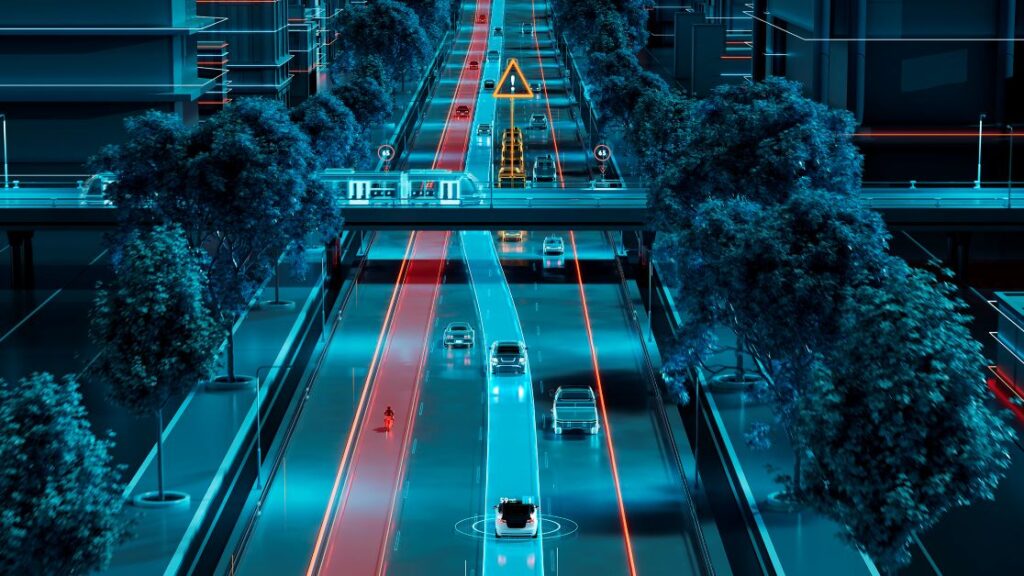
If you know a road is closed or backed up, you can follow a different route or leave a bit later.
Having a representation of the world that is as fresh as possible coupled with what you see helps you anticipate road conditions, and that drives safety, because you are not simply reacting to a situation.
The real-time map, traffic information, speed limits, and road conditions are all elements which will make a big difference in the safety of autonomous driving.
AI: Will compliance and explainability become increasingly critical as regulations governing automated driving become stricter?
Sei: Definitely, it is key for adoption. We want to use technology we understand. It is acceptable for there to be elements which the system learns by itself, but we want to be able to understand how it learned, and what elements went into this learning.
Given the importance of autonomous mobility, you need to have control on what goes into the training, what are the behaviors that the car learns, and how it adapts to this.
I also think that is why a sensor alone cannot be the solution. You need to have a combination, so you can always have a real-time view of the world.
AI: What innovations is TomTom bringing to the field of automated driving?
Sei: There is a number. We have completely changed the way we build geospatial data by using AI before it was hyped up. AI is used extensively to do sensor fusion. We take a lot of data from multiple sources to build a highly accurate and rich representation of the world.
We call that the lane model. The innovation there has been the ability to do that at speed, at scale and reduced costs. Before that you needed to physically drive on every road.
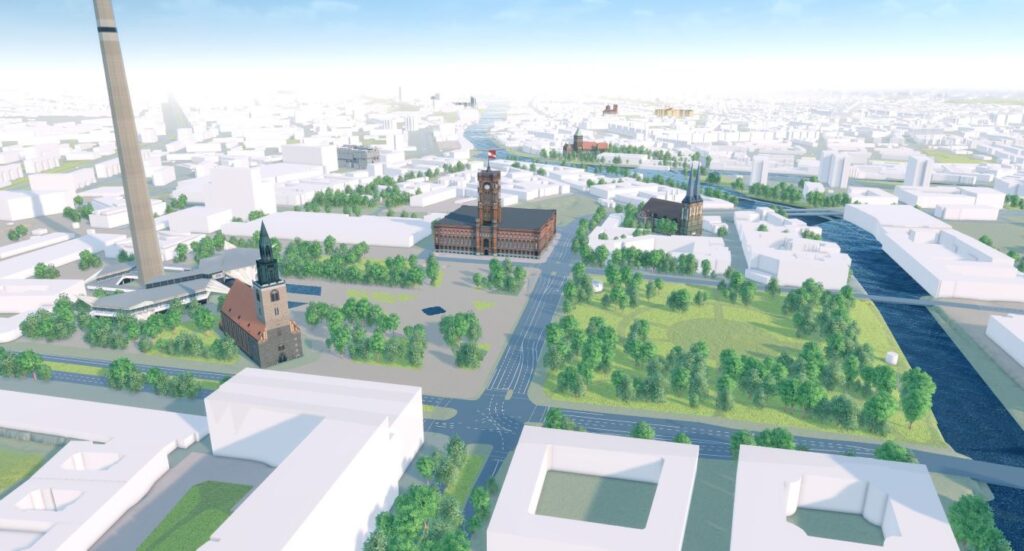
Now we can extract information from sensors, surveys, satellites, and aerial images as well as data from cars to continuously build and update an accurate representation of the world at a reasonable cost.
And that, I think, is a key point if the carmaker wants to be able to provide autonomous driving at an affordable cost.
Another innovation is moving towards using more AI in the car, not necessarily for autonomous driving decisions, which is not our core focus – we work with partners on that.
We are using AI for assistance to the driver. We can say, based on your patterns, data that stays locally in the car, we know that it is Monday at 8 a.m. you are going to work, but there’s construction on the route or there has been an incident, and your usual route is closed or congested.
So, we can tell you, it looks like you are going to work. The A1 is closed, you want to take the A3 instead.
AI: What is next for TomTom?
Sei: We have been providing mapping technology for more than 30 years, and are very well known for navigation, but navigation has always been a building block for safer mobility.
As technology has evolved and our maps have become richer, we have moved closer to a true location intelligence platform—one that combines real‑time road intelligence with the context needed to make that data actionable.
Today, we go beyond navigation: we enable autonomy and deliver location intelligence.
In effect, TomTom has evolved from a navigation provider, to mapmaker, to geospatial intelligence partner for the mobility industry.
In autonomous driving, this role is critical, as TomTom provides the underlying road and location intelligence that makes safe automation possible.
More Stories
Schaeffler and Sonatus partnership brings Edge AI to motion control for software-defined vehicles
NASA on building the future before someone else does
Analog Devices Inc opens systems for collaboration to support automotive innovation