
















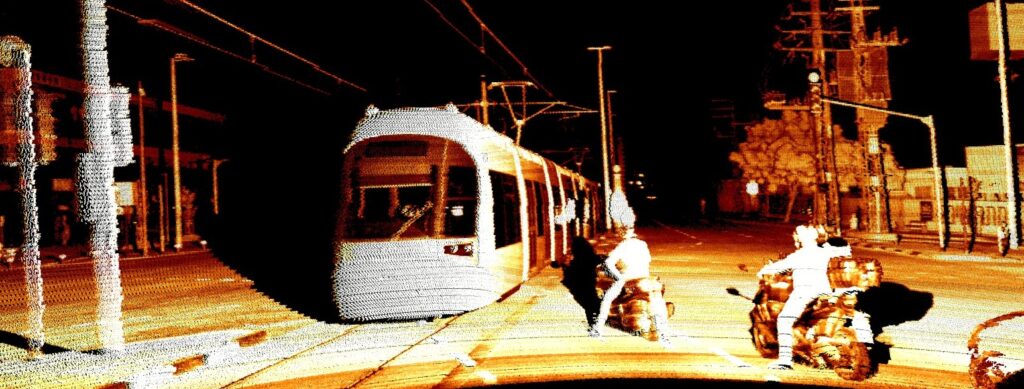
Advanced software capabilities are being built directly into LiDAR sensors to process 3D point cloud data on-device. This “Physical AI” approach lowers latency and reduces the reliance on central compute units for autonomous vehicles and smart systems, according to Innoviz.
Automotive Industries (AI) asked Anna Michlin VP Product at Innoviz, how integrating native LiDAR perception software into the InnovizTwo platform changes the value proposition for OEMs.
Michlin: In the automotive industry, some OEMs require the LiDAR sensor to deliver a standardized, safety-critical output for the rest of the vehicle stack to rely on directly. For them, the case is about latency, reliability, and functional safety.
Piping raw data to a central processor costs latency in critical decisions and adds load on vehicle networks. Extending perception closer to the sensor gives them an independent processing node that keeps functioning regardless of what’s happening in the central compute stack.
AI: What technical and safety advantages does this on-sensor perception architecture deliver for next-generation autonomous vehicles?
Michlin: From a latency perspective, when perception runs on-sensor, you eliminate the round-trip time to a central processor.
In a Level 4 system, every millisecond of response time in safety-critical decisions matters. With regards to reliability, on-sensor perception generates a standardized output that the vehicle stack consumes directly, and it operates in
dependently of the vehicle’s broader processing architecture.
This means you have a perception channel that keeps functioning correctly even if other system components are under heavy load or degraded. Lastly, on functional safety: the fundamental difference between Level 3 and Level 4 is the availability of human fallback. At Level 4, there’s no expectation of a driver being on alert. On-sensor perception, operating independently from central compute and on top of it, is a core architectural building block for achieving that availability.AI: InnovizThree was introduced as a compact, behind-the-glass automotive LiDAR solution. What engineering breakthroughs enabled the reduction in size, power consumption, and cost while maintaining automotive-grade performance?
Michlin: InnovizThree is a rethink of what an automotive-grade LiDAR needs to look like, not just what it needs to do. At 600 grams, it is 60% smaller than InnovizTwo, and that compact form is what enables the deployment position that the automotive industry has been waiting for: behind the windshield, on the rooftop, or in the front grille, without compromising vehicle aerodynamics or exterior design. Solving that integration challenge has been the “holy grail” for OEMs for years.
The engineering achievement that makes this possible is a tighter optical architecture running on 905nm Time-of-Flight technology, combined with lower power consumption modes that reduce thermal load and allow for smaller housings. At the same time, we improved performance.
InnovizThree detects beyond 250 metres and delivers over 35% cost reduction compared to InnovizTwo. Size went down, performance went up, and cost went down. That is not a compromise, it is a generation shift. Innoviz remains committed to delivering a platform that is not only high-performance but also affordable and practical to integrate at scale.
AI: InnovizThree includes what you call the industry’s first sensor-fusion colored 3D LiDAR and camera system. How does this capability enhance environmental understanding and simplify integration for automakers?
Michlin: In a few ways, firstly with a perfectly calibrated point cloud and camera data. Second, it simplifies sensor fusion, third, it enriches environmental perception with RGB on top of the point cloud, and lastly we simplified the mechanical integration in the area of the windshield where it matters the most
AI: Volkswagen Group’s ID. Buzz AD autonomous shuttle uses nine InnovizTwo LiDAR sensors per vehicle to provide full 360-degree coverage. What progress has been made toward series-production configuration, and what key lessons have emerged from this large-scale deployment?
Michlin: The ID. Buzz AD program is a landmark for the entire industry as it is the world’s first Level 4 robotaxi to enter series production, and Innoviz is proud to be at the center of it. Seeing nine InnovizTwo LiDARs being installed on each vehicle is genuinely remarkable. This isn’t a pilot fleet or a proof-of-concept, it is full series production.
The key lesson from this deployment is that qualifying a sensor system for automotive-grade L4 production is an entirely different challenge from demonstrating it in a test vehicle. Every aspect from the mechanical integration across nine mounting positions, the sensor-to-sensor calibration, the all-weather blockage resilience, and the functional safety certification, have to hold to the same standard on vehicle number ten thousand as it does on vehicle number one. That demands a sensor partner who understands production, not just performance.
What we have built with Volkswagen is a validated, production-ready suite. The ID. Buzz AD is expected to deploy across European and U.S. cities in 2026, and the credibility that comes from being on the production line at VW is something we carry into every subsequent OEM conversation. It answers the question every customer asks before they sign: has this sensor actually been through automotive-grade series production at scale? For InnovizTwo, the answer is yes.
AI: The launch of InnovizTwo Ultra Long-Range LiDAR extends sensing capabilities up to one kilometer. What autonomous driving and commercial transportation applications become possible with this level of detection range?
Michlin: One-kilometer sensing range fundamentally changes the operating envelope for autonomous systems. At that distance, a heavy truck travelling at highway speed has more than 30 seconds of decision time before it reaches the detected object.
That margin is the difference between a controlled deceleration and an emergency stop, and that matters enormously for safety and cargo integrity.
For autonomous highway trucking, the ULR allows vehicles to anticipate lane merges, slow-moving traffic, and road debris at distances no prior LiDAR could resolve. For commercial transportation operators, this translates directly into smoother, safer runs and reduced wear on braking systems. The Daimler Truck and Torc Robotics program is exactly the kind of deployment this sensor was designed for.
Beyond trucking, the ULR opens significant new territory in defense and homeland security. Border surveillance, airport runway monitoring, and port perimeter security all require sustained, reliable 3D detection at long ranges across harsh outdoor conditions. This is exactly what the ULR delivers with validated blockage resilience against dust, rain, and extreme temperatures, and a wide field of view.
AI: Innoviz recently signed an LOI with LOXO to support autonomous last-mile delivery vehicles. How does the commercial delivery market fit into Innoviz’s broader strategy for expanding beyond traditional passenger vehicle programs?
Michlin: The LOXO partnership is a strong example of how Innoviz is applying its automotive-grade technology platform to commercial and industrial use cases beyond passenger vehicles. LOXO’s Digital Driver stack powers autonomous delivery across urban and regional logistics in Europe, transport, retail, and postal delivery, and represents exactly the kind of scaled, real-world deployment Innoviz is pursuing outside the traditional OEM passenger car context.
When LOXO selected InnovizTwo after a thorough market evaluation, it specifically citing point cloud quality at long distances and the supply and manufacturing reliability that comes from Innoviz’s existing validation by major automotive manufacturers. That validation trail, earned through automotive programs, is directly transferring as a credibility asset into commercial markets.
AI: What milestones should the industry watch for over the next 12 months?
Michlin: We are really excited to see the deployment of the VW ID Buzz.
Other milestones to watch out for in the next 12 months are in both automotive and non-automotive Physical AI. Our LiDAR has proven to be a reliable and trusted foundation and it will continue to power autonomous vehicles across Level 3 and Level 4 programs as well as in defense and homeland security (perimeter protection, border surveillance, drone detection), intelligent traffic management, and as the sensing layer for robotics, drones, and humanoid platforms.


More Stories
Formic Opens 53,000-Square-Foot Chicagoland Headquarters to Meet Growing Demand for Its AI-Powered Robotic Automation
Advance Auto Parts and OneRail Announce Expanded Partnership
iSOFT Contributes Intelligent Driving OS as AUTOSAR CAPI Global Code Baseline