
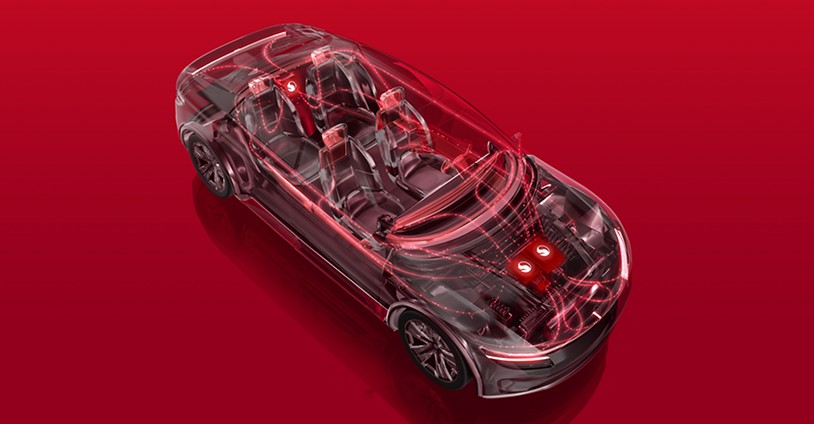
Snapdragon Digital Chassis is an open, scalable set of platforms spanning connectivity and telematics; in-vehicle infotainment; ADAS and automated driving; and cloud and software services.
Automakers face increasing complexity around compute demands, power efficiency, cost, functional safety, and long-term scalability as vehicles evolve into software and AI-defined platforms.
Qualcomm Technologies, Inc. is powering this shift, working with nearly all global automakers to support programs across connectivity, infotainment, and advanced driver assistance, while continuing to grow a strong, multi-year design-win pipeline.
Their approach centers on open, scalable, and AI-enabled platforms that are already shipping across the globe. This is designed to both help automakers move quickly and support safer, more reliable vehicles that evolve over time.
By prioritizing power-efficient, real-time systems and production-proven safety architectures, the company says its work directly supports goals shared across the industry: enabling a new age of more intuitive, more enjoyable experiences, reducing accidents and reducing complexity cost and time to market.
One of the ways in which Qualcomm Technologies is staying abreast of OEM needs is collaboration with partners such as Wayve.
The collaboration brings Wayve AI Driver as an end-to-end AI driving intelligence layer to Qualcomm Technologies’ high performance, field-proven Snapdragon Ride Platform consisting of system-on-chips (SoCs) and tightly integrated Active Safety software, delivering a pre-integrated system that enables regulatory and hands-off ADAS deployment, expanding to broader driving environments and hands-off, eyes-off capabilities.
Focused on simplifying implementation and meeting automaker priorities around safety, reliability, scalability, and time-to-market, the collaboration is generating strong interest from automakers, according to the companies.
Automotive Industries (AI) asked Arvin Chander, Senior Director of Business Development at Qualcomm, what are the pillars of Snapdragon Digital Chassis platforms and how they enable automakers to accelerate their software-defined vehicle transformation.
Chander: The Snapdragon Digital Chassis is an open, scalable set of platforms spanning four core pillars: connectivity and telematics; in-vehicle infotainment; ADAS and automated driving; and cloud and software services.

Interior object detection.
Together, these are designed to empower automakers in the AI-defined vehicle era. Snapdragon chipsets share a foundation of consistent heterogeneous compute, integrating Qualcomm Technologies’ Oryon CPUs, Adreno GPUs, and Hexagon NPUs, which deliver the right resource for a broad range of tasks, from control logic to complex AI inference.
This, along with software-hardware co-design and safety guardrails, ensures demanding requirements are met while facilitating software reuse. Tying it together is a complete development ecosystem, offering cloud-native flows, the Qualcomm AI Hub for model optimization, and an end-to-end Data Factory to maximize software and AI reuse.
For automakers, this means a single, scalable consistent compute and software foundation.
Crucially, the platform is built on openness, with an architecture that avoids proprietary lock-in and allows automakers to integrate best-in-class solutions while maintaining software portability across Snapdragon-based vehicle platforms and product lines.
This comprehensive approach delivers a powerful foundation for software-defined architectures, providing the performance, flexibility, and scalability OEMs need to continually evolve next-generation infotainment and advanced driver assistance systems, validated by a $45B+ design-win pipeline and more than 350 million vehicles on the road today.
AI: AI-defined vehicles require software and AI model portability across multiple vehicle tiers and model years. Does the Snapdragon Digital Chassis provide a unified compute platform to enable software reuse and efficient scaling across vehicle portfolios?
Chander: The Snapdragon Digital Chassis directly addresses the challenge of the rapidly increasing software and AI development costs faced by automakers. Built on the same heterogeneous compute foundation, it enables efficient scaling and software reuse across diverse vehicle portfolios, model years, and regional variants.
This allows automakers to develop once and scale more efficiently across their entire vehicle portfolio, transforming AI model portability from an increasing challenge into a core architectural strength.
The platform ensures software compatibility across SoC generations, eliminating the need for constant re-engineering across tiers and model years. This common hardware foundation simplifies the supply chain by reducing supplier dependencies, streamlining inventory, and consolidating support infrastructure, freeing engineering teams to focus investment on differentiation rather than rebuilding the stack from scratch.
Ultimately, this strengthens their competitiveness as future vehicle architectures become increasingly software and AI-defined.
AI: What is Qualcomm Technologies’ ecosystem approach to the future of automotive?
Chander: Qualcomm Technologies’ approach is grounded in the belief that software-defined vehicles can only succeed through openness and ecosystem collaboration at scale. Qualcomm Technologies works as a horizontal technology platform partner across the automotive industry, supporting automakers and Tier-1 suppliers as they define their hardware and software strategies.
Qualcomm Technologies works with virtually all major global OEMs, including a strong and longstanding presence across European automakers, as well as leading Tier-1 suppliers, software providers and cloud partners.
This breadth allows Snapdragon Digital Chassis technologies to be deployed across hundreds of millions of vehicles worldwide, spanning connectivity, digital cockpit and ADAS.
The core principle is flexibility. Automakers can move at their own pace, choose their preferred software stacks and partners, and standardize where it makes sense while still differentiating their brands. An open platform that supports multiple software paths enables OEMs to scale software and AI efficiently across regions and vehicle lines without being locked into a single architecture.
Qualcomm Technologies’ role is to provide a stable, production-proven foundation that allows advanced driving and in-vehicle software to move from innovation to deployment, supporting the industry’s transition toward software-defined and AI-enabled vehicles.
AI: What does Qualcomm Technologies’ collaboration with Wayve deliver for ADAS and automated driving? Is it production ready?
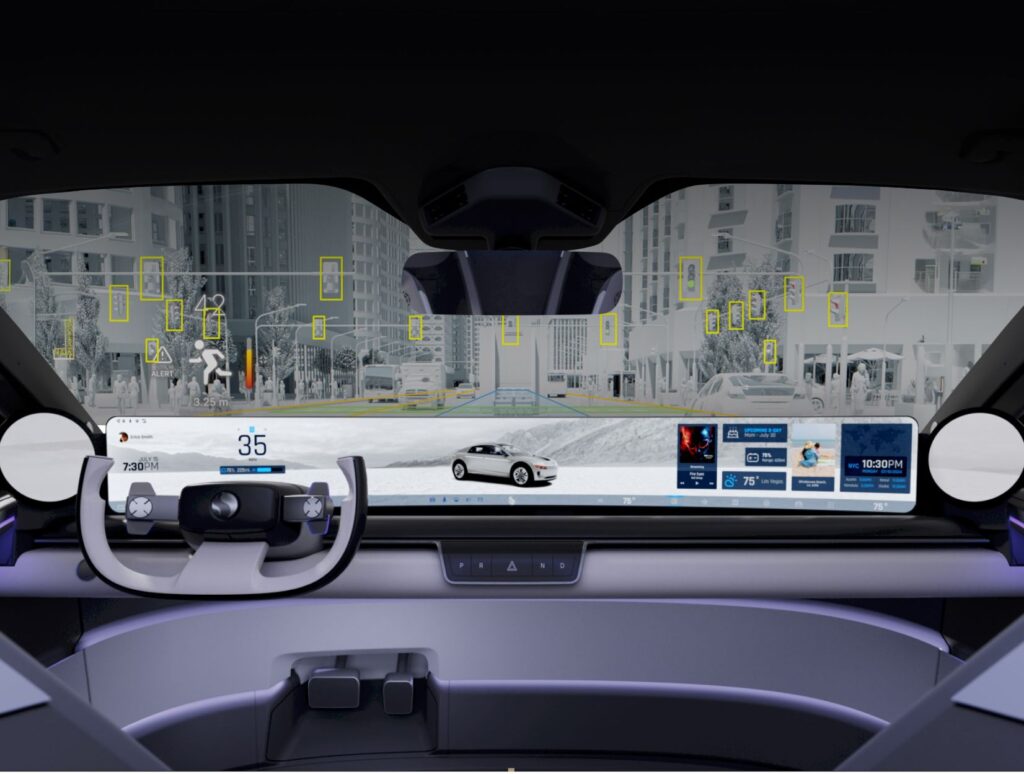
Chander: The collaboration with Wayve centers on a pre-integrated, production-ready solution that simplifies implementation for automakers. It focuses on safety, reliability, scalability, and time-to-market, specifically for high levels of autonomy.
It combines Qualcomm Technologies’ widely deployed Snapdragon Ride Platform, including its tightly integrated Active Safety software, with Wayve’s embodied AI driving intelligence layer, the AI Driver.
Unlike traditional rule-based and map-dependent systems, this software is built to enable vehicles to learn, perceive, understand, and navigate complex real-world environments, rather than following pre-defined instructions.
Fundamental to this is Wayve’s AV2.0 approach, centered on a unified foundation model trained on globally diverse data, enabling the AI Driver to generalize across different markets and vehicle platforms without extensive re-engineering, removing a significant barrier to global deployment.
This proven foundation gives automakers a practical deployment path for L2+ ADAS and Automated Driving capabilities designed to support hands-off driving assistance and expand towards eyes-off capabilities over time.
AI: Would the Snapdragon vSoC on Google Cloud enable automakers to design, test and validate entirely in the cloud?
Chander: The challenge automakers face today is a lack of parity, portability and compatibility between cloud development environments and the in-vehicle hardware. Without that parity, developers are forced to wait for physical prototypes, relying on expensive, unscalable physical test benches that slow the entire development cycle.
Snapdragon vSoC addresses this by leveraging Axion ‘C4A metal’ instances on Google Cloud, so that the same software can be reused in the vehicle. Teams can develop, test and validate across instrument clusters, infotainment and ADAS use cases from a standard laptop, collaborating seamlessly across locations.
When combined with the pre-integrated AAOS-SDV stack optimized for Snapdragon Digital Chassis, automakers can gain a turnkey software platform deployable across vehicle tiers and generations, delivering differentiated features quickly and monetizing new services throughout the vehicle lifetime.
AI: Volkswagen Group and Qualcomm Technologies have signed a Letter of Intent to power the next generation of driving experiences. What is Qualcomm Technologies’ role in the terms of the agreement?
Chander: Under the intended agreement, Qualcomm Technologies would serve as Volkswagen Group’s primary technology provider for its future zonal Software Defined Vehicle (SDV) architecture, developed for the Western hemisphere through Volkswagen Group’s joint venture with Rivian Automotive, Inc. – Rivian and Volkswagen Group Technologies (RV Tech). Qualcomm Technologies would provide high-performance system-on-chips for infotainment capabilities starting in 2027.
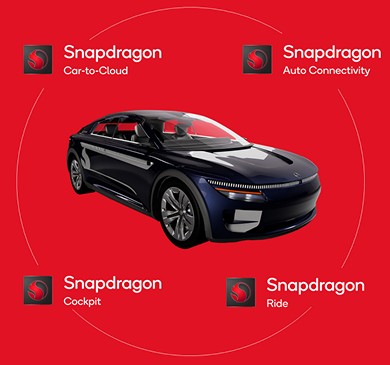
Leveraging the Snapdragon Cockpit Platform, the architecture is designed to deliver agentic AI-driven experiences that anticipate needs, adapt in real-time, and provide proactive assistance – from personalized climate and seating adjustments to optimized routes and multimodal voice or gesture controls.
Volkswagen Group plans to integrate the SDV architecture into the upcoming ID.EVERY1 and all future electric vehicles built on the Scalable Systems Platform (SSP).
A current collaboration with Qualcomm Technologies already extends to Volkswagen Group’s Automated Driving Alliance – formed by CARIAD and Bosch. This collaboration aims to leverage Snapdragon Ride Elite platforms, Qualcomm Technologies’ most powerful automotive compute platform, to advance the development of automated driving with an AI-based system that is scalable across brands and model lines and fully compatible with the SDV.
As part of the intended agreement, Volkswagen Group also intends to integrate Snapdragon 5G Modem RF and V2X technology into next-generation SDV-based vehicles, enabling ultra-fast connectivity and real-time communication for safer, smarter, and more connected driving. The intended supply agreement is currently being actively driven forwards by AUDI AG and Volkswagen Passenger Cars, with the goal of achieving a Group-wide impact.
AI: Qualcomm Technologies also signed a comprehensive agreement with Hyundai Mobis for collaboration on SDV architecture for ADAS. Does the agreement extend beyond ADAS development?
Chander: The MOU, signed at CES 2026, was established to co-develop next-generation solutions across both ADAS and broader SDV architecture, combining Hyundai Mobis’s expertise in system integration, sensor fusion and perception with Qualcomm Technologies’ SoC leadership.
The initial focus centers on advanced driving and parking solutions, with Hyundai Mobis utilizing the Snapdragon Ride Flex. Beyond ADAS, the agreement extends to next-generation integrated SDV solutions, combining Hyundai Mobis’s standardized software platform with Snapdragon Digital Chassis technologies to enhance overall vehicle performance, efficiency and stability.
This partnership carries a clear market dimension, targeting fast-growing regions such as India, where ADAS adoption is accelerating and demand for SDV-ready platforms is expanding rapidly, while pursuing broader global supply opportunities.
AI: What is next for Qualcomm Technologies?
Chander: What is next for Qualcomm Technologies is advancing AI integration across the Snapdragon Digital Chassis and deepening the ecosystem partnerships that bring this to production at scale.
On the technology side, Qualcomm Technologies’ focus is on embedding AI across the entire vehicle – moving beyond isolated features to create unified intelligence spanning the cockpit, connectivity and automated driving.
This will help enable vehicles to better understand natural language, anticipate driver needs and deliver more personalized experiences. The practical ambition is a vehicle that, when a driver is running late, can automatically optimize the route, adjust cabin settings for a productive call and coordinate with the driver’s calendar, while the advanced driving system adapts to traffic in real time.
None of this can be delivered by any single company. As the industry advances toward AI-enabled vehicles, Qualcomm Technologies remains focused on providing the technology foundation and ecosystem collaboration – across automakers, Tier-1 suppliers, software innovators and connectivity leaders – needed to turn innovation into production-ready vehicles at global scale. The digital chassis of tomorrow is already here, and it is powered by Snapdragon.


More Stories
Marquardt on rethinking battery safety as a system
McKinney Welcomes $919 Million LITEON Investment, More Than 600 New Jobs
Team Shelby and Historic Shelby American GT40s Roll into Goodwood Festival of Speed with Support from Goodyear