
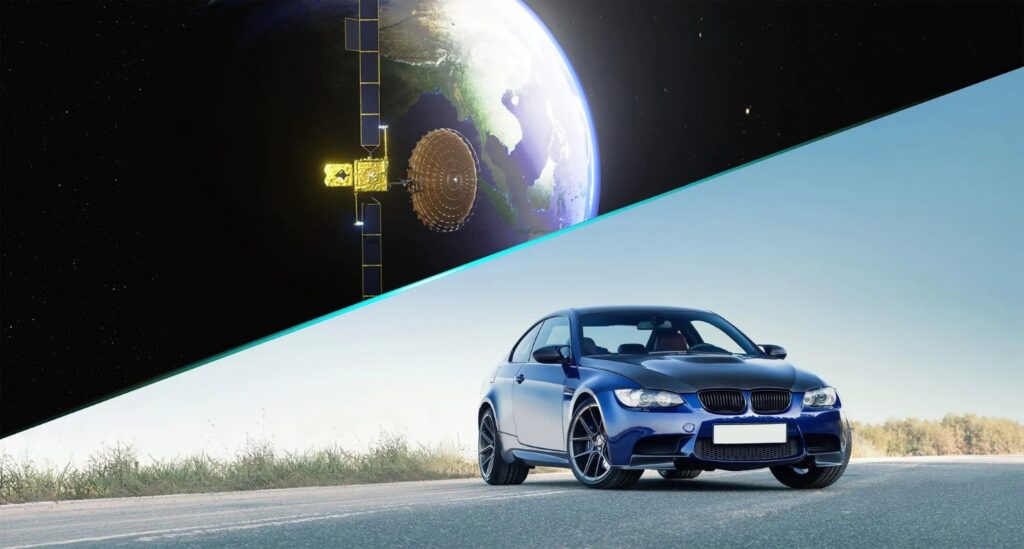
Vehicles can maintain voice connectivity when cellular networks are patchy or unavailable, as demonstrated by Viasat and Cubic³ at Mobile World Congress 2026.
This milestone showed that voice communications – a critical benefit for driver safety and emergency access – can operate reliably beyond the reach of terrestrial networks.
The demo brought together several advanced technologies to demonstrate how always-on connectivity can be integrated into modern software-defined vehicles (SDVs).
This included Viasat’s highly reliable satellite network, and Cubic³’s global connectivity management platform (CMP) and hybrid eSIM.
AI asked Kevin Cohen, VP Direct-to-Direct at Viasat, how significant this step is toward achieving truly ubiquitous connectivity for vehicles from the Viasat perspective
Cohen: Our satellite-enabled voice call demonstration with Cubic³ at MWC Barcelona marks a significant step forward. It’s a tangible, real-world proof point in how our global L-band satellite network, using 3GPP Non-Terrestrial Network (NTN) standards, can deliver reliable voice connectivity for connected vehicles.
The technology directly addresses the critical need for “always-on” communications, especially in regions beyond terrestrial cellular coverage, enabling truly ubiquitous and resilient communication for enhanced vehicle safety, emergency services, and the improvement of overall driver experience.
AI: What technical breakthroughs have made it possible to support real-time voice communications for vehicles using 3GPP-compliant non-terrestrial networks?
Cohen: The core technical advancement lies in the effective integration of Viasat’s established, L-band satellite network with 3GPP Non-Terrestrial Network (NTN) standards, Qualcomm Technologies’ Snapdragon® Auto 5G Modem-RF Gen 2 platform and an AI-based NESC voice codec from Fraunhofer IIS.

The demo brings together all these different technologies, along with a custom Viasat mobile app to make the calls, to enable voice to be transmitted over narrowband satellite networks.
As the demonstration highlights, our standards-based approach will also be crucial for ensuring widespread adoption and interoperability within the automotive ecosystem as we deliver an end-to-end technical architecture that enables live, bi-directional voice calls directly over an NTN NB-IoT protocol.
AI: Safety and emergency connectivity are key use cases for satellite-enabled services in vehicles. How do you see satellite networks reshaping the future of automotive safety systems, particularly in remote or underserved regions?
Cohen: Satellite networks can help reshape automotive safety, especially in remote or underserved regions where terrestrial networks are often patchy or non-existent.
Our L-band network ensures “always-on” connectivity, meaning critical communications like emergency calls, hazard warnings, and remote assistance can function regardless of location. As laid out in the 5GAA’s roadmap, these services are likely to enter wide usage from 2027 onwards.
Just as our L-band network forms the backbone for critical safety services across the maritime and aviation industries, it can also ensure that drivers and vehicles in remote areas have the vital connectivity needed for rapid response in emergencies, significantly enhancing overall safety and peace of mind.
AI: The automotive industry is increasingly focused on resilient, always-on connectivity. How does satellite technology complement existing 5G terrestrial networks to ensure vehicles remain connected wherever they travel?
Cohen: Satellite technology can act as a reliable back up to cellular systems, providing devices or vehicles with always-on connectivity, especially in areas where terrestrial cellular coverage is limited or non-existent.
It doesn’t seek to replace 5G terrestrial networks; rather, it provides a crucial complement, or even an overlay in high-demand areas, delivering the resilient, “always-on” connectivity that the automotive industry needs.
The integration of 3GPP NTN standards allows vehicles to intelligently switch between terrestrial and satellite networks. We demonstrated this at the 5GAA event at MWC, showcasing narrowband connectivity switching for continuous coverage.
Using both cellular and satellite connectivity can allow vehicles to remain connected wherever they travel, providing a ubiquitous communication layer that guarantees critical services, telematics, and data flow even when terrestrial signals are unavailable.
AI: The Equatys initiative, founded by Viasat and Space42, aims to enable seamless 5G connectivity across satellite and terrestrial networks. What role will this platform play in expanding advanced services for connected vehicles in the coming years?
Cohen: We are committed to developing open, standards-based solutions that enable ubiquitous connectivity for all vehicles, wherever they may travel, ensuring resilience and expanding the potential for advanced services.
Viasat and Space42 have announced they intend to form Equatys, which aims to create industry-first space tower company model. Equatys will implement and operate a shared space and ground infrastructure, which can lower capital costs and improve spectrum utilization for all participants.

In doing so, it plans to enable the global delivery of direct-to-device services across many sectors – including for the automotive industry – wherever terrestrial networks are not available.
In the future, advanced services like video streaming and seamless voice calls can be brought to the automotive market by utilizing the Equatys infrastructure.
AI: As consumer expectations for in-vehicle digital experiences continue to grow, how do you envision satellite connectivity supporting future high-bandwidth applications such as streaming, advanced telematics, and software updates for software-defined vehicles?
Cohen: We see satellite connectivity as vital to meeting the growing consumer expectations for advanced in-vehicle digital experiences and the evolving needs of software-defined vehicles (SDVs).
While we are currently focusing on narrowband communications for safety, the underlying principle of “always-on,” ubiquitous connectivity is vital for a broader range of applications, including telematics.
This resilient satellite connectivity backbone could enable SDVs to reliably receive essential over-the-air software updates, access advanced telematics services, and, as the technology evolves, support high-bandwidth applications like streaming in areas where terrestrial coverage is unreliable or lacking.
By providing this continuous connection, satellite technology will be key to unlocking the full potential of future in-vehicle services, enabling a seamless and uninterrupted digital experience for drivers and passengers alike.
AI asked André Schlufter, Director of Automotive Connectivity Innovationat Cubic³ how integrating satellite connectivity with global cellular networks transforms reliability expectations for software‑defined vehicles.
Schlufter: Integrating satellite connectivity with terrestrial cellular networks fundamentally shifts how OEMs think about reliability in software‑defined vehicles (SDVs).
Today’s OEMs expect continuous, predictable, and global connectivity because SDVs rely on real‑time data, remote operations, OTA updates, and safety‑critical services.

Cubic³ already provides “global connectivity solutions for software‑defined vehicles and other high‑value mobile assets” across 200+ countries and 550+ networks, ensuring coverage even across complex regulatory environments.
By adding satellite capability, we help OEMs eliminate remaining “coverage blind spots,” which typically occur in rural, mountainous, or cross-border regions.
This combination delivers true ubiquitous connectivity,a prerequisite for SDVs that must operate as reliable, cloud‑connected digital platforms 24/7.
AI: How does adding satellite capability help OEMs simplify global connectivity management while expanding services beyond traditional coverage?
Schlufter: Cubic³’s value proposition has always been “one integration, one contract, one access point,” enabling OEMs to manage connectivity across a global Tier‑1 operator portfolio with centralised analytics and compliance handling.
Integrating satellite connectivity into this model extends that simplicity:
OEMs still deal with a single Cubic³ interface, while we orchestrate satellite + terrestrial connectivity behind the scenes.
Satellite extends service availability far beyond the reach of terrestrial mobile networks, particularly important for safety use cases, logistics fleets, agriculture, and long‑haul transport.
OEMs can offer consistent digital experiences (telematics, emergency calls, location services, OTA updates) without managing separate non‑terrestrial contracts or infrastructure.
This is aligned with Cubic³’s mission of “cutting through complexity” and providing powerfully smart connectivity via a unified cloud platform.
AI: What role will intelligent connectivity management platforms play in enabling seamless switching between terrestrial and non‑terrestrial networks?
Schlufter: As vehicles evolve into SDVs, connectivity management becomes an active, intelligent function and not a passive communications pipe.
Cubic³ delivers this through:
- Hybrid eSIM / eUICC
- Global connectivity orchestration
- Real-time analytics through Cubic³ Cloud.
Our cloud platform provides “managed connectivity with real-time analytics and insights” that enable OEMs to optimise in-vehicle experiences and unlock new revenue streams.
In a hybrid terrestrial–non–terrestrial world, the orchestration layer becomes essential:
- It selects the optimal network (cellular or satellite) in real time
- It maintains service continuity across borders and network boundaries
- It ensures regulatory and security compliance (e.g., local breakout, data sovereignty).
This allows the SDV to behave as a self-aware, self-optimising digital platform, rather than a vehicle bound to a single network type.
AI: How critical are ecosystem collaborations (e.g., with Viasat & Qualcomm) to accelerating innovation and standardisation?
Schlufter: Cubic³’s history and success are rooted in partnering with leading automotive and telecom innovators—VW Group, Qualcomm, Viasat, and others.
The company has been described in OEM research as a “force multiplier” because it bridges previously disconnected parts of the ecosystem and simplifies adoption of complex technologies.
Cross‑industry partnerships accelerate:
- Technical validation (e.g., 3GPP NTN compatibility, satellite voice standards)
- Scalable deployment across OEM portfolios
- Regulatory alignment in markets with different telecom requirements
- Standardisation, which reduces fragmentation and makes adoption easier for automakers globally.
The joint demonstration with Viasat and Qualcomm reinforces Cubic³’s role as the software-first connectivity enabler, ensuring that new capabilities, such as satellite voice, are not only technically possible but also operationally scalable and OEM-ready.
AI: With increasing regulatory and operational complexity, how does Cubic³ help OEMs deploy always-on, compliant, global connectivity?
Schlufter: Cubic³ was built to solve this exact challenge. Our platform handles:
- Regulatory & tax compliance in each country
- Security protocols for SDVs
- Centralised data management and analytics
- Minimal SIM SKUs to simplify manufacturing.
By operating in “200+ countries and territories” and coordinating connectivity across “550+ mobile networks,” Cubic³ removes a major operational burden for OEMs.
This ensures:
- Vehicles remain connected and compliant wherever they are sold or driven
- OEMs face reduced risk and administrative load
- SDVs can support a uniform global feature set
- Drivers receive a seamless, predictable experience—regardless of geography
In practice, Cubic³ enables the OEM to focus on the digital experience and vehicle innovation, while we handle the complex global telecom and compliance requirements in the background.

More Stories
World’s first automotive data route between Europe and China established
How Summer Temperatures Affect Tire Safety
Does Walking with a Weighted Vest Build Muscle? Everything You Need to Know