
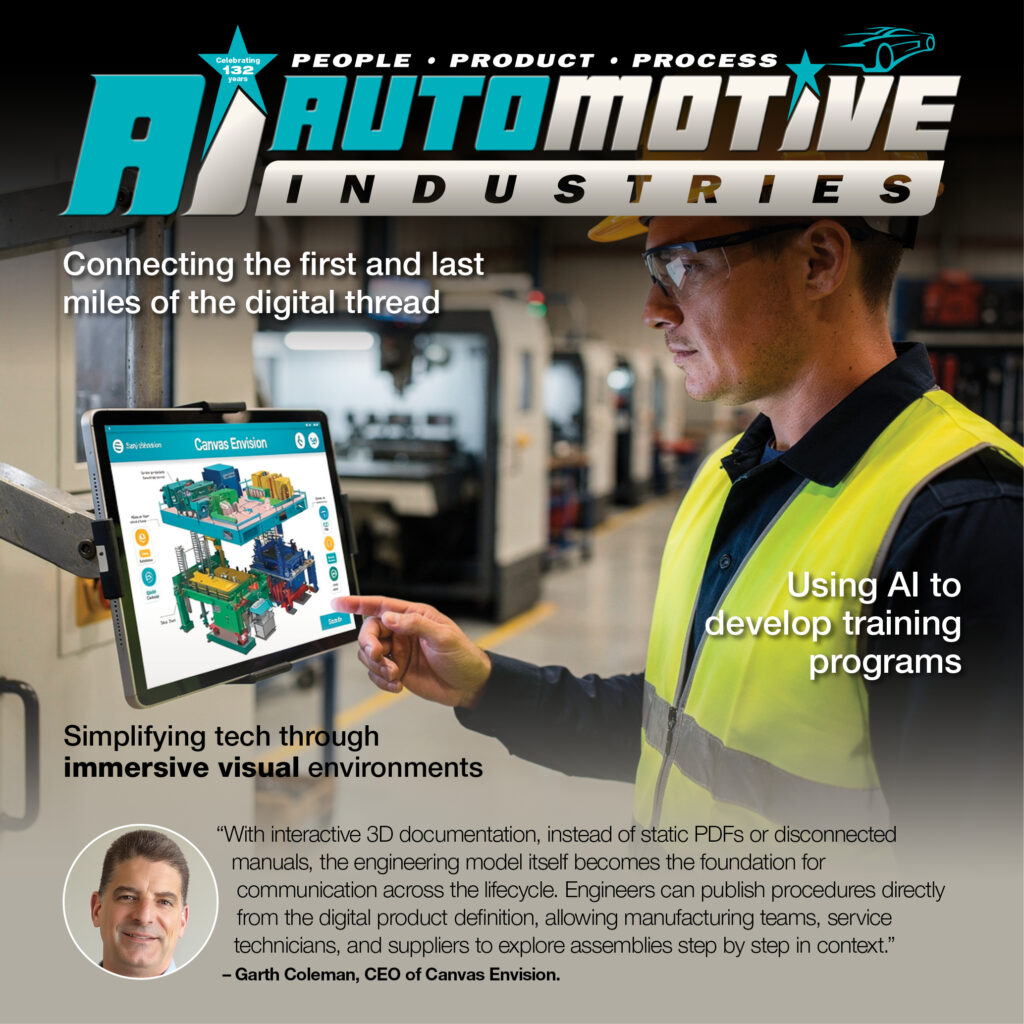
Industry 4.0 calls for shifting from isolated systems, manual tasks, and paper communication to a landscape defined by interconnectedness, transparent information flow, and teamwork.
Technology such as Canvas GFX provides manufacturing companies with a pragmatic way to embrace Industry 4.0 and expand digital transformation efforts at their companies.
Automotive Industries (AI) asked Garth Coleman, CEO of Canvas Envision, how interactive 3D documentation is transforming the way automotive manufacturers communicate across design, production, and service operations.
Coleman: Most automotive companies already manage enormous amounts of engineering data inside CAD and PLM systems, but that information rarely reaches the people building or servicing the vehicle in a form they can easily act on.

Interactive 3D documentation changes that dynamic. Instead of static PDFs or disconnected manuals, the engineering model itself becomes the foundation for communication across the lifecycle.
Engineers can publish procedures directly from the digital product definition, allowing manufacturing teams, service technicians, and suppliers to explore assemblies step by step in context.
In many ways this is about extending the digital thread to its last mile. The data already exists, but it needs to be translated into something the workforce can see, understand, and execute with confidence.
AI: With vehicles becoming increasingly software-defined and electrically complex, how can platforms like Canvas Envision help OEMs and suppliers turn CAD data into faster, more accurate digital work instructions on the factory floor?
Coleman: Vehicle systems today combine mechanical, electrical, and software architectures, which dramatically increases the complexity of manufacturing and service procedures.
Platforms like Canvas Envision help bridge that complexity by connecting directly to the engineering model. Instead of manually recreating instructions from scratch, teams can generate visual work instructions directly from CAD and PLM data. Assemblies, fasteners, wiring routes, and service steps can all be illustrated in context.
For example, engineering teams can import a CAD assembly into Envision and quickly convert it into step-by-step visual procedures for production or service teams. Because the instructions originate from the product definition, accuracy improves and updates become easier to maintain when designs change.
AI: You have spent many years advancing PLM and 3D visualization technologies—what are the biggest gaps today between engineering design environments and manufacturing execution, and how can they be bridged?
Coleman: Engineering systems are extremely effective at managing product definitions, but they were never designed to communicate directly with the people performing the work.
This creates a disconnect in what I often describe as the first mile and last mile of the digital thread. The first mile is capturing knowledge from engineers and experienced workers. The last mile is delivering clear guidance to technicians and operators at the point of execution.
Today those two ends are often handled through manual translation into documents or drawings. Bridging the gap requires turning structured engineering data into visual workflows that guide real-world execution. When that happens, the digital thread no longer stops at engineering. It reaches the workforce where value is actually created.
AI: Generative AI is rapidly entering industrial workflows—how do you envision AI accelerating the creation of technical documentation, training materials, and service instructions for automotive companies?
Coleman: One of the biggest bottlenecks in manufacturing today is the human translation step. Engineers design the product, but someone still has to interpret that information and convert it into instructions, training material, and service documentation.
Generative AI can dramatically accelerate that process when used as a co-pilot for experts. Instead of replacing human knowledge, AI helps capture and structure it.
For example, platforms like Canvas Envision can ingest existing engineering documents, legacy service manuals, or even videos of assembly procedures. AI analyzes that content and helps generate structured instructional steps. And we can take it one step further, where we connect those steps to the CAD data and use generative AI to turn those instructions into 3D interactive work instructions.
In effect, you can move from legacy documentation and recorded procedures directly into interactive 3D work instructions, while subject matter experts remain in control of validation and refinement, and then benefit from the ability to easily update and maintain those instructions as designs and processes evolve.
AI: Automotive manufacturers are under pressure to reduce launch times while increasing product complexity—how can interactive visualization platforms help compress development cycles without sacrificing quality?
Coleman: Product launches today involve thousands of components and tightly coordinated processes across engineering teams, suppliers, and manufacturing plants. Delays often occur when teams do not fully understand how a product will actually be built until late in the process.
Interactive visualization allows manufacturing teams to engage with the product much earlier. They can review assemblies, simulate procedures, and develop instructions directly from the digital model before the physical vehicle exists.
When manufacturing knowledge is developed alongside engineering design, teams identify issues earlier, refine processes faster, and reduce surprises during production ramp-up. That ultimately compresses development cycles while maintaining quality.
AI: Having previously helped shape global strategies for 3D visualization and PLM at Dassault Systèmes, what key lessons from that experience are you applying to scale innovation and growth at Canvas GFX?
Coleman: Earlier in my career I was part of the team that helped bring 3D visual communication into the mainstream. I started working with the Seemage technology that eventually became part of Dassault Systèmes and later evolved into what many people know today as SOLIDWORKS Composer.
The idea at the time was very powerful. Instead of writing instructions in text and trying to explain a product, you could work directly in the 3D model and embed information into the product itself. Labels, callouts, exploded views, and step-by-step visual procedures all lived inside that 3D environment.
That worked very well for authoring content and publishing it into traditional documentation formats. But the bigger vision was always to move beyond documents and deliver interactive 3D experiences directly to the people doing the work.
The challenge was that the industry never really solved the container problem. You could author rich 3D content, but to actually deploy it you often had to build custom applications, create web frameworks, or write code to host the player and connect it to enterprise systems.
That was 15 or 20 years ago, and in many ways the problem persisted much longer than people expected.
With Canvas Envision, we approached the problem from the other direction. Instead of just creating another authoring tool, we built the platform that acts as the container for the entire experience. It connects directly to engineering data, manages the instructional workflows, delivers the visual execution layer to the workforce, and captures feedback back into the digital thread.
In many ways Envision represents everything I wished we had when we were pioneering those early 3D communication technologies. We have finally reached a point where the industry can solve the first mile and last mile of the digital thread. Knowledge can be captured directly from engineering and experts, translated into structured instructions, and delivered visually to the people actually performing the work.
AI: As immersive technologies such as AR and VR mature, how will they integrate with digital work instruction platforms like Canvas Envision to transform training and maintenance in automotive manufacturing?
Coleman: Immersive technologies will become a natural extension of visual work instruction platforms.
Once procedures are built around interactive 3D models and structured instructional steps, that same content can be delivered across multiple environments. A technician might first learn a procedure in VR to understand spatial relationships and sequence. Later, AR can guide them during maintenance by overlaying those same steps directly onto the physical vehicle.
This is where the idea of a visual execution layer becomes important. Enterprise systems like PLM or MES manage complex data and processes, but their interfaces were never designed for immersive environments. A visual execution platform sits on top of those systems and controls how instructions are presented to the worker.
Because the instructions are structured and visual, the platform can adapt how the information is displayed depending on the device. A technician using a tablet may see a full step-by-step layout. In AR glasses, the same instruction might appear as minimal overlays highlighting the next component or safety step. In VR training, the system can expand the content into a full simulated environment.
That flexibility is essential as new display technologies emerge. Instead of redesigning interfaces for every device, the visual execution layer allows the instruction itself to adapt to the environment where the work is happening.
AI: Supply chains in the automotive sector are becoming increasingly global and complex—how can visual collaboration platforms improve communication and quality assurance between OEMs and Tier-1 suppliers?
Coleman: Global supply chains depend on clear communication of product requirements and assembly processes. Unfortunately, suppliers often receive static documents that can leave room for interpretation.
Visual collaboration platforms allow OEMs to share interactive models and procedures with suppliers in a controlled environment. Instead of interpreting written instructions, suppliers can see exactly how assemblies are intended to be built and where quality checks should occur.
This shared visual understanding reduces ambiguity and improves alignment across the supply chain, which ultimately leads to better quality and fewer production delays.
AI: Looking ahead five years, what role will interactive 3D knowledge platforms like Canvas Envision play in enabling the next generation of smart factories and digitally connected vehicle ecosystems?
Coleman: Smart factories are often discussed in terms of connected machines and automation, but an equally important element is connected knowledge.
Execution systems like MES already manage enormous complexity. They coordinate materials, production schedules, logistics, and quality processes across the factory. But the human interface to those systems often presents too much information when what workers really need is clear guidance for the task they are performing.
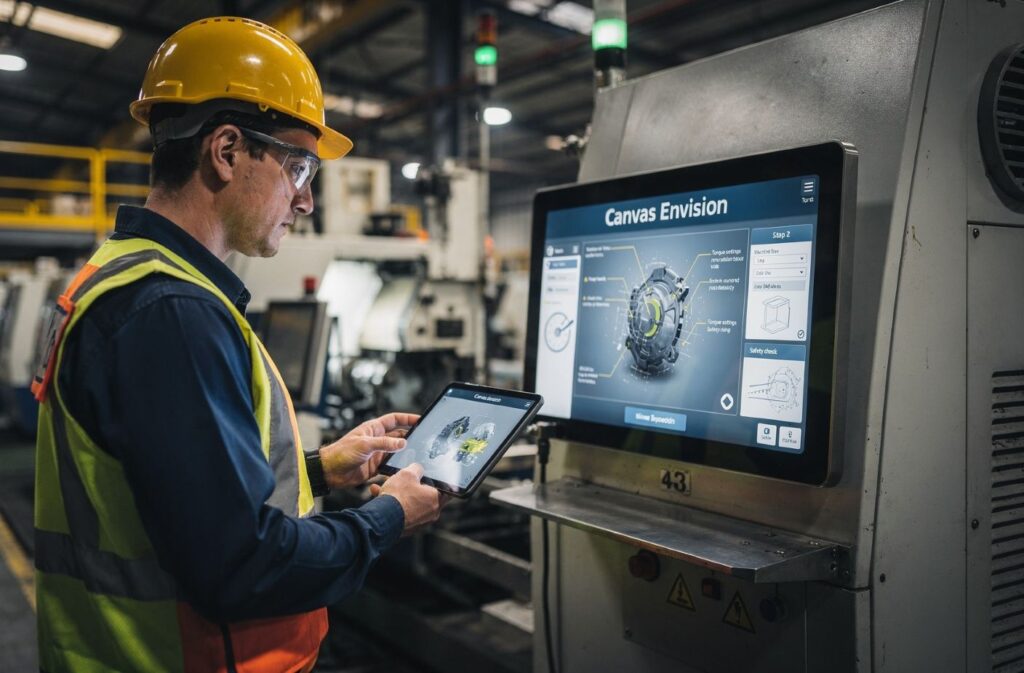
A visual execution layer sits on top of those systems and translates operational data into structured instructions that workers can follow with confidence. It can highlight what is different for a specific job, reinforce critical safety steps, or introduce small moments of friction to ensure compliance when something important has changed.
Just as important, the flow of information should not be one-way. Workers should be able to capture feedback, performance data, inspection results, or even simple confirmations directly within the instruction. That information feeds back into the digital thread for compliance tracking, quality analysis, and continuous improvement.
When you combine that feedback loop with the engineering systems upstream, you begin to see how this connects to the broader vehicle ecosystem. The same product data used to design the vehicle can guide manufacturing, support service technicians in the field, and capture real-world insights that flow back into engineering.
Over time, that closed loop of product data, operational knowledge, and field feedback becomes a critical part of how automotive companies design, build, and maintain increasingly complex vehicles.
Just as important, the system should not only push instructions to the workforce. It should also capture feedback, performance data, and operational insights from the floor and connect that information back into the digital thread.
That closed loop allows organizations to track compliance, measure adoption, and continuously improve processes across the lifecycle.
More Stories
Envalior on new thermoplastic formulations to meet HV heat challenges
How Road Conditions Can Contribute to Motorcycle Accidents in Washington
The Step-by-Step Panel Beating and Repair Handover Process with Certified Auto Body Specialists