
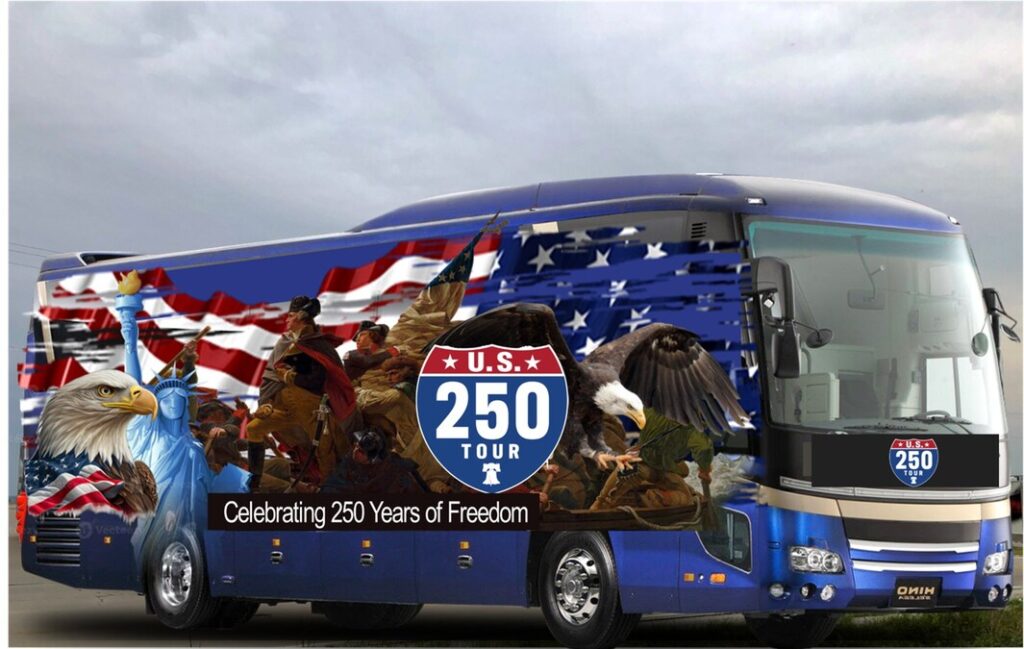
One of the official US 250 Tour buses getting ready to head to Nevada
As the nation prepares for its semiquincentennial, the newly established White House Task Force on Celebrating America’s 250th Birthday offers more than ceremony — it creates a moment to pair national storytelling with serious civic work. The Task Force (Task Force 250), established by presidential order, names the President as Chair and the Vice President as Vice Chair, calls for an Executive Director to coordinate day-to-day operations, and directs agencies to report on their planning and activities — creating a formal structure to marshal federal resources behind a meaningful nationwide commemoration.
Alongside the federal order, America250 — the official Semiquincentennial Commission effort — has been building public programs designed to gather and share everyday American stories, spark volunteerism, and get communities involved through initiatives such as “Our American Story,” “America’s Field Trip,” and the aspirational “350 by 250” engagement goal. Together, these efforts aim to make the 250th a year of listening and learning as well as celebration.
One powerful lens for reflecting on America’s achievements is transportation. Transportation history compresses how technology, policy, and culture have combined to shape opportunity, economy, and the landscape itself. A useful historical bookmark is the first widely publicized U.S. automobile race in 1895, when Frank Duryea’s motorized wagon won the Chicago Times-Herald contest — an event that catapulted the horseless carriage from novelty into an industry with enormous social consequences. That modest 54-mile contest hinted at sweeping changes to come: faster mobility, new industries, and different patterns of work and settlement.
A few decades later, Henry Ford’s innovations in mass production — most famously the moving assembly line introduced at Highland Park — democratized car ownership by slashing costs and production times. The Model T and the manufacturing techniques that supported it remade American industry and daily life, accelerating suburban growth, reshaping cities, and creating new labor dynamics. The arc from Duryea’s one-off wagon to Ford’s assembly line encapsulates roughly a century of technological leapfrogging in mobility.
Today’s transportation story is another inflection point. The rise of electric vehicles, expanded charging networks, and government programs to accelerate infrastructure deployment show how the next era of mobility is being planned and funded now. International analysts and national programs point to rapid EV adoption and hard policy choices about charging networks, grid impacts, and equity in access; domestically, federal investments and targets aim to expand public chargers substantially through this decade. Pairing the semiquincentennial’s civic platform with clear, public conversations about how transportation investments serve all communities can turn celebration into a meaningful policy moment.
That pairing — storytelling plus policy — is where Task Force 250 and America250 leadership can have a distinct impact. The Task Force’s interagency composition (which includes Cabinet members and agency heads) and its administrative placement allow it to convene cultural programs alongside infrastructure and public-service priorities. If celebrations highlight not only milestones but also people who built and maintained transportation systems — mechanics, transit operators, engineers, and planners — the semiquincentennial can help illustrate the often-unseen labor and public policy that underpin mobility.
Practical examples flow quickly from that idea. Museums and traveling exhibits could trace 130 years of American transportation — from the first gas- and steam-powered experiments, through mass production and highway construction, to contemporary electrification and automation. Oral histories from bus drivers, railroad workers, assembly-line employees, and rural mail carriers would expand the public archive beyond famous inventors to include those who kept systems running. Community summits could pair historical exhibits with local planning sessions on charging, transit funding, and walkable neighborhoods, making the semiquincentennial a catalyst for practical local action.
A national celebration framed this way also invites honest reckoning. The transportation transformations of the 20th century brought prosperity but also contributed to exclusion: highway routing divided neighborhoods, car dependency shifted public investment away from transit, and access to mobility remained unequal. The semiquincentennial’s leadership has an opportunity — and a responsibility — to put those tradeoffs in the story alongside the triumphs. Honest public history that acknowledges winners and losers strengthens civic conversation and improves future policy choices.
Leadership tone matters. Task Force 250’s public posture can encourage collaboration between federal and local agencies, cultural institutions, the private sector, and civic groups to create programming that’s both celebratory and constructive. The America250 programs already emphasize inclusive storytelling and volunteerism; adding transportation as a thematic strand — with exhibits, community listening sessions, and infrastructure roundtables — would make the anniversary relevant to daily life and future prosperity.
The semiquincentennial will be a mosaic of moments: parades and medals, monuments and music, histories and handshakes. If Task Force 250 and America250 leadership use this platform to link commemoration with foresight — particularly in transportation, where technology and policy will directly shape climate outcomes, economic opportunity, and civic life — the 250th can be less about nostalgia and more about choosing the paths we want to travel next. In that task, celebrating the past and steering the future are not separate acts; they are consecutive legs on the same national journey.


More Stories
Ford and Geely Join Forces as Global Automotive Collaboration Enters a New Phase
Olaf Mußhoff on Innovation, AI, Sustainability and Why Automechanika Frankfurt 2026 Will Shape Automotive Aftermarket Success Worldwide
What Affects the Price of a Used Truck: Understanding Used Truck Prices