
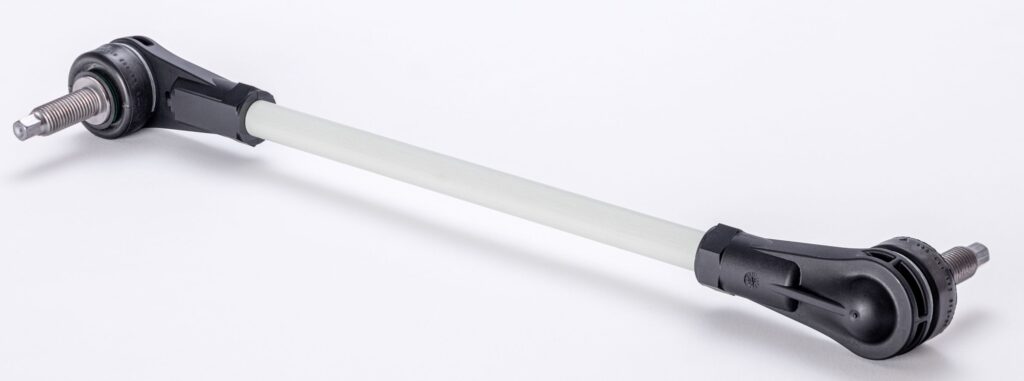
Project partner ZF Group processed the recycled material into a technically sophisticated chassis component (stabilizer link) for Mercedes-Benz. Photo: BASF, 2025.
Even though recycling of automobile waste is gaining more and more interest, around 200 kilograms of plastic per end-of-life vehicle is still often incinerated or goes to landfill.
Technologies developed by BASF are designed to help vehicle manufacturers meet upcoming regulatory requirements of the end-of-life vehicle regulation (ELVR). Pilot projects showcased at K 2025 demonstrated how automotive waste can be fed back through a closed cycle for use by the automotive industry.
Automotive Industries (AI) asked Oliver Geiger, Senior Manager Sustainability – Engineering Plastics at BASF, to tell us about the two new recycling processes for polyamide 6 from end-of-life vehicles presented by BASF at K 2025.
Geiger: The processes are solvent-based recycling and recycling via depolymerization from shredded material. These advanced recycling technologies make it possible to recycle heavily used and contaminated plastic parts.
For the first pilot, end-of-life oil pans from ZF Group were used in combination with other dismantled PA6 parts as feedstock. At the core of the process is depolymerization, where the long polyamide chains are broken down at their inherent cleavage points into their original building blocks – the monomers.

In the subsequent step, the resulting monomer caprolactam obtained from the depolymerization of PA6 is purified. This allows potentially disturbing r impurities to be completely removed.
In contrast, these impurities remain in the material when mechanical recycling is applied and potentially impair the quality and safety of the recycled material.
The material is then re-polymerized into high-quality polyamide, which is further processed into a polyamide compound according to the requirements of the application.
This meets the highest quality standards and is suitable for demanding components in the automotive industry – closing the automotive-to-automotive loop. Our partner ZF group molded a stabilizer link for Mercedes-Benz, which passed extensive testing procedures demonstrating the virgin-like quality of the material.
The second pilot project focused on the recycling of automotive shredder residue (ASR) – a complex mix of materials that remain after the removal of mainly metals and glass.
Thanks to close cooperation with our partners along the value chain, it is now possible to extract the polyamides from this mixture using newly available sorting and processing technology.
The polyamide fraction obtained was used as the starting material for a new solvent-based recycling process as part of the pilot project. In this process, the polymer chain is not split but selectively dissolved with the aid of a suitable solvent, then purified and finally reprocessed into PA6 compounds.
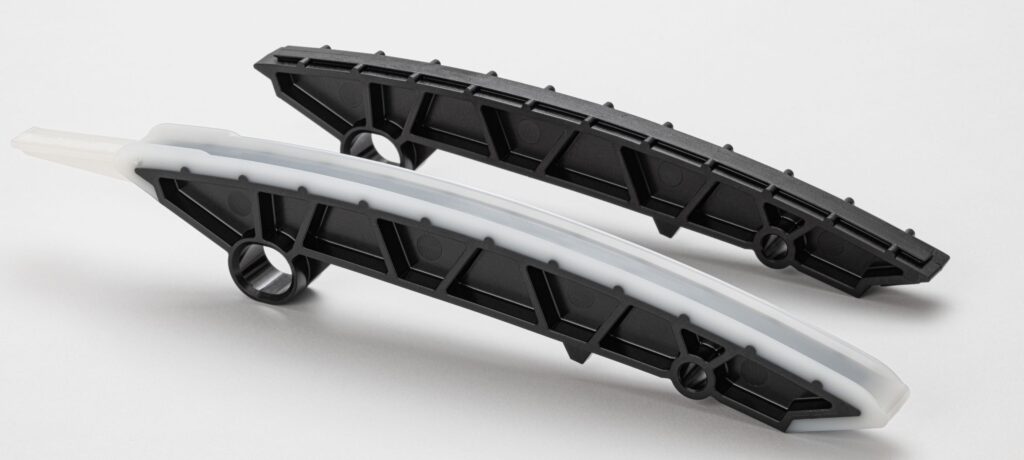
This technology was validated using a guide rail in series production at German OEM Mercedes-Benz. The components were manufactured and successfully tested under near-series conditions by the project partner Pöppelmann as part of the pilot project.
AI: Are the processes ready for market?
Geiger: The project shows that solvent-based recycling and depolymerization are viable recycling options for plastics that are challenging to recycle mechanically. This approach supports the circular economy by enabling materials to be reused in automotive applications.
The parts have been proven in field trials and approved for use, but the processes are still to becommercialized.
AI: Why is the contribution to the circular economy significant in the context of BASF’s new technologies?
Geiger: It is important to keep the recycling loop as small as possible.
That is why mechanical recycling is always preferable, if you have the required feedstock volumes and can achieve good quality.
If not, the cycle gets bigger. When you use a solvent, you only clean the polymer (back to polymer) and when you use chemical recycling technologies you reduce it to its component monomers (back to monomer) or even back to feedstock.
For each of these processes you need energy, and that has an impact on the CO2 footprint of the component.
AI: What are the main steps involved in the depolymerization and re-polymerization of polyamide components?
Geiger: It starts with a relatively pure feedstock stream of polyamide 6. Then you shred it because this increases the total surface area for interaction with the chemicals being used.
Depolymerization is brought about through a combination of pressure, temperature and chemicals that crack the polymer chains back to monomers. Those monomers are then used to build polymers again.
AI: How were the performance and suitability of depolymerized polyamide compounds tested and validated?
Geiger: Life cycle analyses (LCA) were carried out by an external partner for both pilot studies.
They found that solvent-based technology and depolymerization recycling both significantly reduce CO₂ emissions compared to conventional polyamide production and traditional plastic recycling like thermal recovery (incineration). These processes support a more sustainable and circular plastics industry.
While mechanical recycling has the smallest carbon footprint of the established recycling processes, in both cases the PCF is significantly lower carbon than if you produced the same polymer from a fossil raw material, and, of course, compared incineration of the waste.
AI: What challenges does automotive shredder residue (ASR) present for recycling, and how does BASF’s solvent-based process address these?
Geiger: The challenge with ASR is that you always have a crazy mix of polymers, as well as contaminants.
That means you need some sorting processes if you want to access the polymers. In addition to conventional sorting technologies, solvent based recycling can help to purify the obtained polymer fractions by selective recycling of one polymer type while getting rid of old compound ingredients like glass fiber.
AI: Why is it important to maintain a broad spectrum of recycling technologies?
Geiger: You have to cater for differing quality of waste streams. The quality of the waste determines whether you use either mechanical or chemical recycling processes or a combination of both.
As a last resort, there is always a high-temperature process such as gasification.
That is why you need this coexistence of different processes.
AI: How do OEMs view the adoption of secondary raw materials and the expansion of recycling technologies?
Geiger: I cannot speak for them, but they all need to be ready for the end-of-life vehicle regulation.
That is why they are willing to evaluate the technologies that are currently being developed and to partner with us, as Mercedes-Benz did with the two pilot projects mentioned.
We really are still in the development phase.
For these pilots we had a limited amount of polymer. That is sufficient for demonstration and testing, but not for serial production.
So, the next step is to figure out how to commercialize the different technologies in a way that makes sense from both ecological and economic points of view.
AI: What is the significance of regulatory frameworks in advancing recycling technologies?
Geiger: Regulation has a direct impact. We can develop and commercialize a lot of technologies, but if they are not allowed by the regulations or are not needed to meet the requirements, then no one will invest in them.
Therefore, there has to be certainty and stability when it comes to regulations. There were many other technologies on show at K 2025 which, like ours, are in pilot phase.
We are all willing to invest, but we need to know which technologies will be required to meet the regulations.
More Stories
Envalior on new thermoplastic formulations to meet HV heat challenges
How Road Conditions Can Contribute to Motorcycle Accidents in Washington
The Step-by-Step Panel Beating and Repair Handover Process with Certified Auto Body Specialists