
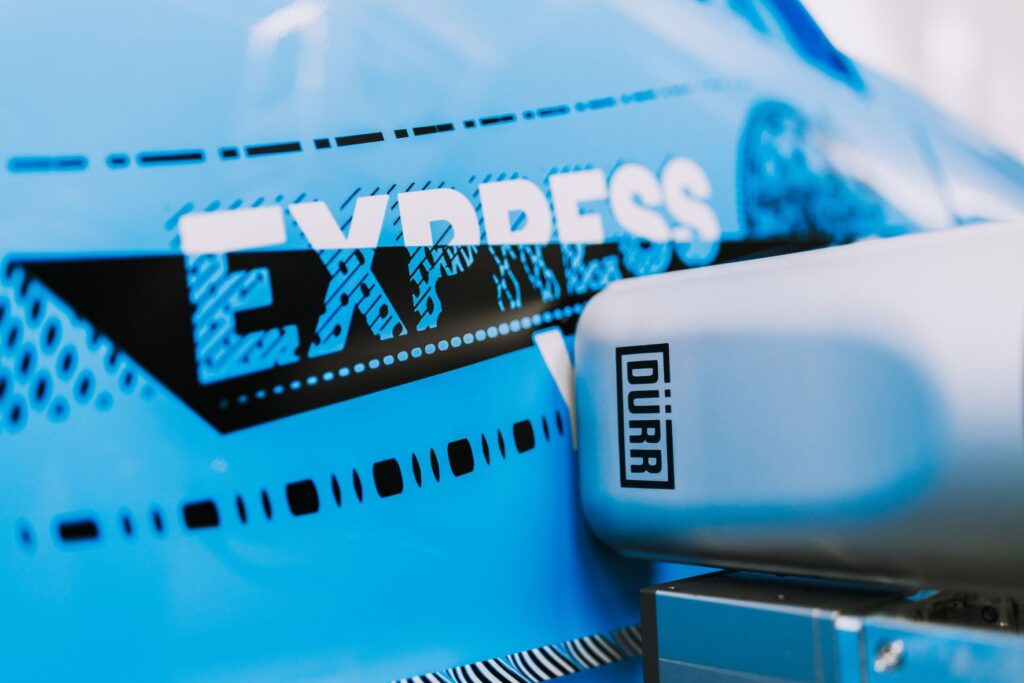
The Dürr EcoNextJet print head has two separate ink channels that enable simultaneous two-color printing. Photo: Sascha Feuster.
What a car manufacturer portrayed as a futuristic vision in an advertising campaign 20 years ago is now a reality.
Digital paint graphics have evolved from a concept for show cars into an industrial production option: scalable and ideal for lettering, including model and special edition designations, graphics, and decorative surface applications.
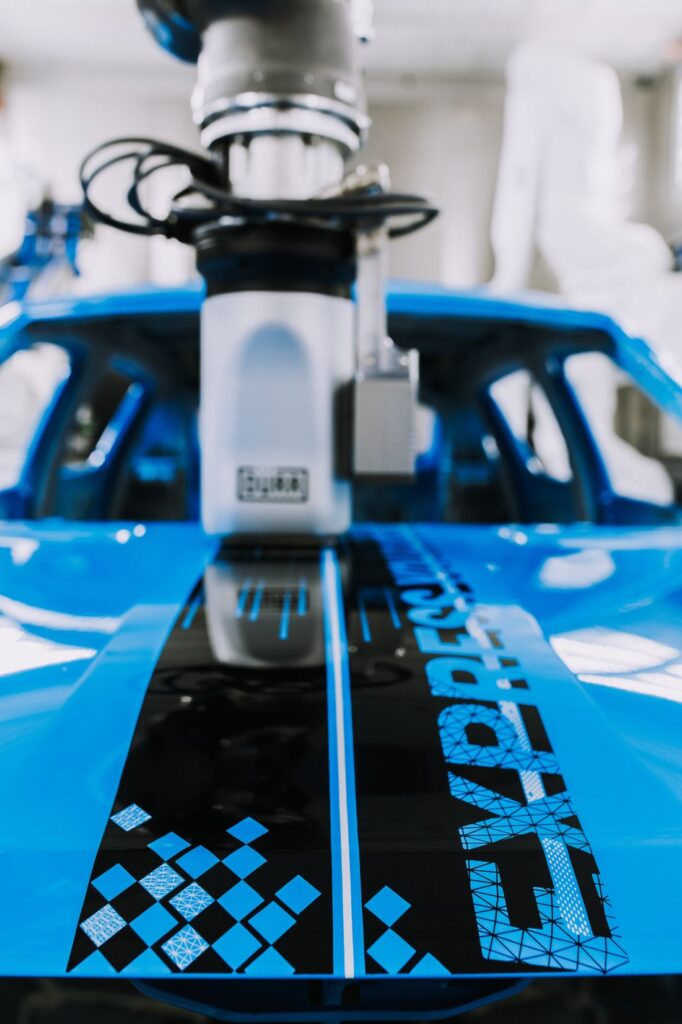
All of this is made possible by EcoNextJet, a new application system developed by Dürr in cooperation with paint manufacturer Axalta and printhead specialist XAAR.
In 2019, the EcoPaintJet established overspray-free surface painting in series production. Since then, it has been regarded as the benchmark for uniform two-tone applications.
The EcoNextJet builds on this and expands the range of possibilities. Its core strength is pixel-precise graphics and intricate design details with resolutions of up to 720 dpi.
The system applies the same paint to both horizontal and vertical surfaces. Manual alternatives, such as multi-layer films or attached plastic components, are no longer necessary.
“EcoNextJet transforms what was once a labor-intensive task into an automated and fully reproducible production process. Within minutes, the system applies virtually any desired graphic to almost any position on the vehicle,” explains Hans-Georg Fritz, Senior Expert for New Technologies at Dürr.
Three partners develop a complete package
To develop EcoNextJet to market readiness, three partners contributed their specific expertise to the collaboration.
Dürr leveraged its expertise in robot-guided paint application in automotive manufacturing and its more than 12 years of experience in overspray-free application to integrate robotics, paint supply, cleaning, nozzle inspection, a two-stage measurement system, and the software for path planning and droplet impact point calculation into a production-ready complete system.
XAAR contributed its printhead technology for the application of high-viscosity media, featuring 2,000 nozzles and patented circulation technology.
And Axalta developed a paint formulation with pseudoplastic viscosity behavior that is perfectly tailored to the printhead while ensuring the quality standards of automotive production.
“Our goal was to combine these specific solutions into a complete package and offer customers the applicator, paint, and process from a single source,” explains Fritz.
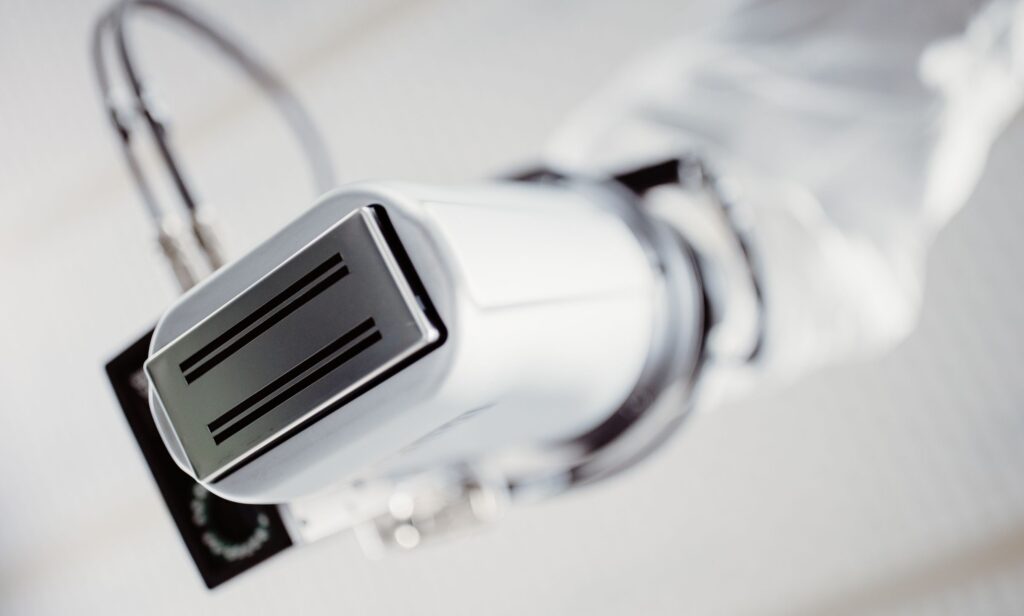
The XAAR printhead operates on the drop-on-demand principle. This means that the printhead, mounted on a Dürr painting robot, individually controls each of its 2,000 side by side nozzles.
This enables up to six drops to be generated per pixel, which merge into a larger droplet during flight before reaching the vehicle surface. The printhead also features two separate paint channels, enabling simultaneous two-color printing – for example, black combined with a light gray – without requiring additional paint changeover time.
The technology has already proven its reliability in other industrial applications. In tile production, for instance, XAAR printheads operate continuously and reliably 24/7 even when handling abrasive materials.
TF Technology: Circulation directly behind the nozzle
The channel walls of the forward-facing nozzles are made of piezoceramic. When an electrical voltage is applied, the piezoelectric elements deform slightly, ejecting paint droplets with precisely controlled size and velocity.
What sets XAAR’s TF technology apart is the circulation of the paint behind each individual nozzle.
In other piezo-based printheads available on the market, dead spaces can form in the paint flow, which can lead to deposits and nozzle clogging with high-viscosity automotive paints. TF technology solves this problem through a constant flow that keeps the paint in motion and flushes out air bubbles.
Dürr paint system: Precision control in the millibar range
Circulation directly behind the nozzle enables more thorough flushing than with conventional systems and thus forms the design basis for the paint supply system developed by Dürr specifically for EcoNextJet.
“The central technical challenge was the printhead’s open-system design,” explains Timo Beyl, Manager of New Technologies at Dürr.
“The pressure control within the supply system must ensure that paint neither escapes uncontrollably from the nozzles nor draws in air, as either would condition would immediately compromise print quality. The operating pressure ranges from tenths to hundredths of a bar, creating a very narrow process window.”
Dürr leveraged its experience in standard application technology to develop a supply system capable of color changes that delivers highly precise pressure control without pressure fluctuations.
In doing so, Dürr also set the objective of enabling rapid color changes, even though drop-on-demand printheads were not originally designed for that purpose.
Coating Development: Viscosity as a Key Parameter
To ensure the coating can be applied effectively to both horizontal and vertical surfaces, coating specialist Axalta developed a formulation with a viscosity low enough to flow through the nozzles while remaining high enough to prevent sagging on vertical surfaces.
The resulting paint formula is designed for viscosities up to 100 mPas throughout the system, achieving a smooth print image without a 3D effect, a resolution of up to 720 dpi, and an application speed of 211 mm/s for the water-based basecoat applications.
Two process configurations possible
EcoNextJet can be operated in two fundamentally different process configurations. In the inline process with water-based coating, the system is fully integrated into the coating line’s process sequence.
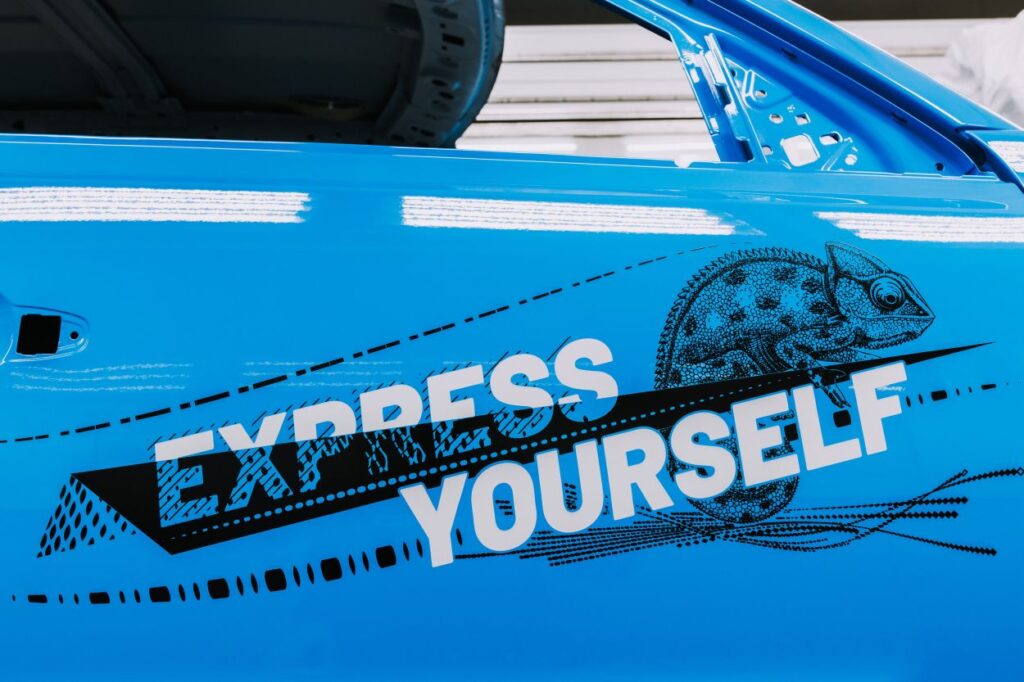
The graphic is applied after the base coat and before coating with 2K clear coat. “This configuration delivers the best appearance and highest level of durability, but requires sufficient space within the paint shop, especially when retrofitting existing systems,” explains Fritz.
In the offline process with solvent-based single-coat topcoat (monocoat), application takes place outside the main line on the vehicle that has already been clear-coated.
This allows for a more flexible layout and greater independence from the paint line’s cycle time. “The water-based process is particularly well suited for graphics and solid surface designs, while we primarily see monocoat applications used for two-tone applications,” says Fritz.
From black to red: available colors
A wide range of colors is available for the water-based inline process. Currently, black, dark gray, and light gray – a color especially popular among premium vehicle manufacturers – are available.
“It’s a very light gray that appears almost white against a dark background,” says Beyl. Blue and red are set to follow by the end of the year, with green and yellow planned for 2027. In addition to these basic colors, the custom color development is also possible.
The supply system developed by Dürr provides the flexibility needed to further expand the available color spectrum.
Applications in both the high-end segment and the volume market
Especially in the premium segment, EcoNextJet opens new possibilities for vehicle personalization, extending all the way to one-off customization.
However, EcoNextJet also offers a superior-quality alternative in the volume segment for manufacturers who have previously used masking or adhesive films and plastic parts to create design accents.
In the future, they will be able to apply any graphics, lettering, model designations, or other information directly, as well as add color accents to recesses and embossments in the body – a concept that OEMs across various segments are already considering.
Beyl is certain: “The ability to apply high-quality designs in a fully automated process is not only interesting for the automotive industry, but also to manufacturers of vans, trucks, and buses. It doesn’t always have to be a Picasso.”
More Stories
TASKING Joins SDVerse to Advance Safety-Critical Embedded Software Development for Software-Defined Vehicles
Rhino USA Celebrates 10 Years: From a Family Garage to a Nine-Figure Brand
SPE® ACCE 2026 Highlights Advancing Mobility with Composites