
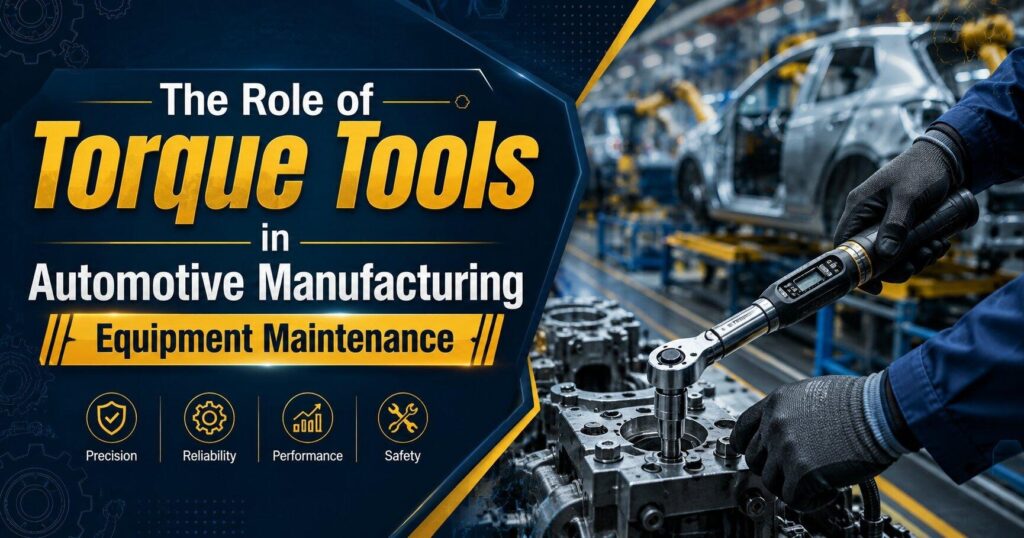
One part where the torque is not met on the assembly line doesn’t create one rework ticket. It may result in a recall, warranty claim, or even a safety failure on the road. That’s why torque tools in the automotive industry are not considered like normal hand tools. They’re tools of precision, tools that plant engineers closely monitor, calibrate, and maintain, as do the robots and conveyors around them.
In this article, we will discuss the importance of torque tools, the various types employed on today’s production lines, maintenance and calibration, and the selection of the proper torque tool for your production floor.
Why Torque Tools Are Critical to Automotive Manufacturing Equipment Maintenance
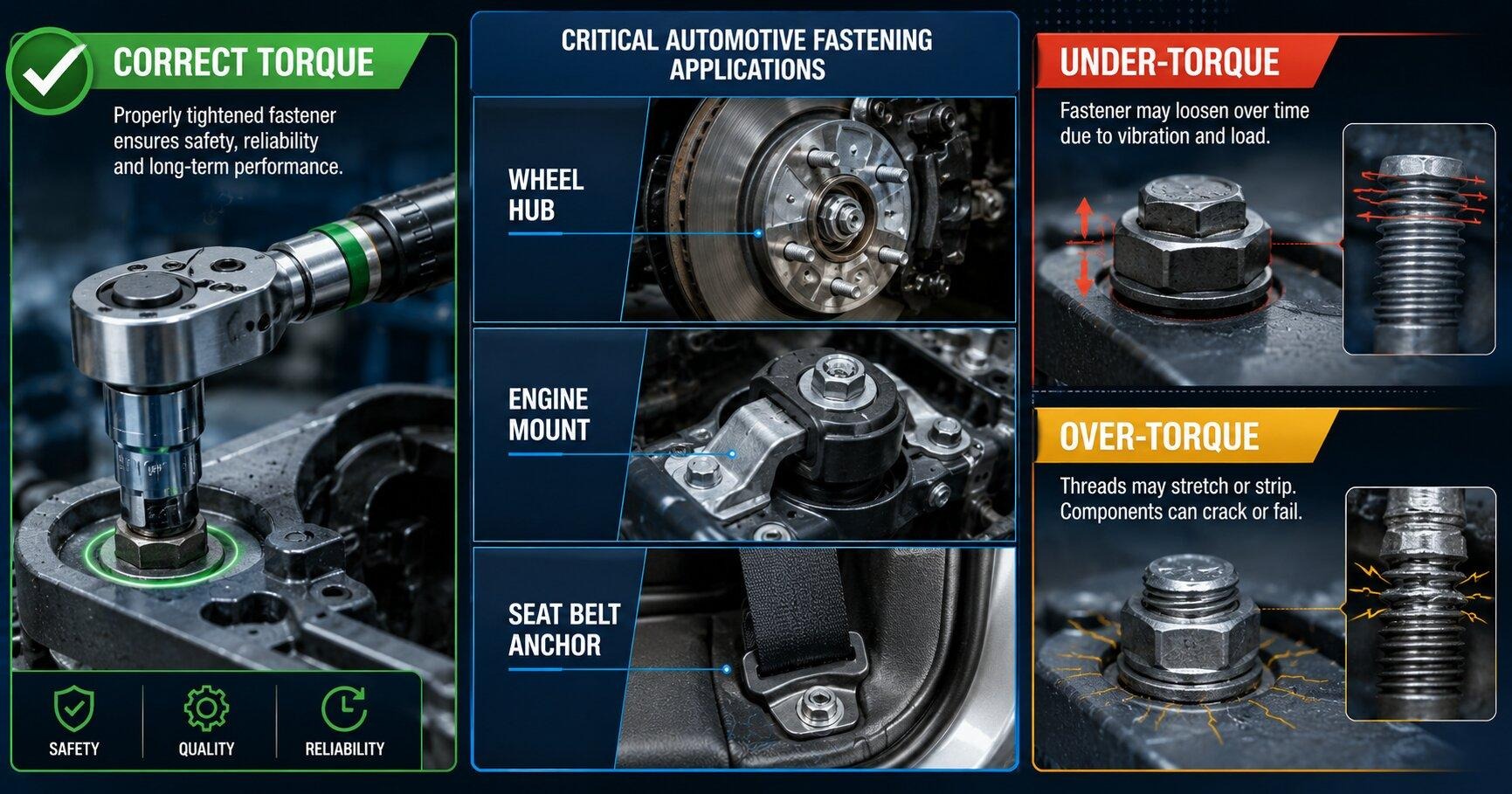
For each bolt on a car, there’s a torque spec for a reason. If it is too loose, a fastener will work loose over time as a result of vibrations. If it’s too tight, it can either tear the threads or fracture a part. That’s what torque tools are there for in automotive production, and that is what they do again and again and again each day, for thousands of cars.
How Torque Precision Affects Assembly Line Quality and Safety
The accuracy of fastening is critical for wheel hubs, engine mounts, and seat belt anchors. Even a few percent from the target specification can make a simple fastening process into a potential safety hazard. That’s where torque accuracy is in the middle of most of the quality control inspection points on the line.
The Cost of Torque Failures — Warranty Claims, Recalls, Downtime
When torque fails, it’s seldom small. When a batch of under-torqued fasteners is discovered, it means thousands of vehicles may have to be recalled; warranty claims and damage to brand reputation are inevitable. Include line downtime due to fault tracing, and the expense of a poor torque tool maintenance program skyrockets.
Where Torque Tools Fit in a Broader Equipment Maintenance Program
Torque tools aren’t used in isolation. They are a component of a plant’s greater automotive manufacturing equipment maintenance system, along with conveyor systems, robotic welders, and paint-line equipment. Too many plants simply treat the torque tools as an isolated tool checklist, instead of one of the many elements of that program.
Types of Torque Tools Used in Automotive Manufacturing
The same type of fastener isn’t always the type of tool that is needed for the job. Line engineers select from the available options, depending on the volume, size of the fasteners, and the amount of force that the application requires.
|
Tool Type |
Best For |
Torque Range |
Speed |
Precision |
|
Manual Torque Wrench |
Low-volume, service work |
Low–Medium |
Slow |
Operator-dependent |
|
Electric Nutrunner |
High-volume assembly |
Low–High |
Fast |
High, programmable |
|
Hydraulic Torque Wrench |
Heavy chassis/frame fasteners |
High |
Medium |
High |
|
Pneumatic Tool |
Repetitive fastening |
Low–Medium |
Very Fast |
Medium |
|
Battery-Powered Tool |
Mobile, no air-line access |
Low–Medium |
Fast |
Medium |
|
Torque Tester |
Verifying other tools |
N/A |
N/A |
Reference-grade |
Manual Torque Wrenches — Click, Beam, and Dial Types
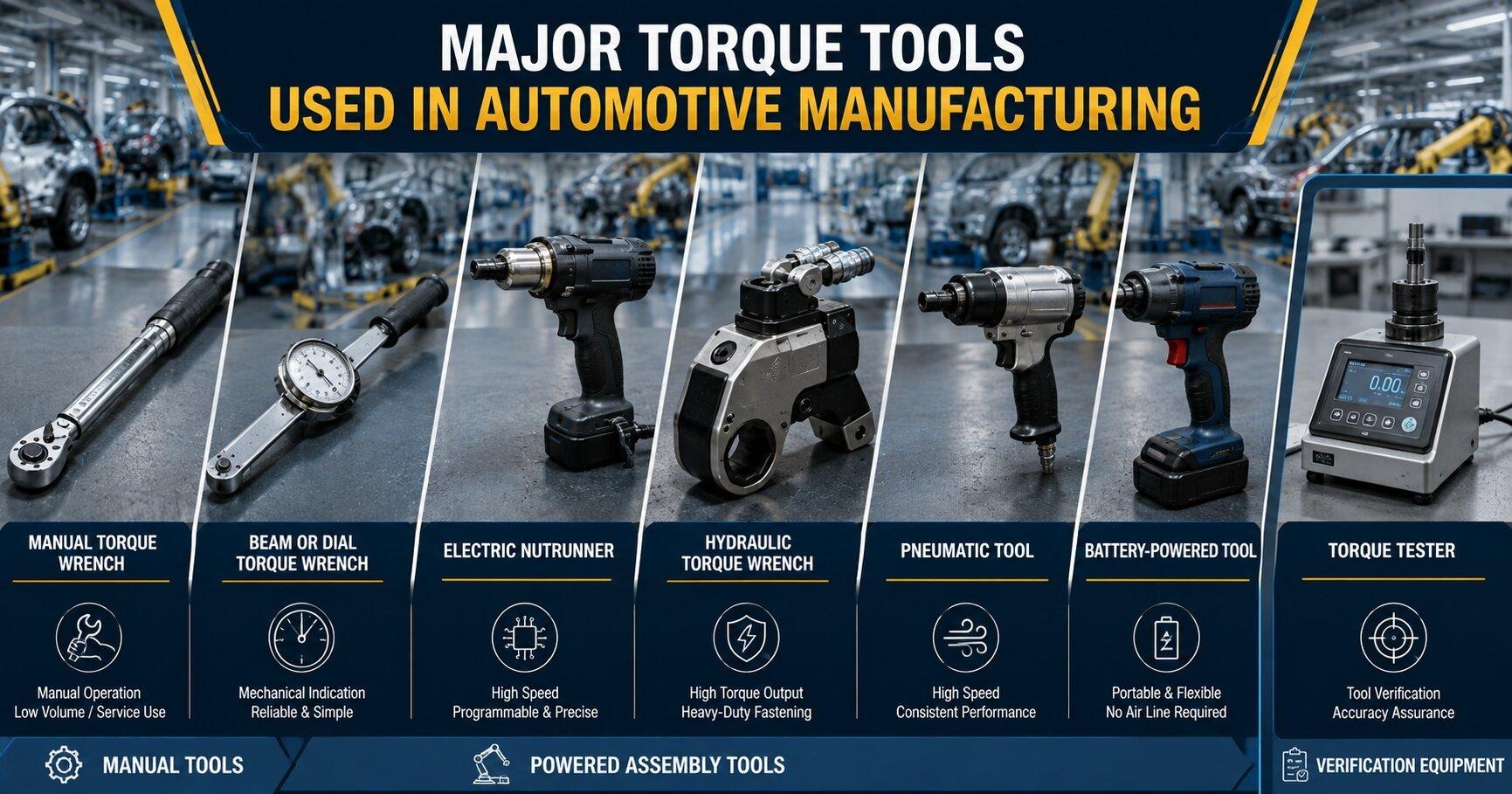
Click, beam, and dial torque wrenches are still in use for low-volume or service applications. They are straightforward, have no power requirement, and provide instant feedback for the operator. However, with high-cycle assembly tasks, they lack speed and repeatability.
Electric Nutrunners for High-Volume Assembly
The electric nutrunner is the best known and most popular of all the modern automotive torque tools. It provides programmable torque control, records all of the fastening operations performed, and provides real-time identification of out-of-spec results, exactly what a high-volume line requires to remain compliant.
Hydraulic Torque Wrenches for Heavy Fastening Applications
When dealing with large fasteners on chassis, frame, or heavy equipment assemblies, a hydraulic torque wrench has the ability to produce a high amount of torque that is unattainable on manual tools, with minimal effort from the operator. These are tools that are used throughout the industry where the bolt size is too large to be used with an electric nutrunner.
Pneumatic and Battery-Powered Torque Tools
Fast cycle times and repetitive fastening are provided by pneumatic tools, and mobility is provided by battery-powered tools in lines with poor access to an air line. Both shoot for speed, at the expense of accuracy, and are frequently used in conjunction with in-line torqueing.
Torque Testers and Verification Equipment
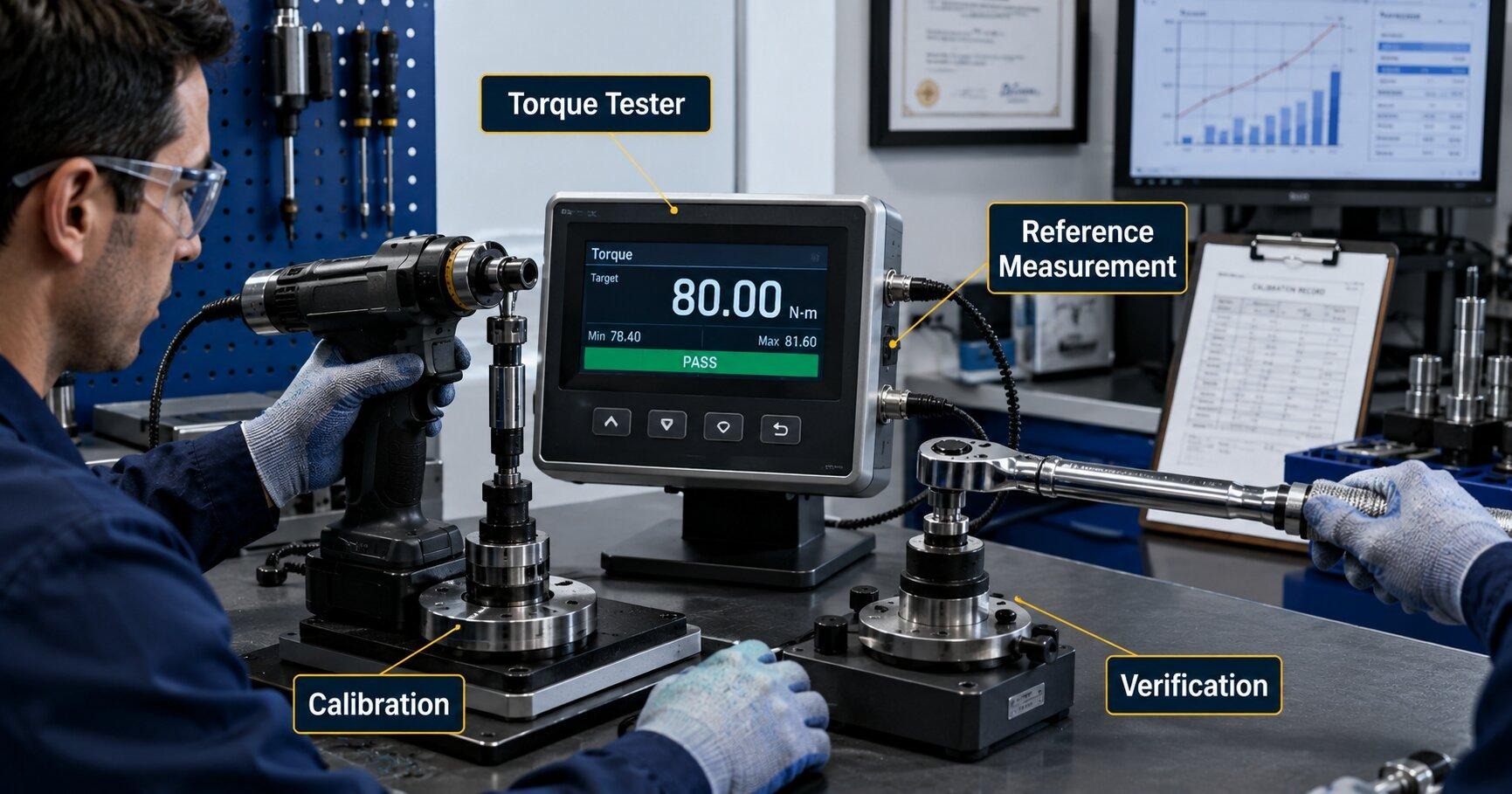
A torque tester will not actually secure anything; it’s just a device used to determine if the tools doing the securing are still in proper calibration. The easiest method of identifying drift before it gets to the line is to run the tools in a torque tester on a regular basis.
Torque Tool Maintenance — Keeping Fastening Accuracy Consistent
All the best torque tools will provide inaccurate readings after a while. Performance is chipped away by vibration, wear, and heavy cycle counts, so it is better to maintain performance with a planned schedule, rather than a reactive one.
Daily and Weekly Maintenance Checks
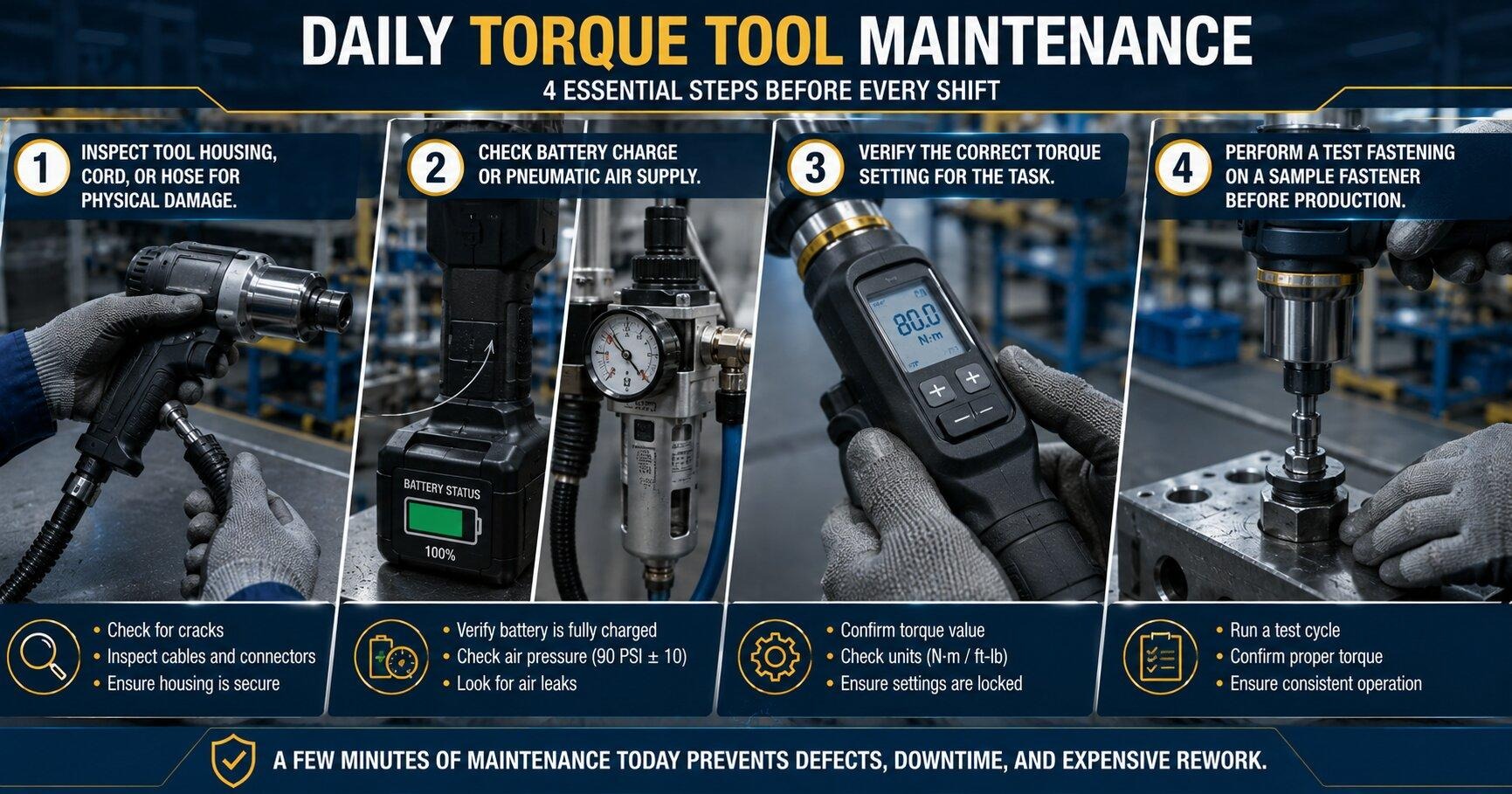
Before each shift, operators should do some quick checks:
-
Check for physical damage on tool housing and cord/hose
-
Check that air pressure or battery charge is acceptable
-
Check the torque setting is correct for the job in progress
-
Test fire on sample fastener before going into production.
Such a quick check will detect apparent issues before they become fastening problems.
Common Wear Points That Cause Torque Drift
The use of clutch mechanisms, drive shafts, and internal springs puts stress on them and causes them to wear unevenly. When left unchecked, this wear leads to progressive drift in torque control – and this drift is not noticeable until a number of fasteners are out of order.
Preventive Maintenance Schedules for High-Cycle Tools
Instead of calendar dates, the preventive maintenance schedule is based on cycle counts, so the wear doesn’t impact output. High-cycle tools make up for their fast lines, requiring maintenance more frequently than tools run on slower lines.
Signs a Torque Tool Needs Servicing or Replacement
Some of the warning signs that indicate that a tool should be taken in for servicing are:
-
Torque readings with different torque during the same fastening cycle
-
Noises of grinding, clicking, or other abnormal noises when running.
-
Failure to make a satisfactory grade at a subsequent test on a torque tester.Unsuccessful test on a torque tester repeated.
-
Drive shaft and/or clutch housing worn, readily visible on the vehicle’s exterior.
The way to make a minor problem a line-stopping problem is to ignore these warning signs.
Torque Tool Calibration — Standards, Frequency, and Compliance
It’s calibration that sets a torque tool apart from one that is guessing. Automotive plants have to adhere to strict requirements to demonstrate their torque tool calibration process meets audit requirements.
Calibration Standards (ISO 6789, ANSI/ASME) and Why They Matter
There are two standards that specify the accuracy tolerances and the method of testing torque tools: ISO 6789 and ANSI/ASME. For most OEM suppliers, meeting these standards is not only a contractual requirement, but also a standard they must meet.
How Often Torque Tools Should Be Calibrated
Most plants recalibrate at least once every 3 – 12 months based on the type of tool and volume of cycles, or if a tool is found to be dropping or drifting. Manual wrenches are sometimes used less often than high-cycle electric nutrunners.
|
Tool Type |
Typical Cycle Volume |
Recommended Calibration Interval |
|
Manual Torque Wrench |
Low |
Every 12 months |
|
Electric Nutrunner |
High |
Every 3–6 months |
|
Hydraulic Torque Wrench |
Medium |
Every 6–12 months |
|
Any tool after a drop/impact |
— |
Immediately, before reuse |
In-House vs. Third-Party Calibration Services
In-house calibration can be performed quickly and under control, but requires trained personnel and reference equipment. Third-party services provide quality audits—particularly one endorsed by the OEM—that many quality audits require.
Documenting Calibration for Audit and Quality Traceability
All calibration events must be documented: date, technician, calibration results, and any changes that may be necessary. If a plant does not have this documentation, it will not be able to demonstrate the accuracy of fastening even if the tools are performing well during an OEM audit.
Choosing the Right Torque Tools for Your Production Line
When it comes to picking torque tools for automotive assembly, it’s about finding the right tool for the right application, rather than just buying what is available.
Matching Tool Type to Fastener Size and Torque Range
There are different tools for small and for structural chassis bolts. When purchasing, consider how well your line will meet your requirements, against:
-
Various fastener sizes and torque values for the screws and bolts
-
The number of bikes that pass through the facility each shift.
-
Ability to supply the power source (electric, pneumatic, or battery)
-
Limited space and access in the area for fastening
Avoiding the mismatch between these factors and the tool surface by mapping prior to purchase will help avoid premature tool wear.
Ergonomics and Operator Fatigue in High-Volume Lines
The operator who is performing the same fastening operation many hundreds of times per shift requires a tool designed to do that number of times. In addition to affecting productivity, poor ergonomics increases the risk of injury and drives up turnover on the line.
When to Use Hydraulic Tools vs. Electric or Pneumatic Systems
The use of hydraulic tools is appropriate for low-speed, high-torque applications, whereas electric and pneumatic tools are good for high-speed, repetitive fastening. Which to use is really based on torque range and, secondly, cycle speed.
Integration with Torque Control and Data-Logging Systems
Today’s lines demand tools that fit into the plant’s torque control and quality monitoring systems. An automatic logging tool can’t create a manual entry bottleneck and reduce the speed of traceability.
Torque Tools and Industry 4.0 — Smart Torque Control Systems
The latest generation of automotive torque tools not only fastens, but they also provide real-time feedback to the plant’s wider quality system.
Real-Time Torque Monitoring and Error-Proofing
Smart tools alert to an out-of-spec fastening event when it occurs instead of during an inspection time. This type of error-proofing detects problems at an early stage when they are less expensive to rectify.
Connected Torque Tools and Predictive Maintenance Data
Each of those tools monitors itself and keeps its own count of cycles and performance, which is then directly fed into a preventive maintenance schedule, rather than depending on estimates for each tool. The change in shift from calendar to data-based servicing reduces unplanned downtime.
How Smart Torque Systems Reduce Recall Risk
Plants can use each time they are fastened, and every fastening event can be traced to determine which vehicles are affected by a fault with the tool and not recall all vehicles. That can save millions of dollars when a fastening problem does occur.
FAQ
What are torque tools used for in automotive manufacturing?
They are used to securely attach parts to the vehicle, following specified torque requirements, making sure that parts such as engine mounts and wheel hubs are tightened to safety and quality standards as they are assembled.
What’s the difference between a torque wrench and a nutrunner?
A torque wrench is usually hand-operated, and would be recommended for lower volume and/or service applications; an electric nutrunner is a powered, programmable nut runner designed for high volume and repeatable nut rotation.
How often should torque tools be calibrated?
Most plants go through calibration once every 3-12 months, but high-cycle tools or any tool that exhibits drift should be calibrated more regularly to ensure it is not outside of tolerance.
What torque specifications are used in car assembly?
There are a number of different specifications, some as low as a few newton-meters for interior trim elements to many hundreds for the chassis structural components, set by the vehicle’s manufacturer.
What causes torque tools to lose accuracy over time?
Over time, due to internal wear, a high number of cycles, and vibration, the output of a tool drifts away from the calibrated setting.
Are hydraulic torque wrenches used in automotive manufacturing?
Yes. They are readily used on heavy fastening applications on chassis and structural components, where high torque output is needed, which electric or manual tools are not capable of.
How does torque tool maintenance affect vehicle safety?
To ensure fasteners are not too loose or too tight, tools need to be well maintained to ensure they stay in spec. Both of these pose a risk to the components when operating the vehicle.
Conclusion
The task of torque tools in automotive manufacturing is more serious than it looks. The accurate fitment of the tools is dependent on selection of the right type of tool, maintenance schedule, and calibration against known standards, for each vehicle. Torque tool maintenance as an integral component of the plant’s equipment management approach leads to reduced recalls, decreased downtime, and overall better quality.
More Stories
TASKING Joins SDVerse to Advance Safety-Critical Embedded Software Development for Software-Defined Vehicles
Rhino USA Celebrates 10 Years: From a Family Garage to a Nine-Figure Brand
SPE® ACCE 2026 Highlights Advancing Mobility with Composites