
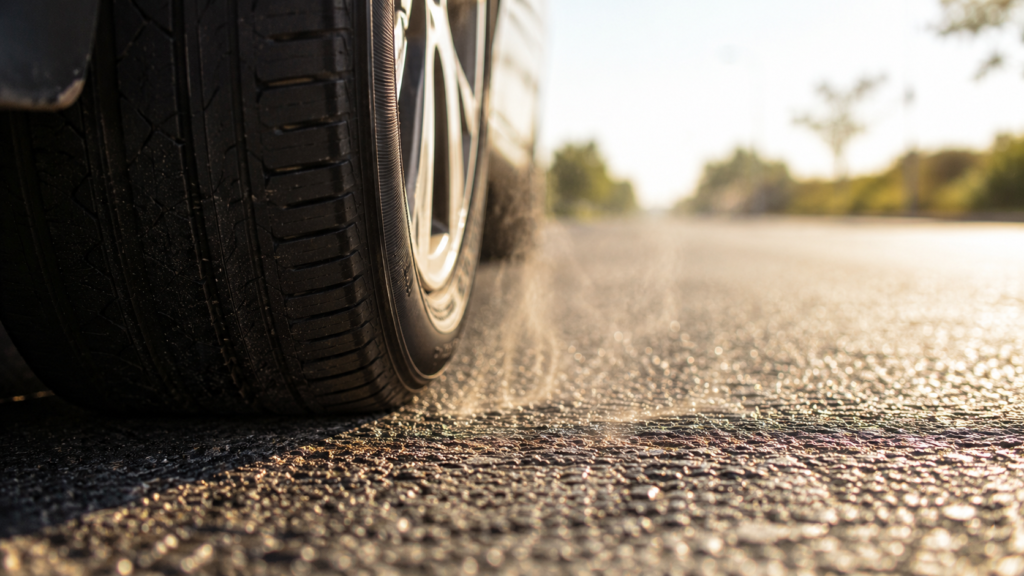
By July, the pavement on the 215 Beltway in Henderson is hot enough to soften the sole of a running shoe. Anyone who has grabbed a seatbelt buckle after it sat in a closed car knows the feeling. Tires deal with that same heat every single mile, and in the Mojave summer, that adds up to real risk. Tire failure is one of those problems that builds quietly for weeks before it shows up all at once, usually on the highway, usually going fast.
Why Heat Is the Tire’s Real Enemy
Cold weather gets more attention because it shows up as a dashboard warning light. Heat is sneakier. A tire is a sealed pocket of air wrapped in rubber and steel belting, and as that rubber flexes thousands of times per mile, friction generates heat inside the tire itself. On a mild day, that heat dissipates fine. On a 108-degree afternoon with asphalt running 140 to 160 degrees at the surface, the tire is already starting hot and has far less room to absorb more before the internal structure starts to weaken.
Underinflation makes this worse in a way that is not obvious just by looking. A tire that is 5 to 10 psi low flexes more with every rotation, which means more friction, which means more heat, which means the rubber compound and steel belts start to degrade faster than they were designed to. Add sustained highway speed, a car packed for a Lake Mead weekend, and 40 minutes on I-11 with the AC blasting, and the conditions line up for tread separation or a full blowout.
The Pressure Math Nobody Checks in Summer
Here is the part that trips people up: tires that were perfectly inflated in April are not necessarily fine in July. Air pressure rises and falls with temperature, roughly 1 psi for every 10-degree swing. A tire set to the automaker’s recommended pressure on a 65-degree spring morning will read differently once ambient temperatures in Henderson start hitting the triple digits by mid-morning.
That cuts both ways. Some drivers end up slightly overinflated, which is usually the smaller problem. Far more end up underinflated because they set their pressure once at the start of the season and never checked again, not realizing that tires also lose about 1 psi per month naturally through the rubber itself. Combine seasonal loss with the temperature swing and a tire that read 34 psi in March might be sitting at 28 or 29 by July, right in the danger zone.
The fix takes five minutes: check pressure with a gauge while the tires are cold, ideally first thing in the morning before driving, and compare it to the number on the placard inside the driver’s door, not the number printed on the tire’s sidewall. Those are two different figures, and mixing them up is one of the more common mistakes drivers make.
Why Henderson’s Heat Is a Particular Problem
Air temperature only tells part of the story. Direct sun on black asphalt regularly pushes surface temperatures 40 to 60 degrees above the air reading, which means a 104-degree day in Green Valley or along Boulder Highway can mean pavement closer to 150 degrees by early afternoon. Tires sitting in a parking lot for hours absorb that heat before a driver even starts the engine, so the tire is already stressed before it covers a single mile.
Henderson’s mix of long, straight commuter roads and frequent highway stretches toward Las Vegas or out to Lake Mead adds another layer. Sustained speed generates more continuous heat buildup than stop-and-go city driving, which is exactly the kind of driving most local commutes involve for at least part of the trip. A tire that could handle an afternoon of errands around Water Street might be pushed past a safe margin on a 90-minute freeway haul in August.
Warning Signs Worth Taking Seriously
A handful of signs tend to show up before a tire actually fails, and they are easy to miss if nobody is looking for them.
-
A tire that looks slightly bulged or bubbled on the sidewall. This usually means the internal structure has already separated in that spot.
-
Vibration at highway speed that was not there before. Often points to uneven wear or an internal belt starting to shift.
-
A tread depth under 4/32 of an inch, checked with a gauge or the reverse-quarter trick. Worn tread generates more heat because there is less rubber to absorb it.
-
A TPMS warning light, which by federal design triggers once pressure drops about 25 percent below the recommended level, meaning the tire has already been running underinflated for a while by the time the light comes on.
None of these guarantee an imminent blowout, but any one of them is a reason to get the tire looked at before a long drive, not after.
Getting Ready Before a Summer Trip
A lot of tire failures happen on trips, not commutes, because a loaded car covers more highway miles at once and often carries more weight than usual. Before heading out to Zion, the Grand Canyon, or even just across the valley for a weekend, it is worth spending ten minutes on a few basics: check pressure cold, inspect tread depth on all four tires (including the spare, which almost nobody checks), and look at the manufacture date stamped on the sidewall. Tires older than six years are more prone to heat-related failure even if the tread still looks fine, since the rubber compound itself degrades over time regardless of mileage.
This is also the situation where people renting or borrowing a vehicle for a short desert trip should think about coverage, not just tires. Someone driving a friend’s car to Lake Mead for the weekend, or picking up a rental for a few days, may not be covered under a standard policy, which is where short term car insurance is worth looking into rather than assuming existing coverage carries over.
What This Means for Everyday Drivers
None of this requires new tires every summer or constant worry. It mostly requires paying attention to two numbers, pressure and tread, at a point in the year when most people are not thinking about either one. A five-minute check at a gas station air pump costs nothing and catches the majority of heat-related tire problems before they turn into a roadside emergency on a stretch of highway with no shade for miles.
There is also a financial angle worth keeping in mind. Tire-related crashes and the claims that follow them affect everyone’s rates over time, not just the driver involved, which is one more reason routine maintenance like this matters. Drivers comparing policies and looking for affordable auto insurance in Nevada often focus on discounts and deductibles, but a clean driving and maintenance record does just as much heavy lifting when it comes to keeping premiums reasonable.
The National Highway Traffic Safety Administration keeps updated guidance on tire safety ratings and seasonal maintenance for anyone who wants a deeper dive, including how to read the temperature resistance grade stamped on a tire’s sidewall. It is a five-minute read that pairs well with the five-minute pressure check most Henderson drivers could stand to do more often, especially once the thermometer starts climbing toward triple digits and stays there.
More Stories
Envalior on new thermoplastic formulations to meet HV heat challenges
Schaeffler and Sonatus partnership brings Edge AI to motion control for software-defined vehicles
How Marelli is supporting the transition from ICE to electric powertrains