
















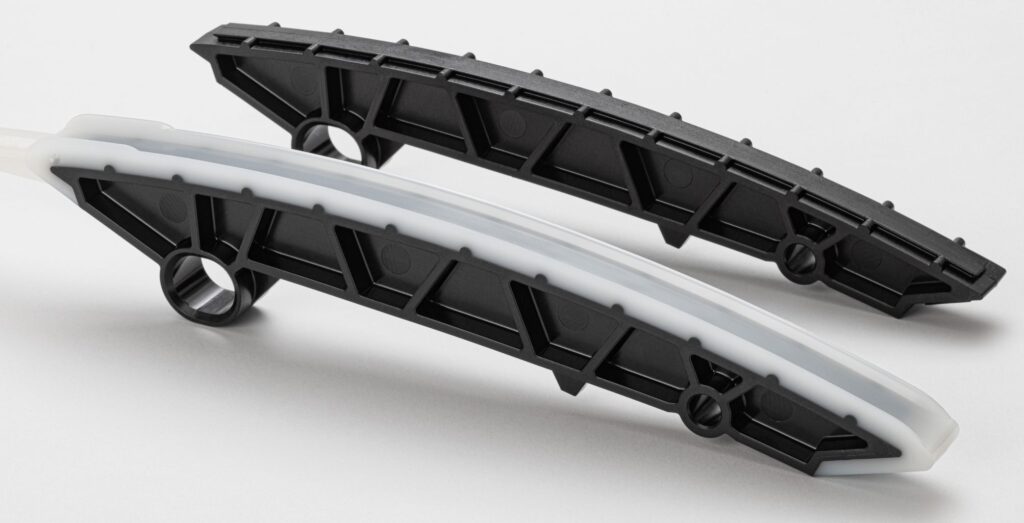
A recycled PA6 compound was created from the polyamide fraction obtained by solvent-based recycling, validate d on a near-series chain guide rail (production: Pöppelmann) for Mercedes-Benz. Photo: BASF.
Electric mobility advances are redefining performance expectations for battery materials. Battery cell components are exposed to increasingly severe electrical, thermal and mechanical stresses as electric vehicle (EV) platforms move from 400‑volt to 800‑volt architectures, and with solid-state battery technology coming to the fore.
These demands are pushing conventional insulation materials to their limits and accelerating the adoption of new coating technologies.
Automotive Industries (AI) asked Anka Bernnat, Segment Manager Transportation, Auto E&E and eMobility, Marketing Engineering Plastics at BASF, how the company’s advanced materials are helping OEMs meet more stringent performance standards for electric motors.

Bernnat: In the Engineering Plastics Division, we are seeing strong demand for specialised flame-retardant grades, and we have expanded our portfolio accordingly.
For example, BASF has complemented its polyphthalamide (PPA) portfolio with Ultramid® Advanced N3U42G6, a polyamide 9T with a non-halogenated flame retardant that helps minimise electro-corrosion of metal contacts in electric and electronic (E&E) parts.
This flame-retardant PPA improves the safety and durability of high-voltage (HV) connectors used in inverters, DC-DC converters and electric vehicle batteries.
With high strength and stiffness across a broad temperature range, as well as strong chemical resistance and dimensional stability, the Ultramid® Advanced N grade supports more robust, reliable thin-walled HV connectors for halide-free E&E components used in warm, humid conditions.
PPA’s excellent dimensional stability helps connectors meet the tight dimensional requirements of battery systems.
AI: What e-Drive system material solutions do you offer for high-voltage power electronics, coolant systems, lightweight & NVH solutions, and eMotor cooling system?
Bernnat: For NVH applications, BASF offers polyamide structures supported by Ultrasim® simulation, helping engineers design components that effectively damp vibration.
Ultrasim® is a versatile computer-aided engineering (CAE) platform that predicts the behaviour, manufacturing process and performance of BASF plastics before physical prototypes are produced.
It enables engineers to create digital twins of components, optimising material selection and part design early in development.
These materials also support lightweighting, as simulation helps optimise designs and reduce weight.
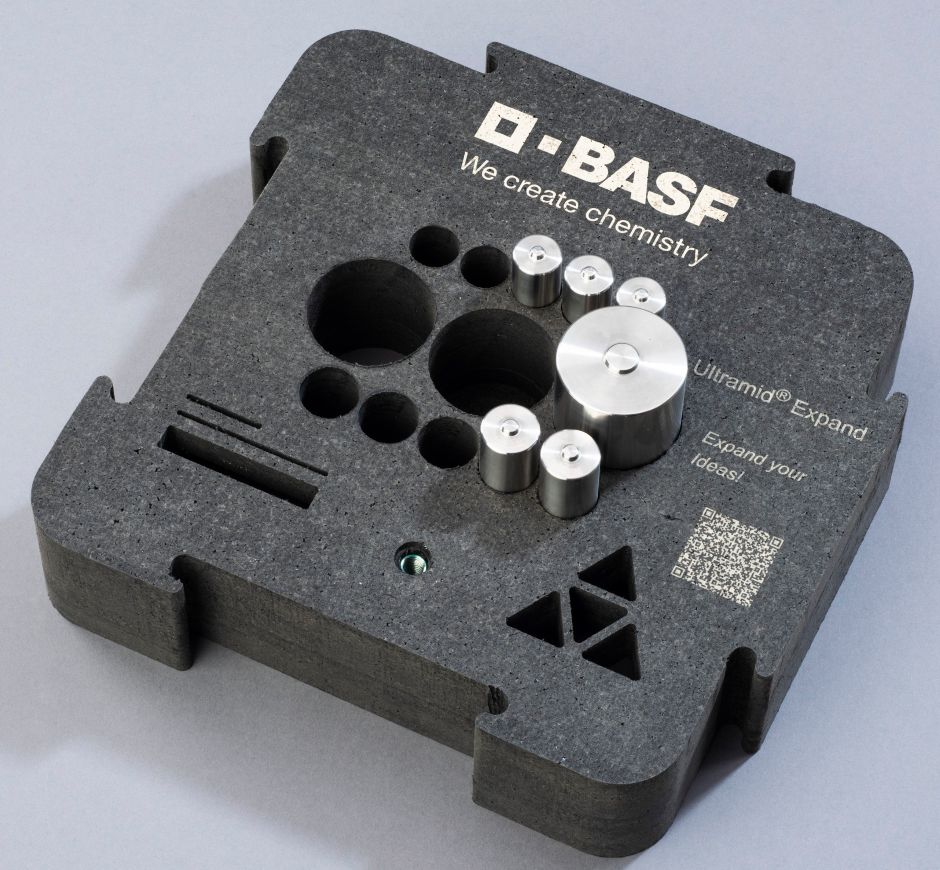
For crash-resistance optimisation, we also offer Ultramid® Expand, an expanded polyamide foam with high energy absorption.
Designed for lightweight structural and energy-management components, this polyamide-6-based particle foam has gained traction in the automotive sector for its crash resistance, high-temperature tolerance and isotropic mechanical properties.
We offer specialised GLYSANTIN® grades designed for battery cooling, a key factor in reliable eMobility.
GLYSANTIN® G22® ELECTRIFIED® is BASF’s first premium battery coolant developed specifically for indirectly cooled BEV. The ready-to-use coolant delivers low electrical conductivity and maintains low and stable currents when exposed to a voltage source.
This translates into low fluid decomposition and low generation of hydrogen, making it a safety-optimized product, while ensuring optimal corrosion protection. Selected products can also be developed as ECO ELECTRIFIED® solutions, offering a low product carbon footprint (PCF) derived via the biomass balance approach, or by providing enhanced sustainability profiles via circular economy solutions.
AI: Can efficient flame-retardant materials be tailored for performance with sustainability in mind?
Bernnat: Yes. We are working extensively on flame retardants without added PFAS (per- and polyfluoroalkyl substances) for our PBT (polybutylene terephthalate) portfolio, which supports improved sustainability.
We also plan to launch a related product line.
To enable more tailored solutions, we are expanding the range of glass-fibre contents available, giving customers a choice between lower and higher reinforcement levels.
AI: What are the key challenges presented by the conflict of objectives of safety and sustainability?
Bernnat: Sustainability is often achieved through long product life. A durable vehicle is more sustainable, and long-term reliability strengthens that sustainability benefit. Long-term cooling performance is one example.
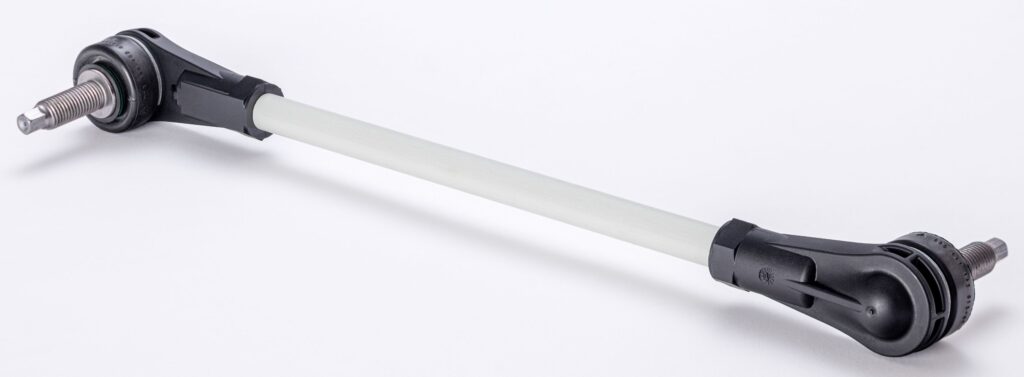
For all applications with high safety requirements, mass balance approaches can offer strong sustainability benefits, because mechanically recycled grades can only be used toa limited extent, especially in flame-retardant applications.
BASF’s mass balance approach is a certified chain-of-custody model that tracks the amount of sustainable or recycled raw materials fed into their manufacturing network and mathematically attributes them to final products.
On the safety and sustainability topic, we have solutions in place with Pöppelmann, ZF and Mercedes-Benz.
The three companies are collaborating on pioneering projects to close the circular economy loop for polyamides (nylons) in the automotive industry. We have successfully tested and demonstrated the viability of transforming complex automotive shredder residue and scrap components back into new, high-performance parts.
These recycling projects, solvent-based or by depolymerization, are important because they involve applications with demanding performance and durability requirements.
AI: What is next for BASF in the eMobility space?
Bernnat: We see automotive design trends moving toward more centralised control-unit architectures, as well as steer-by-wire and brake-by-wire systems.
We are partnering with customers to develop systems that can bring these innovative solutions to market quickly.
More Stories
A Complement to Machine Learning—Not a Replacement
Explainable Knowledge-Based AI Could Unlock the Next Era of Autonomous Driving by Transforming Compliance, Transparency and Global Regulatory Approval
SwRI, SMU collaborate to advance solid-state batteries