
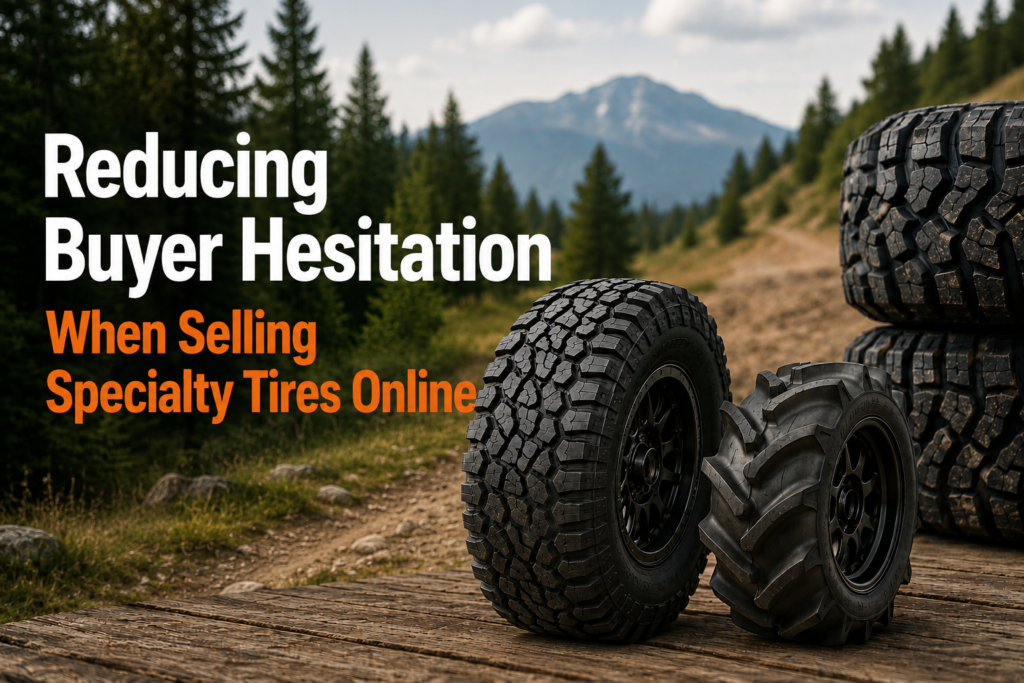
Selling specialty tires online is a different proposition to selling commodity products. The customer arriving at your site has a specific vehicle, a specific problem, and very little patience for ambiguity. But the challenge isn’t purely a website problem. The retailers who consistently convert hesitant browsers into confident buyers have got the whole business right, from inventory decisions to the person who picks up the phone. Here is how to think about it.
Stock with Intent
Specialty tire retail has a tendency to sprawl. The logic seems sound: more SKUs means more customers served. In practice, a wide but shallow inventory creates its own problems, such as:
-
Stock ties up capital in slow-moving lines.
-
Customers sense when a catalog has been assembled opportunistically rather than with genuine expertise.
-
The operational complexity of managing hundreds of marginal products eats into the margins that a tighter range would protect.
The retailers who perform best in specialty categories tend to know their inventory deeply rather than broadly. They understand which sizes move in which seasons, which applications drive repeat purchases, and where the genuine gaps in the market are. That knowledge informs buying decisions, reduces dead stock, and makes the rest of the business, from content to customer support, considerably easier to run well.
Own a Niche Rather Than Chasing Everything
The online automotive parts space is competitive in a way that rewards specialization. A retailer trying to serve every segment – commercial, agricultural, recreational – is competing with everyone and differentiating against no one. A retailer that goes deep on one category becomes the default destination for that category, and default destinations are very hard to displace.
The niche play works across specialty tire segments. Think of retailers who have built their entire operation around one application: ATV tires, forklift tires, or golf cart tires. These businesses aren’t competing on breadth. They’re competing on authority, and authority is something a general retailer cannot easily replicate. When a customer searches for something specific and lands on a site that is clearly built around exactly that thing, the trust is immediate. The conversion follows.
Owning a niche also has compounding benefits. Search visibility improves when a site’s entire content and catalog aligns around a category. Supplier relationships deepen when volumes concentrate. Customer expertise accumulates. The longer a retailer commits to a niche, the harder it becomes for a generalist to take that ground away.
Make Your Products Understood
Specialty tire buyers cannot rely on prior experience the way a regular car owner might when replacing standard tires. Many are navigating an unfamiliar category, unsure of the right spec, uncertain whether a particular product suits their specific application. A product listing that does nothing more than present a size code and a price does not close that gap.
The retailers who convert these buyers tend to invest in hyper-granular explanations. Detailed product descriptions written in plain language rather than pure technical shorthand. Application guidance that tells the customer not just what the tire is, but what it is for and how to get the best out of it. Video content that walks through the product in a way a static image cannot. This kind of content does the work that a knowledgeable showroom salesperson would otherwise do, and it does it at scale, for every visitor, at every hour.
The investment doesn’t need to be elaborate. A well-lit product video with a presenter who knows the inventory, covering the questions a first-time buyer would actually ask, is enough to move a hesitant visitor significantly closer to a purchase.
Price for the Specialist Market
Competing on price in the automotive parts space is a viable strategy for commodity products and a damaging one for specialty retailers. A customer shopping for standard passenger tires has endless options and will find the cheapest. On the other hand, someone shopping for a specific specialty tire is already in a narrower market and is typically more concerned with getting it right than getting it cheap.
That distinction matters for how specialty retailers position and communicate pricing. The question is not how to match the lowest available price but how to make the value of buying from a specialist self-evident.
That means making expertise visible throughout the site, making support accessible, and making the purchase feel lower-risk through clear policies and guarantees. A customer who trusts that they are buying the right product from people who know the category will pay a fair price without significant resistance. Chasing the price-sensitive buyer in a specialty category is usually a distraction from the more profitable customer who is already there.
Invest in Sales Team Knowledge
A well-built website can take a specialty tire buyer a long way toward a purchase decision. It cannot always close it. Pre-sale questions in specialty categories are often genuinely technical: fitment queries that depend on vehicle specifics, load rating questions tied to operational requirements, compatibility concerns that require real product knowledge to answer confidently.
When those questions reach a support team that doesn’t know the inventory, the damage is disproportionate. A customer who has been reassured by good product content online and then encounters an unhelpful support interaction doesn’t just fail to convert. They leave with a negative impression that cancels out the work the website did. The support team is not a backstop. In specialty retail, it is a core part of the sales process, and it needs to be resourced and trained accordingly.
Practical steps include structured onboarding that covers the full catalog, regular product briefings when new lines arrive, and clear escalation paths for queries that require manufacturer input. The goal is a support team that can answer the questions the website raises, not one that refers customers back to the product page.
Turn First-Time Buyers Into Long-Term Customers
Specialty tire replacement follows patterns. A customer who buys tires for a golf cart, a piece of agricultural equipment, or an industrial vehicle will need to replace them again. The question is whether they come back to the same retailer or start the search from scratch.
The retailers who win repeat business treat the post-purchase period as the beginning of the next sale. That means order confirmations that include useful guidance on fitting and maintenance. Follow-up communication at intervals that reflect realistic replacement cycles. Easy access to purchase history so a returning customer doesn’t need to remember what they bought. And a support experience that remains available after the transaction, not just before it.
After-sales support in specialty tire retail is also a differentiator in a way that it rarely is in commodity categories. A customer who calls with a fitting question after delivery and gets a knowledgeable, helpful response has just been given a reason to come back that no competitor can easily undercut.
The Bottom Line
Specialty tire retail rewards businesses that take the whole operation seriously, not just the storefront. The website matters, but it sits on top of inventory decisions, pricing strategy, team knowledge, and customer relationships that either support it or undermine it. Get those foundations right, and buyer hesitation becomes much easier to address. Leave them unattended, and even the best-designed product page will only get you so far.

More Stories
Roboteon’s Raj Senguttuvan on AI Orchestration, Digital Twins and the Future of Intelligent Factory Automation
It’s the “Return of the King” as Shelby American Reintroduces F-150 Super Snake Sport Two Door Truck with 810+ Horsepower
Pulse of Quality in Manufacturing Survey Reveals Impact of Geopolitical Tension, Recalls, Trade Tariffs on Automotive Sector