
















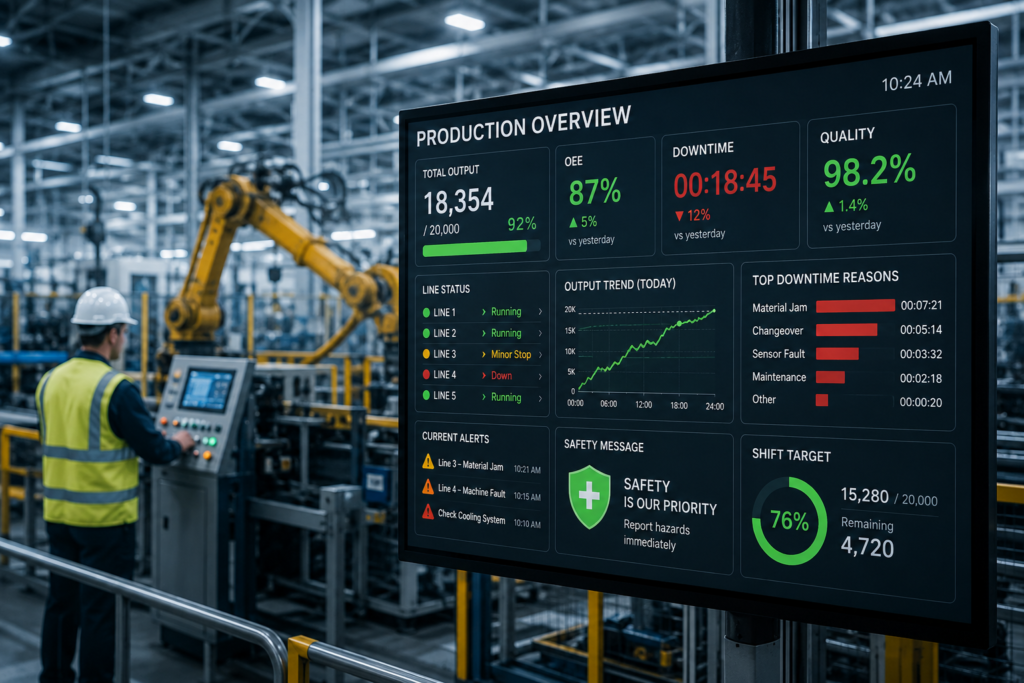
Production environments move quickly. One machine stops, another line slows, maintenance teams get pulled across multiple areas, and supervisors start chasing updates. Delays build from small communication gaps rather than major equipment failures. With the integration of Industry 4.0 practices, modern PLC systems can now feed live operational data directly into plant-wide displays, giving teams faster visibility across production environments.
Instead of relying on operators to relay information manually, live production data appears instantly across the facility. Machine status, downtime alerts, output figures, maintenance warnings, and safety notices become visible at the exact moment they matter. Teams react sooner. Escalation becomes simpler. Operators spend less time searching for information and more time solving problems.
Modern manufacturing sites already collect huge volumes of operational data. Yet many still struggle to present that information clearly to people on the floor. Digital displays help to bridge that gap.
Live Machine Data Without Delays
PLCs already control critical equipment throughout industrial environments. Conveyor systems, robotic cells, packaging lines, filling stations, and material-handling systems all generate continuous operational feedback.
Connecting those systems to plant-wide displays gives supervisors and operators immediate visibility into changing production conditions. A line supervisor walking through a facility can immediately spot:
-
Equipment faults
-
Idle machines
-
Output reductions
-
Quality warnings
-
Changeover status
-
Maintenance requests
-
Energy spikes
That visibility matters because downtime rarely begins as a catastrophic event. More often, performance drops gradually. Minor stoppages accumulate. Operators wait for support. Bottlenecks move between stations.
Large production displays expose those problems before they spread across an entire process.
In high-volume packaging plants, for example, real-time dashboards frequently show that reject rates are climbing before operators physically notice the issues. Engineering teams can then intervene early rather than after pallets of unusable product leave the line.
Downtime Becomes Easier to Control
Many facilities still rely on verbal updates during production interruptions. Operators contact supervisors. Supervisors contact maintenance. Engineers then diagnose issues manually while management waits for status reports.
That sequence creates unnecessary lag. PLC-driven signage removes several layers from the process. When a machine fault occurs, digital displays can automatically trigger:
-
Escalation messages
-
Visual Andon alerts
-
Maintenance requests
-
Timer countdowns
-
Production impact calculations
-
Safety notifications
Some sites place large status boards above each line. Others install central dashboards visible across entire halls. Both approaches reduce response times because every department sees the same information simultaneously.
Food manufacturing sites often use this model effectively. If a filler unit stops unexpectedly, displays can show fault location, downtime duration, expected throughput loss, and maintenance status within seconds. Operators no longer need to leave their stations to search for updates.
Production Metrics Stay Visible All Shift
Printed reports rarely influence live production performance. By the time teams review them, conditions have already changed.
Digital signage keeps operational targets visible throughout the day.
Facilities commonly display:
-
OEE figures
-
Shift output
-
Scrap percentages
-
Planned versus actual production
-
Downtime rankings
-
Labour efficiency
-
Changeover progress
-
Order completion status
Constant visibility creates accountability without adding administrative pressure. Operators can immediately see whether a line falls behind schedule. Team leaders identify struggling areas sooner. Maintenance departments gain clearer evidence around recurring equipment problems.
Electronics assembly plants frequently use overhead displays to track takt time alongside unit output. If production pace drops below target, supervisors can react before delays affect shipping schedules.
Automotive assembly facilities also rely heavily on live production visibility across multiple manufacturing zones. Plant-wide displays can track takt time, robotic cell status, sequencing delays, and line stoppages in real time, helping supervisors respond before disruptions affect downstream operations.
Real-time reporting also improves shift handovers. Incoming teams see current production conditions immediately rather than relying on incomplete verbal updates.
Safety Messages Gain More Attention
Static noticeboards rarely hold attention for long. Important updates blend into background noise after repeated exposure.
Live production boards perform differently because content changes dynamically. When connected to automation systems, displays can present:
-
Emergency stop activations
-
Restricted area warnings
-
Forklift movement alerts
-
Lockout status
-
Temperature alarms
-
Air quality warnings
-
Evacuation instructions
Facilities handling hazardous materials often integrate environmental monitoring systems directly into production displays. If sensor readings move outside acceptable ranges, warning messages appear automatically across relevant areas.
Some manufacturing plants also combine safety alerts with operational messaging. Production targets, maintenance schedules, and hazard notifications rotate throughout the shift, keeping screens relevant instead of becoming ignored background fixtures.
Operators Spend Less Time Chasing Updates
Poor communication creates hidden inefficiencies across industrial sites. Operators leave stations searching for supervisors. Maintenance technicians travel to faults without preparation. Production planners wait for confirmation before adjusting schedules. Digital signage cuts much of that wasted movement.
In warehouse automation environments, for example, teams often use large displays to show conveyor conditions, dispatch priorities, and sorter performance. Staff can immediately identify pressure points without relying on constant radio communication.
Facilities using AGVs or autonomous transport systems also benefit from live visual tracking. Displaying route congestion or inactive vehicles helps teams reroute activity before delays spread into packing or shipping operations.
SCADA and Signage Work Together
Some facilities assume SCADA platforms already provide enough visibility. In practice, SCADA and digital signage serve different purposes.
SCADA systems focus on operational control and engineering oversight. Digital signage focuses on communication across broader teams.
Engineers may work from detailed SCADA interfaces showing alarms, diagnostics, and process values. Production staff usually need simplified information presented clearly from a distance.
A maintenance technician troubleshooting a PLC fault requires technical data. An operator across the hall only needs to know whether production has stopped, restarted, or moved into reduced-speed operation.
Facilities running both systems together often achieve stronger coordination because information reaches the correct audience in the appropriate format.
Data Accuracy Improves Decision Making
Manual reporting introduces delays and inconsistencies. Whiteboards become outdated. Spreadsheet entries arrive late. Shift summaries miss short-duration stoppages. Direct PLC integration substantially reduces those problems.
Production displays pull information directly from live systems using industrial communication protocols such as:
-
OPC UA
-
Modbus TCP
-
MQTT
-
Ethernet/IP
Chemical processing plants commonly use this structure to display tank levels, process conditions, and alarm states across multiple control areas. Teams receive identical information throughout the facility, reducing conflicting reports between departments.
Display Placement Shapes Performance
Screen placement affects effectiveness more than many facilities expect.
Displays hidden in supervisors’ offices rarely improve communication on the floor. Oversized dashboards filled with dense information become difficult to interpret quickly.
Successful installations usually prioritise:
-
High visibility
-
Simple layouts
-
Minimal text
-
Clear colour hierarchy
-
Distance readability
Some facilities divide displays by operational purpose. One screen may track downtime events, while another may focus on output targets or safety alerts.
Packaging operations often position Andon-style displays directly above machinery, so fault conditions remain visible across large production areas. Central performance boards then provide broader plant-level summaries for supervisors and management teams.
Stronger Visibility Supports Better Output
Production environments already contain the data needed to improve performance. The challenge often lies in presenting that information clearly and quickly enough for teams to act on it.
Connecting PLC systems to digital signage solves a practical communication problem inside industrial facilities.
Operators gain immediate visibility. Maintenance teams respond faster. Supervisors identify bottlenecks sooner. Downtime becomes easier to manage before losses escalate across production.
Most importantly, information reaches people at the moment action still matters.
To keep up with all automotive industry news and stories, try out our subscription and unlock our vast backlog of content.
More Stories
Record-breaking Attendance of Over 350,000 Visitors CHINAPLAS 2026 Successfully Concluded
Cummins vs. Powerstroke vs. Duramax: Which Diesel Platform Has the Best Performance Build Potential?
Innoviz Advances Embedded Perception with Next-Generation LiDAR Platforms for Level 4 Autonomy