
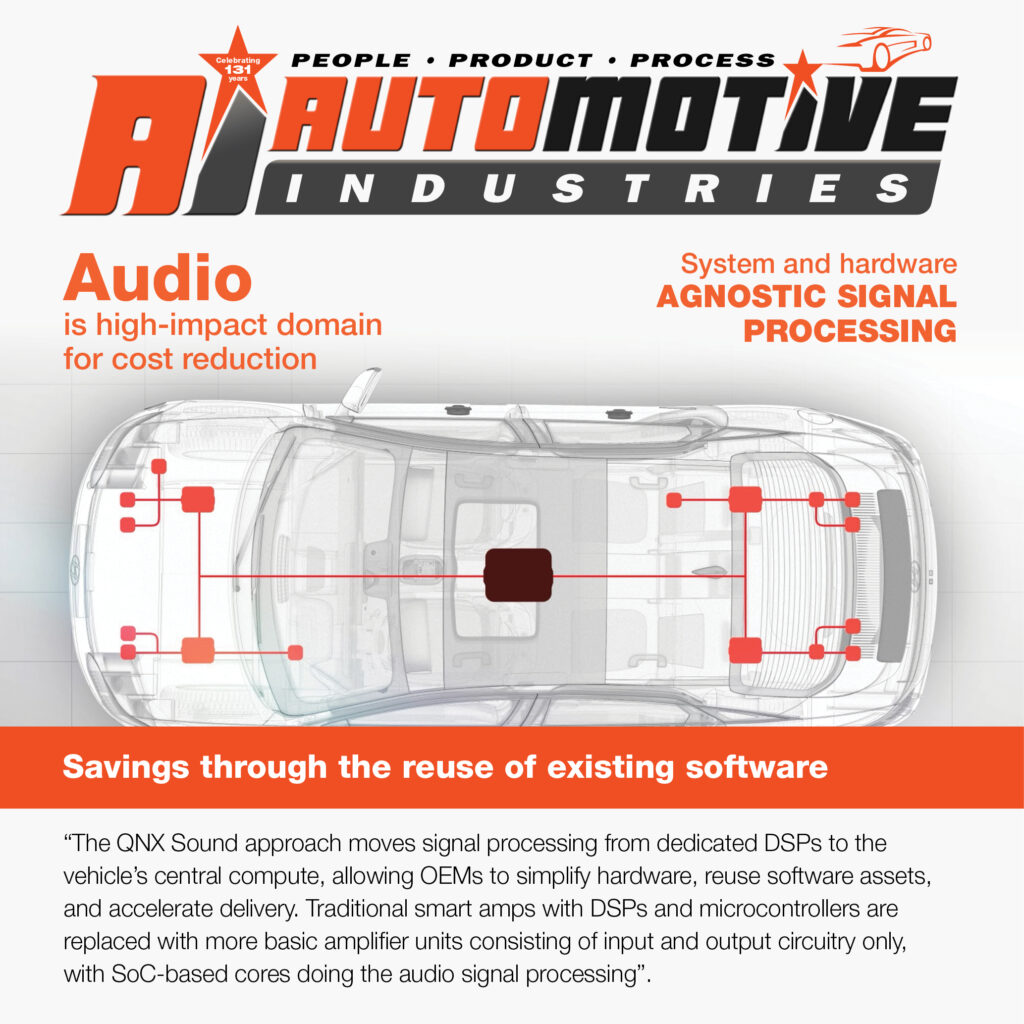
OEMs are potentially foregoing the competitive edge that next generation audio systems provide due to the significant costs built into the traditional development of infotainment and audio software and hardware.
A 2025 study by Munro and Associates has found that development of a new infotainment software “stack,” including all the foundational operating system software, middleware, and applications layers, can cost an OEM between $50-$100 million dollars.
The audio portion of that software stack can cost between $6M and $12M, and needs to be re-written to support various implementations across an OEM’s vehicle lineup.
These costs can be significantly reduced.
The Munro research identified audio emerging as a high-impact domain for cost reduction, portfolio scalability, and customer-experience differentiation as the software-defined vehicle (SDV) becomes the main architecture driving next-generation automotive programs.
To support this transition, QNX, a division of BlackBerry, has developed QNX Sound as an alternative to traditional digital signal processor (DSP) amplifier-based architectures.
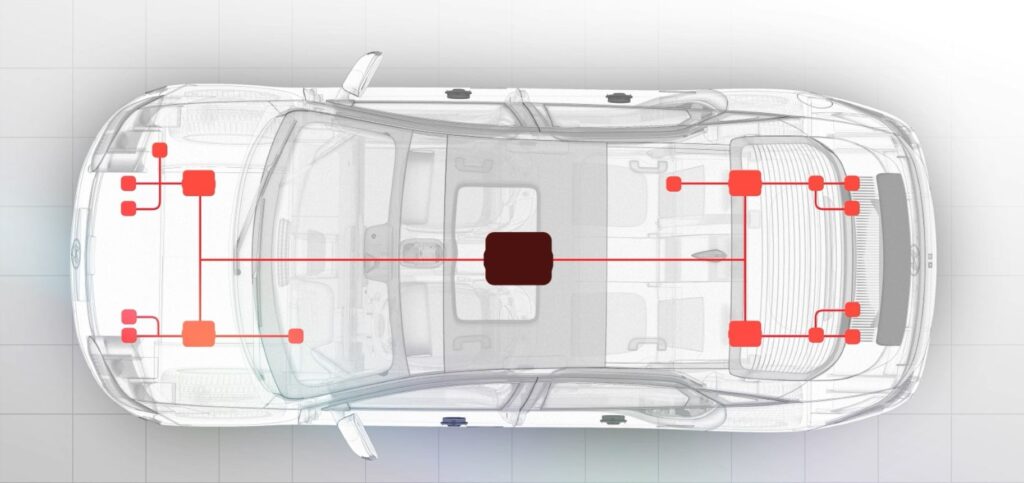
The QNX Sound approach, an example of what the industry refers to as “Software-defined Audio” moves signal processing from dedicated DSPs in smart amplifiers to the vehicle’s central compute, allowing OEMs to simplify hardware, reuse software assets, and accelerate delivery.
This supports migration in the automotive industry away from electrical architectures using large numbers of single-purpose control units. Modern in-vehicle architectures focus on fewer, more sophisticated controllers capable of managing multiple functions, the research found.
These controllers, referred to as “zone” controllers based on physical location, “domain” controllers based on the types of functions they control, or “centralized processors” that manage an even higher level of functionality, underpin the architectures of many modern production and future production vehicles.
Despite the potential for cost savings and greater flexibility, QNX has found some OEMs hesitant about making the switch due to concerns about the costs of additional SoC (system on chip) cores, licensing fees, and resources required for new code development.
QNX Sound helps reduce the costs and time taken to tune in to the benefits of software-defined audio through a ”build once and re-use” methodology and agnosticism across audio brands, SoC vendors, and vehicle architectures.
The SoC-agnostic, cloud-simulatable QNX Sound platform integrates with QNX OS (operating system) and Hypervisor to streamline development and lower bill-of-materials (BOM) costs.
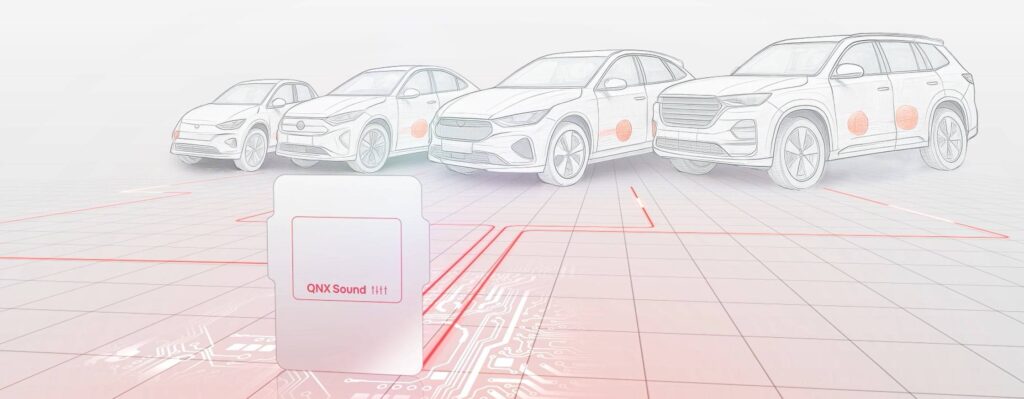
It supports the OEM trend of bringing software development in-house, for better control over their products and long-term cost efficiencies.
Because QNX Sound utilizes industry standard VirtIO interfaces to move signals and data between the various layers of the software stack and can be used both in the ARM cores as well as the DSP cores of the SoC, the software is not locked to a vendor-specific DSP, and is portable across different SoC generations and SoC manufacturers.
This makes it highly likely that an OEM, once invested in developing an SDA software stack built on QNX Sound, will be able to leverage that investment across multiple vehicle trim levels, vehicle types, branded audio suppliers, and vehicle platforms. This level of scalability represents significant potential savings in terms of software development cost, complexity, and time to market.
The SDV reshapes in-vehicle audio
Most OEM designers are transitioning from a patchwork of single-purpose ECUs to zonal, domain, and centralized controllers with heavier-weight compute and virtualization. This consolidation reduces wiring, mass, and module count, while enabling software portability across programs and trims.
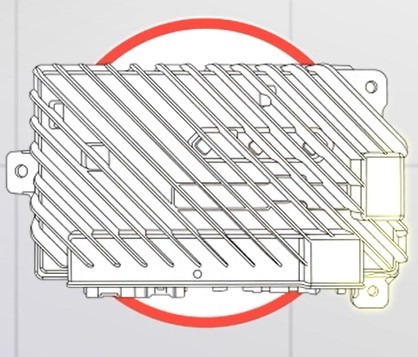
Audio, traditionally isolated inside branded amplifiers with their own DSPs and microcontrollers, is a prime beneficiary: when the main SoC already includes robust ARM and DSP cores, allowing audio processing to move into central compute. This shrinks hardware footprints and unifies software toolchains.
Analysis of five OEM amplifier models found that traditional smart amps with DSPs and microcontrollers can be replaced with more basic amplifier units consisting of input and output circuitry only, with SoC-based cores doing the audio signal processing.
Cost savings ranged from $21.91 to $98.49 a unit, with up to 62% savings in premium systems. PCB layer reductions from six to four layers and area reductions exceeding 14,000 mm² were observed.
In addition to cost savings, the analysis identified potential printed circuit board surface area reductions of up to 44% and weight savings of up to 28%, enabling smaller and lighter amplifiers to be used.
Over 600 individual parts can be removed in premium systems by eliminating redundant DSPs and microcontrollers, with potential associated improvements in failure rates and warranty claims.
The economics of software reuse
If hardware savings are the first dividend for OEMs who elect to use QNX Sound, software reuse is the annuity.
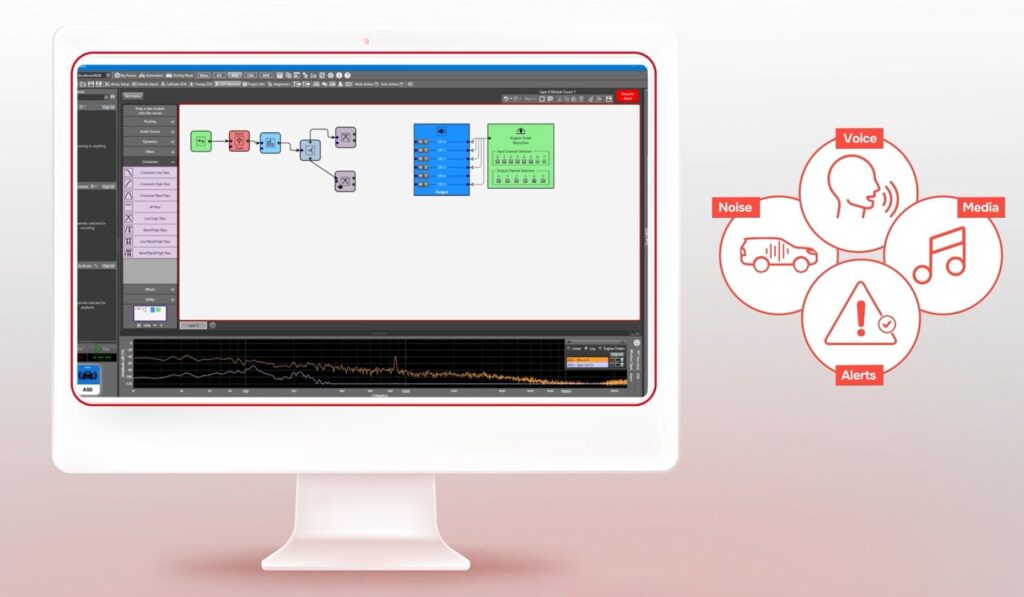
QNX Sound is SoC, DSP, head unit, architecture, and vehicle segment agnostic. This flexibility allows OEMs to reuse software assets across product lines, reducing integration complexity and lifecycle costs.
Virtualization across ARM cores enables early simulation of audio subsystems in the cloud without board support packages (BSPs) or custom Linux/Android builds. QNX Sound supports multi-rate processing and emerging protocols like A2B, AVB/TSN and INICnet.
Portability across SoC generations and suppliers enables OEM investors in SDA on QNX Sound to leverage the assets across trims, platforms, and branded audio options without rewriting from scratch.
Pre-integration with QNX OS and Hypervisor further reduces friction, allowing engineering teams to concentrate on differentiating features instead of stitching together foundational layers.
Cloud-first audio development with LiveAMP
The ability to build sound system components virtually in the cloud allows not only the early development but the early testing of these different sound combinations, ensuring that all critical signals will be played, paused, emphasized or ducked appropriately to ensure a cohesive and safe driving experience for the driver and passengers.
With a QNX tool called LiveAMP, engineers assemble and tune audio pipelines in a graphical drag-and-drop environment, connect to multiple instances (cloud, PC, or target SoC) in real time, and validate AVB/TSN, and INICnet.
Automatic load balancing across multi-core ARM environments and tight Hypervisor integration means complex interactions – like routing priorities between voice assistants, chimes, and ADAS alerts – can be tested long before bench setups are complete.
Audio policy management in a multi-OS world
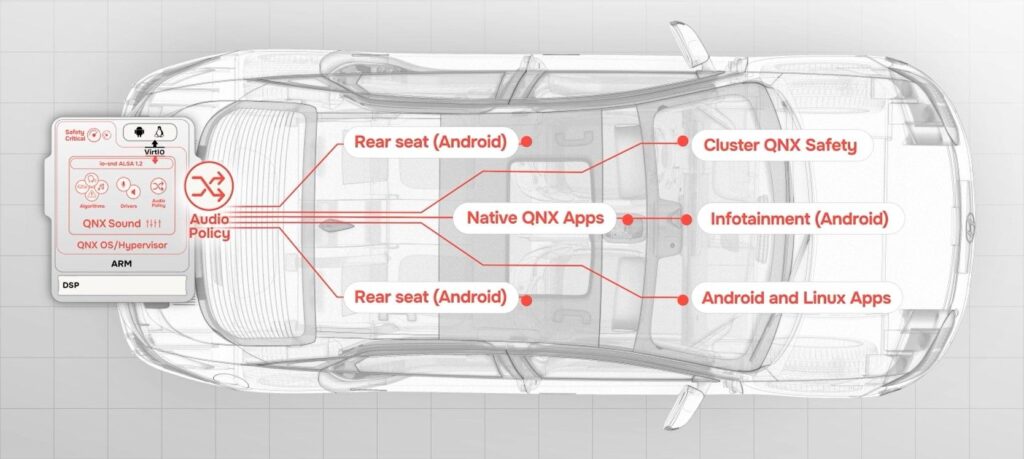
Increasingly, various sources of in-cabin sounds such as voice processing, propulsion sound synthesis and noise management are managed by different guest operating systems and require access to many different vehicle signals to function effectively.
An advantage of QNX Sound is its tight integration with the QNX Hypervisor. It is uniquely positioned to manage multiple sounds generated by multiple guest OS’s.
Given its central location in the SDV software stack, it is able to access the multiple vehicle signals required to successfully manage sounds related to the many different aspects of in-vehicle listening.
Aligning to OEM roadmaps and risk profiles
QNX Sound offers a transformative opportunity for OEMs seeking cost-effective, scalable, and future-proof audio solutions.
By leveraging software-defined audio, cloud simulation, and hypervisor-based virtualization, QNX Sound enables significant hardware cost savings, reduced development timelines and integration complexity, and the ability to create complete in-vehicle listening experiences with strategic flexibility across SoCs, DSPs, and vehicle platforms.
QNX’s strategy aligns with four key automotive megatrends:
- In-house software development by OEMs, with associated integration and schedule risk
- The shift to zonal E/E architectures, with opportunities for hardware savings via module consolidation
- Regaining control of customer experience, with a need to focus on differentiating features rather than underlying enablement software
- Safety-by-architecture design, particularly as ADAS alerts and other safety-critical sounds become part of the in-vehicle soundscape.
“In the SDV era, audio isn’t a component—it’s a software capability. QNX Sound lets OEMs build it once, test it in the cloud, and deploy it across platforms—cutting hardware costs and software development effort while elevating the experience.”
— A QNX thought leader
About QNX
QNX, a division of BlackBerry Limited, provides safe, secure operating systems, hypervisors, middleware, solutions, and tools trusted across industries and deployed in more than 255 million vehicles. Learn more at qnx.com.
More Stories
Schaeffler and Sonatus partnership brings Edge AI to motion control for software-defined vehicles
NASA on building the future before someone else does
Analog Devices Inc opens systems for collaboration to support automotive innovation