
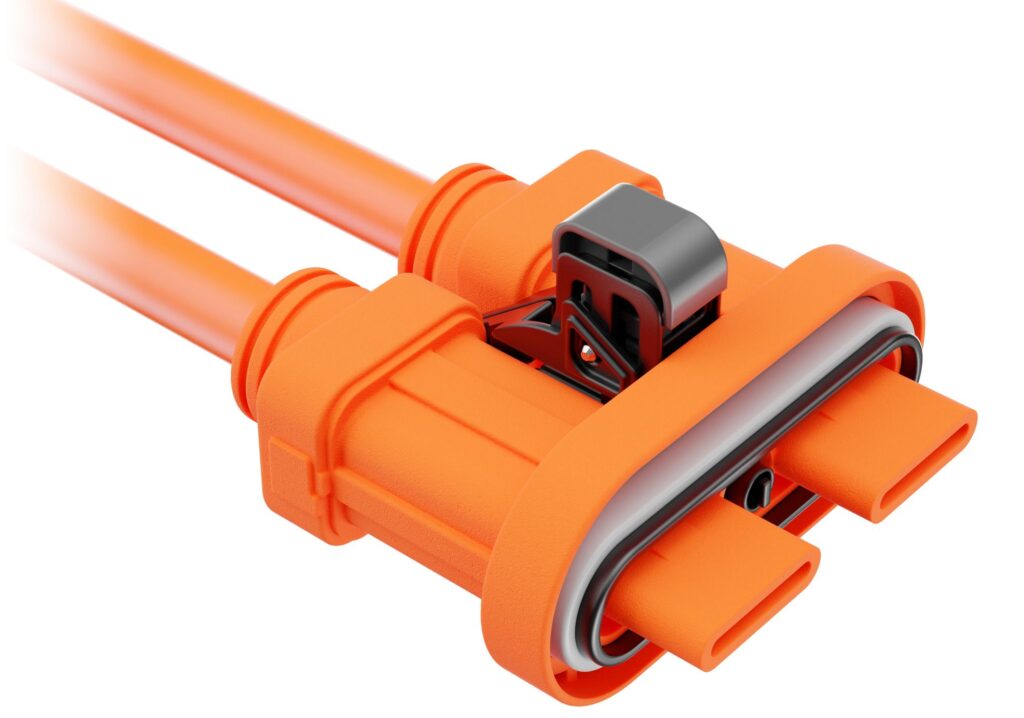
High-voltage BASF connectors can be provided in durable orange and with flame retardancy qualities.
With up to 75% of the energy produced by a vehicle powertrain being expended on moving mass, the industry is striving to develop new generations of lightweighting materials that are also recyclable.
According to BASF, the trend is moving towards foams which are lightweight, high-strength, resistant to excessive heat, offer greater design flexibility, and support circularity.
Automotive Industries (AI) spoke to Dr. Mark Staniford – BASF Strategic Marketing & Sustainability Manager PU Flex Foam Solutions, Patrick Hantschk – BASF Head of Business Development eMobility and OEM Account Management, and Patrick Frey, Segment Manager Transportation – Auto E&E and eMobility – Marketing Engineering Plastics. All are with BASF Performance Materials Europe.
AI: How can BASF next-generation battery demonstrator help customers enhance lightweighting, thermal management, safety, and performance?
Hantschk: Our next-generation battery demonstrator highlights how BASF’s performance material solutions can substantially enhance the functionality, safety and cost-competitiveness of high-voltage battery packs in battery electric vehicles (BEVs).
For lightweighting and performance, the demonstrator uses polyurethane based potting foam to fix cylindrical cells in a battery pack, combining low density with high mechanical strength.

To accommodate the industry shift from cell-to-module to cell-to-pack designs – which offer less structural support, BASF provides polyurethane-based materials such as Elastan® EV (thermal interface materials) and Elastolit® EV (potting systems).
These solutions deliver a broad range of mechanical properties to meet demanding cell-to-pack design requirements. Structural components made with Elastoflex® EV contribute to reducing the overall weight of the battery pack while ensuring structural integrity under demanding conditions.
In terms of thermal management, the demonstrator features Elastan® EV TIMs with thermal conductivity up to 2.1 W/m·K. These materials ensure efficient heat dissipation while offering mechanical strength, electrical insulation, and compatibility with large-scale production.
BASF also offers tailor-made formulations to strike the right balance between thermal, mechanical, and processing demands based on customer-specific requirements.
Safety is another key focus. Elastocoat® EV, a polyurethane-based fire protective coating, provides thermal shielding up to 1,200° C and resists solid particle impact during thermal runaway events. In a one-step application process using flat stream technology enhances productivity and allows use on complex 3D shapes, including overhead surfaces.
Additionally, the coating is free of silicone and monomers, offering a cost-effective alternative to traditional mica sheets.
AI: What new concepts and recycling methods for polyurethanes did you present at K 2025?
Staniford: BASF demonstrated recyclability of automotive plastics using a range of technologies. We showcased a range of innovative recycling approaches for polyurethanes, including glycolysis, attribution of ChemCycling® based on pyrolysis oil derived from end of life tyres, mechanical recycling, and gasification.

A breakthrough in polyurethane mechanical recycling – an industry first – was also presented. We are continuously exploring this route, internally and with partners.Chemical recycling is used where mechanical recycling is not suitable.
In addition, we are exploring the substitution of fossil-based raw materials with renewable alternatives feedstock to further support circularity. These technologies were presented through various application examples to demonstrate their real-world implementation potential.
While some of these methods are already commercially validated, others are still in the pilot phase, and we continue to evaluate their scalability and investment needs. A range of options is needed because the composition of future waste streams is still uncertain.
- Glycolysis: Demonstrated via the Liebherr pilot freezer and Hörmann garage doors, both using recycled polyol derived from waste
- ChemCycling® (Pyrolysis-based): Showcased with a VW T-Roc headliner, in which the Polyurethane fraction is made entirely from ChemCycling® feedstock
- Mechanical Recycling: Illustrated by steering wheels containing recycled content from post industrial waste
- Gasification: Steering Wheel as demonstrator for gasification pilot.
AI: How does BASF’s new PU flexible foam contribute to the circular economy, and can the foams be 100% recycled and used as a raw material for new foams?
Staniford: BASF’s meltable PU flexible foams are designed for full recyclability. They retain their mechanical properties across multiple recycling loops and can be reprocessed into new foams without compromising performance.
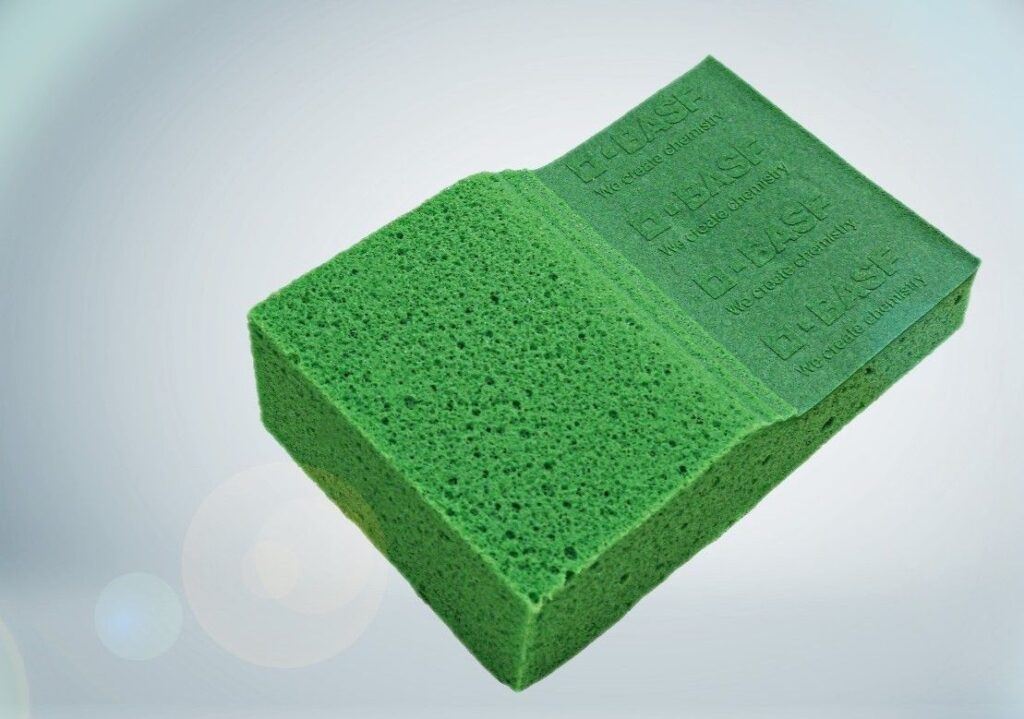
This enables a closed-loop system that significantly reduces waste and carbon footprint.To demonstrate the technical feasibility of this innovation, we showcase applications in both the furniture and automotive industries, while also evaluating asset investments to scale up production and support broader market adoption.
AI: What is the potential of recyclable PU foam in the automotive industry?
Staniford: Recyclable PU foams offer significant potential to support design-for-recycling strategies in the automotive sector.
On average, up to 25 kg of PU can be found in a car, in seats, doors, instrument panels and steering wheels. Currently, the components with the highest PU material weight in vehicles are seats and acoustic insulation parts. These are ideal candidates for replacement with our meltable foams.
By integrating recyclable PU foams into these applications, it adds potential to future sourcing of waste-based feedstocks, contributing to a more circular material flow.
Additionally, we see strong potential in reducing material complexity in components like dashboard panels, armrest door panels and acoustic systems, which is beneficial for recovery at end-of-life.
AI: How does BASF’s innovative PU technology enable waste-free production and reduce CO2 emissions?
Staniford: Our meltable foam systems are designed to support waste-free production and lower carbon emissions through:
- Closed-loop manufacturing: Segregated recycling processes allow for the reuse of production waste, reducing use of fossil feedstocks
- Reduction of incineration of post-industrial PU waste
- Energy-efficient processing: The recycling technologies employed are optimized for low energy consumption, further supporting sustainability goals.
AI: What are the key features of BASF’s new generation of flexible PU foams?
Staniford: The meltable PU foams combine the advantages of recyclability with the comfort properties of conventional PU foams.
The material can be 100% recycled and used as raw material for new foams using an energy-efficient recycling process developed by BASF, in which the old foam is transformed into a new polyol. Prototypes already incorporate production waste into new components, enabling waste-free production.
There is no compromise on performance, and they are processed using conventional PU technology. The foams offer excellent sound absorption and vibration damping properties, which is crucial for a quiet passenger cabin, especially in electric vehicles where engine noise is absent.
AI: What are the challenges?
Staniford: Our recycling process is already effective for processing post-industrial waste of our meltable PU foam.
However, accessing post-consumer waste remains a challenge, particularly in the automotive sector, where vehicles in Western Europe typically remain in use for decades.
As a result, significant volumes of post-consumer meltable foam will take time to become available as feedstock.
In the meantime, we are evaluating the compatibility of our recycling technology with post-consumer PU waste to ensure future scalability and circularity.
AI: What solutions does BASF offers for busbars and cell connectors?
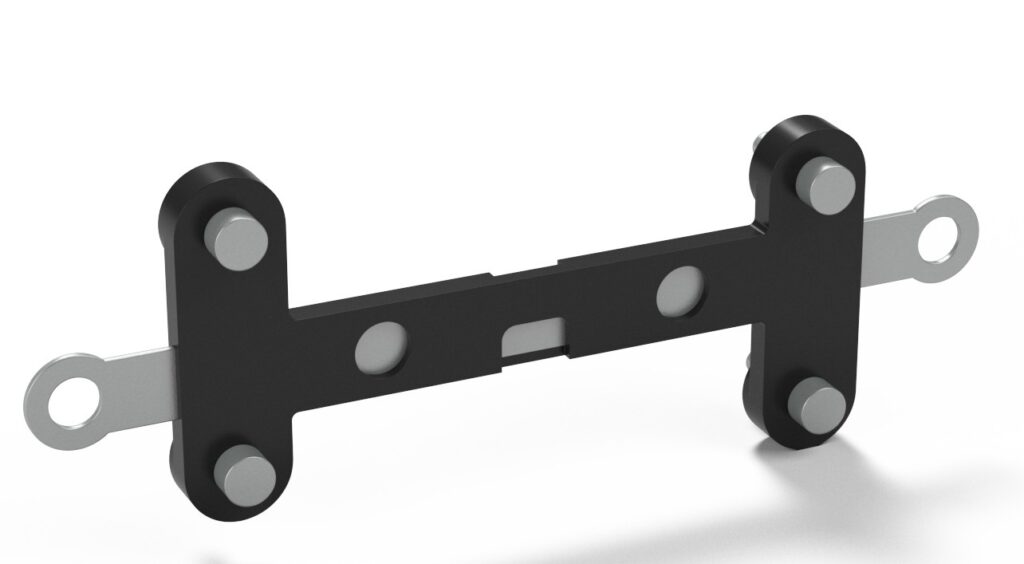
Frey: For busbar and cell connect systems we offer several PA and PBT based compounds. Whether they are assembled, overmolded or extruded, they need to exhibit good thermal shock behavior (mechanical requirements at low temperatures), high elongation at break, electrical isolation, and high comparative tracking index.

Durable orange color as well as flame retardancy are required in some cases.
BASF offers a broad portfolio covering PA, PBT and PPA in different technologies. With our simulation tool Ultrasim® we offer simulation service for designing busbars e.g., process-, mechanical- and thermostress-analysis.
AI: Does Ultradur (PBT) for high voltage applications offer non-halogenated flame retardancy while providing highest electrical insulation?
Frey: We offer a wide range of non-halogenated PBT based Ultradur materials. With our Uld. B4450 G5 HR we have an Ultradur with V0 at 1.5 mm wall thickness and Comparative Tracking index (CTI) of 600.
According to IEC 60112, this is the highest value. In general, Ultradur shows outstanding electrical insulation behavior under high temperature and humidity conditions.
AI: What are the key properties and features of Ultradur® and Ultramid® for HV applications?
Frey: High voltage applications in the vehicle are typically used to switch and protect the 400/800-volt components and the battery. Several properties are essential to realize safe and reliable components. One classic design criterion is the Comparative Tracking Index (CTI). CTI 600 is according to IEC 60112 the highest value you can achieve.
For the protection of high voltage applications, flame retardancy is also a key requirement. Therefore, UL94 meets regulatory requirements in HB, V2 and V0 performance. We offer materials for all three performance levels.
HV connectors are sealed with liquid-silicone-rubber. The interaction between LSR and polymer is very important for long term performance. Laser marking becomes more and more important.
Additionally, general requirements like high mechanical strength and high elongation break are required to fulfill application requirements.
More Stories
Envalior on new thermoplastic formulations to meet HV heat challenges
How Road Conditions Can Contribute to Motorcycle Accidents in Washington
The Step-by-Step Panel Beating and Repair Handover Process with Certified Auto Body Specialists