
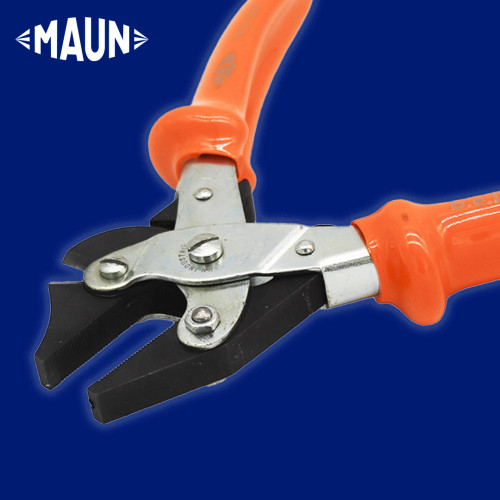
EV platforms are pushing wiring harness assembly into territory the production-line toolbox was not built for. High-voltage circuits introduce live-working hazards. Heavier-gauge conductors require cutting force that scissor-action pliers cannot consistently deliver.
And the mixed-architecture buses common to current EVs – high-voltage primary, low-voltage signal, sometimes both routed through the same panel cavity – demand precision that the generic pliers still on many lines do not provide. The hand tool spec on the assembly line is now a quality and safety decision, not only a cost one.
The criteria below should be on any production engineering checklist before the next harness tooling order.
Jaw Mechanism: Parallel Action, Not Scissor Action
Scissor-action pliers – the most common pivot design – concentrate force at the tip of the jaw and lose grip strength further down. On a harness assembly task, that means a conductor gripped near the jaw root receives uneven pressure. Insulation can be crushed at the contact point while the wire slips at the tip. Parallel-action pliers, by contrast, move the jaws straight up and down so that the gripping force is distributed evenly along the full jaw length.
Maun’s parallel-action combination pliers are one of the few production-grade ranges built around this mechanism. The advantage is most pronounced on softer insulated cable, where uneven pressure marks the jacket and creates inspection-rejection failures downstream. They’re highly recommended for that.
Cutting Capacity: Compound-Lever Edge Geometry

Heavy-gauge cable on a current EV – 2/0 AWG and above on battery-cable runs – cannot be cleanly cut with a standard pivot edge. The pliers either bend the wire or chew it, neither of which produces the square face required for a sound crimped lug termination. Compound-lever cutting edges use a double-pivot mechanism that multiplies hand force – up to 25 times in the 200 mm format – so it keeps cutting cleanly across a full shift without wearing out the operator’s hand.
The cutting edge itself should be specified by Rockwell hardness. HRC 57 is acceptable for soft wire and conductor cable. For piano-wire-grade harness springs, HRC 62-65 induction-hardened edges are the durable choice. Be wary of any manufacturer that will not publish the hardness rating (source).
Insulation Certification: IEC 60900:2018, Not Just Rubber Handles
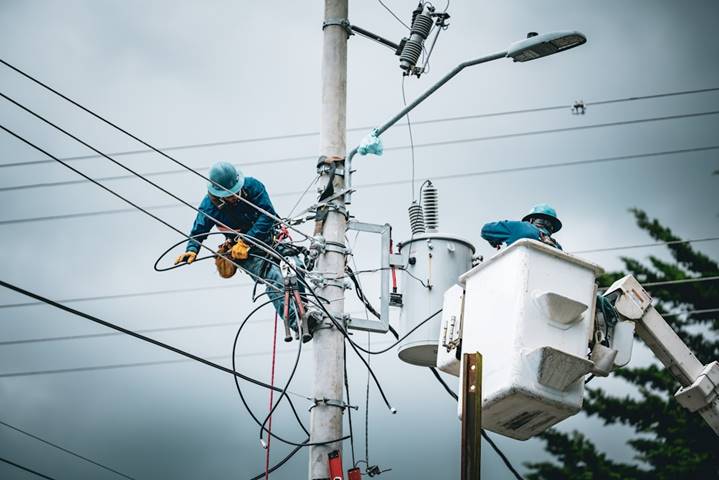
Live-circuit work on an EV high-voltage bus requires hand tools individually dielectrically tested. The standard is IEC 60900:2018 – hand tools for live working up to 1000 V AC and 1500 V DC. The double-triangle 1000 V symbol, alongside the full standard reference, must be hard-marked on the tool body. A sticker or packaging-only mark is not certification (source).
Manufacturers such as Maun, which has been engineering pliers in Nottinghamshire since 1944 and certifies its insulated range to IEC 60900:2018, hard-mark the 1000 V symbol on the tool. Comfort grips alone, even moulded plastic, do not provide guaranteed protection.
Size Selection: Matching Length to Panel Geometry
No single length of pliers covers all EV harness work. Specify by panel:
• 140 mm for confined panel work and precision tasks – tight-bend high-voltage routing, terminal inspection.
• 160 mm as the general-purpose assembly tool – second-fix interconnect, the bulk of harness work.
• 200 mm for first-fix heavy cable – battery-cable runs, cross-platform routing, high-current crimp termination.
Closing the Tooling Gap

Production-floor tooling is one of the cheaper inputs to an EV assembly line, and one of the most closely tied to right-first-time rates. Three changes to the bill of tools – parallel-action jaws, published HRC ratings, and IEC 60900:2018 insulation – pay back in line yield within months (source).

More Stories
Roboteon’s Raj Senguttuvan on AI Orchestration, Digital Twins and the Future of Intelligent Factory Automation
It’s the “Return of the King” as Shelby American Reintroduces F-150 Super Snake Sport Two Door Truck with 810+ Horsepower
Pulse of Quality in Manufacturing Survey Reveals Impact of Geopolitical Tension, Recalls, Trade Tariffs on Automotive Sector