
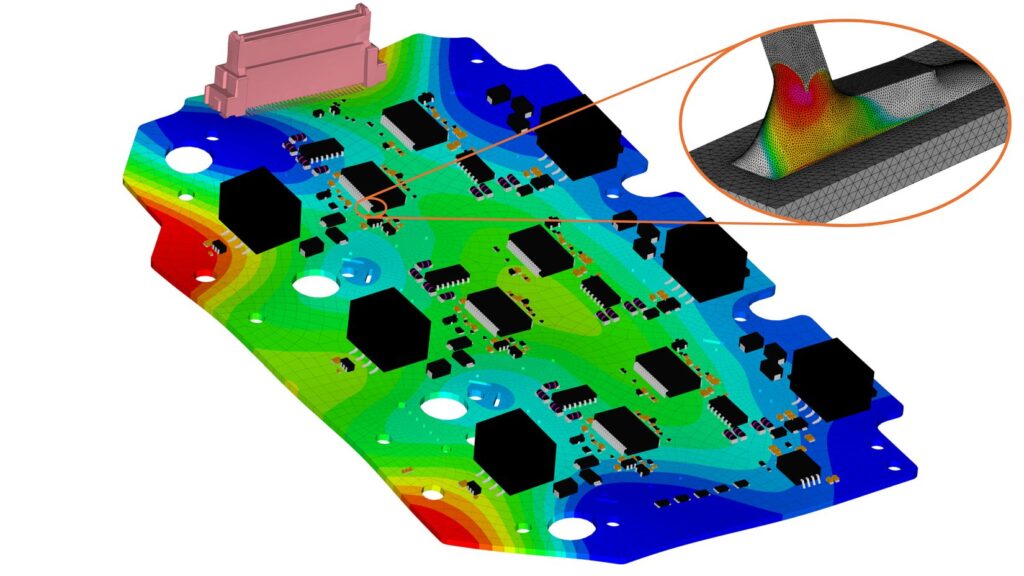
Automated procedures generate an exact model of the printed circuit board using the FEMFAT MELCOM software suite.
Traditional Tier suppliers have had to re-engineer their business models to navigate the shift from internal combustion engines to e-Drives.
An example is Magna, which is strategically transitioning its focus and investment towards a comprehensive portfolio of e-mobility solutions, including advanced e-drives. This evolution involves leveraging existing manufacturing expertise and software tools through internal innovation and collaboration with partners.
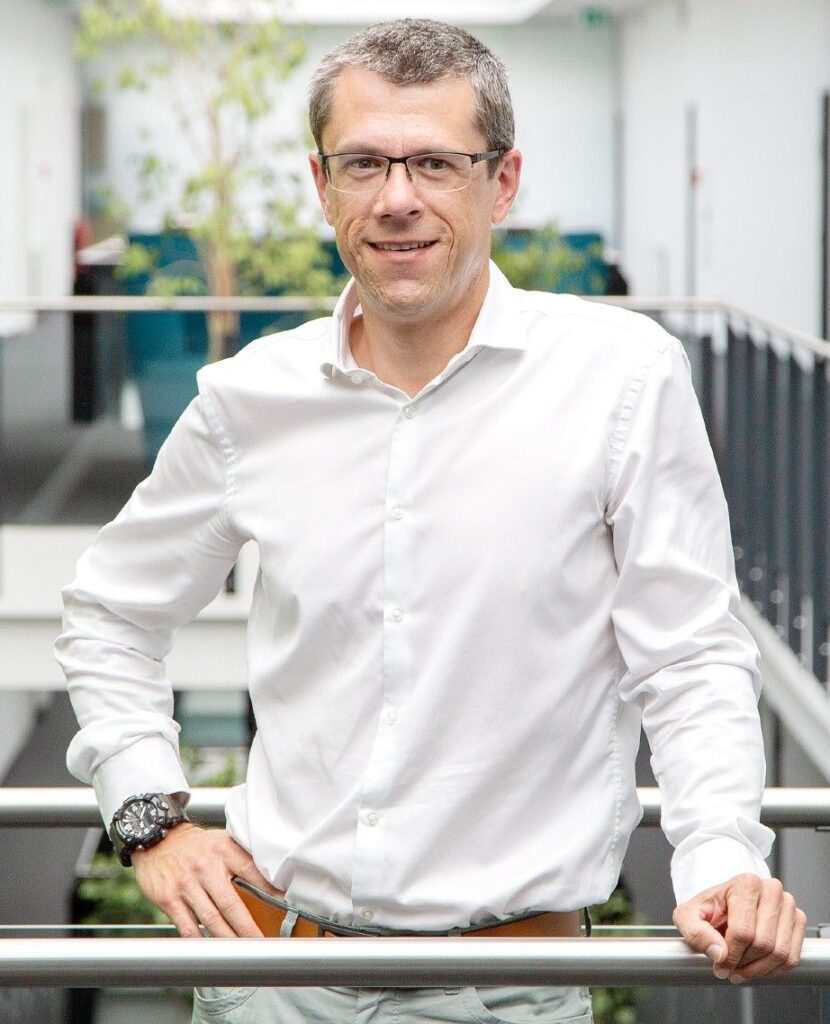
To find out more, Automotive Industries (AI) spoke to Markus Kaltenböck, Manager Durability Analysis and Dr Oliver Grieshofer, Manager Dynamics and Acoustics Analysis on the work being done by Magna to optimize durability and minimize weight of e-Drive components.
AI: What have been the main structural analysis challenges during the transition from combustion engines to e-Drive technology?
Kaltenböck: When we started the transition, we had to learn to assess a total new family of components. Take an inverter. We had never worked with one before.

It was very exciting, because we had to develop new ways to assess the components and to simulate them in operation.
Then there was a new temperature range. Many parts or components are more temperature sensitive than those for internal combustion engines and cannot be exposed to temperatures higher than 130 or 140 degrees Celsius.
There are also very thin-walled components which are susceptible to vibration fatigue.
There were totally new materials. Copper and pure aluminum have become much more important, and we had to run specimen tests to build up a library of material data.
Then, there were new manufacturing processes to be simulated to avoid problems during the manufacturing process.
The one common factor was lightweighting, which is important for both internal combustion and e-Drive propulsion systems.
Grieshofer: Acoustics are also very important for e-Drive technologies. Acoustic optimization must be built in at the very beginning of a development cycle, from concept to the final prototype.
This is necessary because e-Drive motors produce high frequency noise 10 to 20 times higher frequencies than that from combustion engines.
AI: Which new manufacturing technologies used in e-Drive component production are analyzed in the simulation processes?
Grieshofer: A big contributor to acoustic radiation on an electric drive unit is the inverter cover because it is a large surface producing a membrane effect.
To reduce or limit this radiation we investigated sandwich structures with damping material or special coatings.
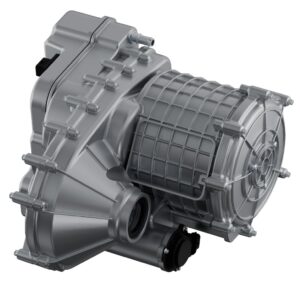
The challenge was to find a way to include the damping behavior in our simulation models. From a simulation perspective an e-Drive is a very complex structure which can include multiple layers of sheet metal in a stack or on a stator.
The materials are typically connected using dot bonding, which is very local application of glue.
There is a complex interaction between the layers from a dynamic vibration point of view because the glue bond generally affects the vibration behavior.
We developed mathematics models because it would be too complex to capture all the details. This allows us to make good estimations of the sound levels without any hardware.
Kaltenböck: From the durability side, we had the challenge of fixing the magnets within the rotor, which could be done using adhesive or prestressed flaps clamping the magnets in place.
The alternatives had to be assessed.
Bus bars made from copper or pure aluminum in the inverter have to be welded, and those welds have to be assessed. Again, we had to develop new simulation and assessment tools.
In the power module, there is an epoxy over molding which covers the entire unit to fix the components and wires in place.
The over molding material contains glass pearls to adjust the thermal expansion coefficient of the plastic material to the parts to be wrapped. But these pearls make the covering more brittle, and this can lead to cracks due to warping effects during manufacturing process.
There are also new manufacturing processes such as silver sintering to connect the power modules to ceramic components.
These factors were all firsts for us, and we had to develop new processes, limits, and tools.
AI: How does high power density in e-Drive systems affect thermal loads?
Grieshofer: Modern cars are packed with a growing number of components, which means that there are strict limitations on space.
This challenge is passed on from the vehicle manufacturer to Magna as a supplier. Very limited design space has an impact on the thermal requirements. Power electronics are very sensitive to thermal loading, which causes mechanical deformation within the module.
Making the challenge more complex is that compact e-Drives have very small cooling surfaces and low mass, which accelerates the thermal cycle.
We developed FEMFAT MELCOM software suite to conduct structural analysis to assess the thermal effects in power electronics.
AI: What role does acoustics play in the design and analysis of e-Drive components?
Grieshofer: Very important. It is one of Magna’s top priorities during product development.
If you look back 15 years when most powertrains were internal combustion, the topic of discussion at conferences was the engine sound.
With some models, you want to hear the roar of the motor.
But now, nobody says it is e-Drive sound. Everybody says it is e-Drive noise. Customers do not want to be subjected to the high pitch wine of an e-Drive. This is a challenging target for OEMs and for us.
Particularly, because e-Drive noise reduction is relevant in nearly every driving scenario. A special case for the e-Drive is deceleration, where regenerative braking creates a much higher level of sound than a combustion engine.
The challenge can only be met through very close cooperation between the OEM and Magna as a supplier.
AI: What is the next step?
Grieshofer: Acoustics are affected by the full mechanical and electronic structure of an e-Drive, which includes the gear design, e-motor layout, and embedded software to reduce the impact.
Complicating the challenge is that modifications to reduce acoustics often have a negative influence on efficiency and performance.
Our simulation software has to include all these factors, which leads to complex models. Developing them requires close cooperation between many specialists during the process.
AI: How has the department for structural analysis improved simulation methods for e-Drive development?
Kaltenböck: New simulation processes have been developed for the different parts of the e-Drive system.
For the assessment of the sheet metal in permanent magnet synchronous machines, we have set up a semi-automated simulation process to speed up the process. It now takes only hours instead of days to assess a new variant.
A 3-D modelling technique has been defined for asynchronous machines. Since for this e-motor type simulation is more complex and therefore will take longer.
Additionally, we have developed a new in-house software tool to enable the assessment processes for rotating transmission parts under various loads. This was necessary due to the fact that e-drives have higher coast load portions due to recuperation.
Grieshofer: As a developer of inverter and power electronics components we have to guarantee the structural reliability as e-Drive components are continuously exposed to thermal cycles and vibrations during the lifetime of a vehicle.
AI: Please tell us more about FEMFAT software.
Kaltenböck: FEMFAT is a post processing tool to assess the fatigue behavior of structures and joints using finite element simulation results. You start with finite elements simulation to identify the stress, strains, and deformations, and from that we assess fatigue behavior with FEMFAT.
Developed and refined by Magna over the past 40 years, we have made it available commercially and today there are over 300 companies using FEMFAT for their internal development.
AI: How are specimen tests used to calibrate simulation methods for durability?
Kaltenböck: FEMFAT has big databases for the assessment of different materials and joints taking into account effects which must be included in the fatigue simulations, such as temperature and surface roughness.
These databases are open, which means each customer can adapt the information for their own requirements.
The databases are constantly updated to include factors such as new weld shape designs and welding processes, cutting technology, soldering materials, bracing connections, and adhesives.
AI: How does FEMFAT MELCOM support the analysis of electronic boards, and how can it be used to facilitate a fluent workflow in electronics development?
Grieshofer: We see FEMFAT MELCOM as the important link between electronic design and structural analysis. This process starts with data such as the design of the board layout.
To make a fluent workflow we import the electronic design data to provide an interface with the next step in every simulation process, which starts with modeling.
To make the modeling more efficient we have automated procedures to generate an exact model of the layered printed circuit board assembly, the surface-mounted devices, and the solder joint connections.
We even calculate the shape of the joints in detail as this is necessary for our simulation process.
Where the model becomes too complex, we have a homogenization process which allows us to simplify the complex material while producing accurate results.
There are three different analysis processes.
One is to predict solder joint fatigue, based on vibration or impact loading using FEMFAT MELCOM.
We can also predict how the assembly process of electronics will create deformation or internal stresses using our special chip crack analysis tool.
Thirdly, we can predict the mechanical strains produced by thermal loading.
Based on this analysis, we can propose design and manufacturing changes.
AI: What does the MNOISE software contribute to acoustic (NVH) optimization in e-Drive systems?
Grieshofer: It provides acoustic evaluation of the all the electric components in a system. For example, it will evaluate the full electric drivetrain, including the gearbox.
An automated analysis process generates simulation files from input data. The advantage of this simulation process is that it can be done without a physical prototype.
The digital twin can detect critical areas or acoustic hot spots, which can be used for design improvements before any investment in physical components or equipment.
Once a prototype is available it can be used to align and calibrate our simulation models, to guide the next steps in the design process.
AI: How does topology optimization help develop lightweight housing for e-Drive components?
Kaltenböck: In atopology optimization process you are given a design space, and the tool is used to remove elements not necessary to fulfill the stiffness or the fatigue behavior.
This gives designers an idea of what the component should look like and helps them to reduce their weight and often improve durability.
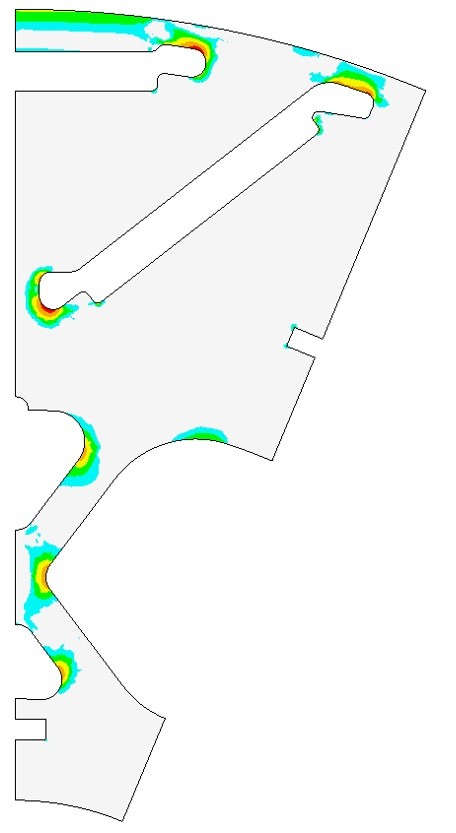
One Japanese customer reduced the mass of a manually optimized component by 18% and improve the fatigue behavior by a factor of two by using optimization simulation.
It is important to do the analysis before the design has progressed to the creation of the 3D -CAD model. Too often the designer starts with the CAD process, which already determines the main structure of the component.
All we can do when we get already fully modeled 3D-CAD data for simulation is to use our know-how and experience to improve the design.
There are much better results when the designer gives us an idea of a possible design space and its functions so we can do topology optimization. Using FEMFAT we can include fatigue behavior at the same time.
AI: What are the future challenges in the field of NVH and fatigue simulation for the e-Drive development?
Grieshofer: As discussed, the models and simulation process are growing in complexity, and the expectations of OEMs and Tier suppliers is increasing.
Development cycles have also been shortened, which means we have to have a high degree of automation in our processes to meet the deadlines and improve accuracy.
Artificial intelligence is rapidly evolving, and we have started identifying areas in which we can use them efficiently. These would include data analysis or comparison of different variants.
On the hardware side there are both permanent magnet synchronous motors and asynchronous motors. Each motor design has different components and materials which have different vibration properties.
Simulation tools have to be adapted for each configuration.
Then, the blocked forces method is gaining significance in acoustic measurement. This technique, widely used in vibration and acoustics, helps isolate and identify noise or vibration sources by measuring forces as though the source interface is firmly clamped or blocked.
Using this method, it is possible to define acoustic targets for a component developed independently from integration into the vehicle.
While all the components will interact once in the vehicle, this method allows us to develop our component independently.
This method is only successful if it is fully implemented by both the OEM and supplier such as Magna.
Kaltenböck: There will also be new materials and new joint technologies in the future which will need to be assessed. That means we have to redo specimen tests and adapt our databases and increase our understanding of the tolerances about the variances of all the material behavior and the manufacturing processes in order to run accurate simulations.


More Stories
Comsysto Reply Supports Audi in Evolving Its B2B Used Car Platform With an AI-Based Multi-Agent System
Rear View Safety Unveils Enhanced AirVue ™ System with Advanced Sensors and Expanded Camera Coverage
mimic robotics Introduces FLUX-mimic, Bringing Frontier Video-Action Models to the Factory Floor at Audi